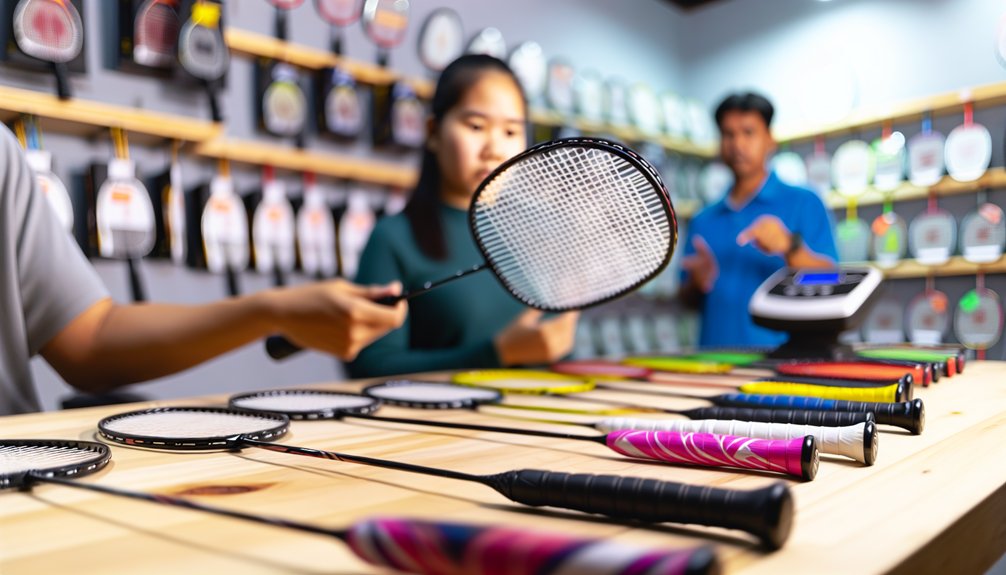
When a recreational player switches from a 4U even-balance racket to a 3U head-heavy model, smash speed often jumps by 3–5%, but so does forearm fatigue. If you’re choosing a racket in 2026, you can’t just trust marketing labels. You need to understand how weight classes (5U–2U), balance points, and shaft flex interact with your swing mechanics—because picking the wrong combo can quietly cap your progress.
Key Takeaways
- Choose weight by level: 4U/5U for beginners or defensive play, 3U/2U for stronger players needing stability and heavier smashes.
- Pick balance by style: head-heavy for rear-court power, head-light for fast drives/defense, even-balance for all-round versatility.
- Match shaft flex to swing speed: flexible for slower, longer swings; stiff for fast, compact swings and advanced timing.
- Prioritize comfort and injury prevention: lighter or more head-light setups ease shoulder/elbow load, especially in long sessions or doubles.
- Always test under realistic conditions: check timing, control, and fatigue response rather than relying only on hand feel or specs on paper.
Understanding Modern Badminton Racket Specs in 2026
Although players still talk casually about “light” or “head-heavy” rackets, modern 2026 badminton racket specs are far more quantifiable and standardized, letting you match a frame precisely to your playing style. You now evaluate frames using published metrics: overall mass (grams), balance point (millimeters from the butt cap), shaft flexibility rating, frame stiffness, swing weight, and recommended string tension. You should read a spec sheet the way you’d read lab data. Mass and balance point define how the racket accelerates; shaft and frame stiffness govern energy return and shuttle dwell time. Swing weight, often expressed as kg·cm², indicates rotational inertia. Finally, manufacturers specify safe string tension ranges (e.g., 20–30 lbs) to maintain structural integrity while optimizing control. Modern spec sheets also highlight advanced frame technologies—such as Dual Optimum Frame designs or aerodynamic profiles—that fine‑tune stability, repulsion power, and maneuverability for specific play styles.
Racket Weight Classes: From 5U to 2U Explained
Racket weight classes like 5U through 2U look cryptic at first, but they’re simply standardized mass brackets that let you compare frames objectively. Most modern systems align roughly as follows: 5U ≈ 75–79 g, 4U ≈ 80–84 g, 3U ≈ 85–89 g, and 2U ≈ 90–94 g (unstrung, without overgrip).
You should treat these bands as performance ranges, not marketing labels. Lighter 5U–4U rackets typically reduce cumulative load on your shoulder and elbow, useful if you play fast doubles, have a smaller build, or log high weekly volume. Heavier 3U–2U frames demand more strength and timing precision but tend to feel more stable on impact and handle off-center hits with less torsional distortion and energy loss. Choosing the right weight class also helps you match your racket to other key specs like shaft stiffness, balance, and string tension for a setup that complements your skill level and play style.
Balance Types: Head-Heavy, Head-Light, and Even-Balance
Once you’ve chosen a weight class, balance point becomes the next critical variable, directly affecting swing dynamics and shot outcomes. A head-heavy racket typically boosts smash speed and rear-court power, while a head-light frame enhances maneuverability and control in fast exchanges and net play. If you want a statistically balanced trade-off between power and precision, an even-balance racket gives you an all-round performance profile suitable for mixed styles and evolving skill levels. Testing different balance types and matching them with the right shaft stiffness helps you fine-tune both power generation and control for your specific playing style.
Head-Heavy Power Advantages
When the weight distribution shifts toward the head of the frame, a badminton racket gains measurable advantages in power generation, especially on smashes and deep clears. You’re effectively increasing the rotational moment of inertia, so once you get the racket moving, it carries more angular momentum through impact. This translates into higher shuttle exit speed with the same swing effort.
A head-heavy balance benefits you most if you rely on offensive play and have sufficient forearm and shoulder strength to accelerate the racket.
- Smash efficiency: Produces steeper, faster smashes with less “muscling” of the stroke.
- Deep clears: Helps you drive the shuttle to the rear court under pressure.
- Offensive stability: The weighted head resists twisting on off‑center hits, preserving power.
Head-Light Control Benefits
Although head-heavy frames dominate offensive discussions, a head-light balance offers quantifiable advantages in maneuverability, reaction time, and precision control. By shifting mass toward the handle (typically <285 mm balance point), you reduce rotational inertia, allowing faster racket-head acceleration and deceleration. This directly improves your ability to make late directional changes on drives, blocks, and net interceptions.


In defensive scenarios, a head-light racket lets you close the racket face several milliseconds faster, which can be the difference between merely returning a smash and placing it accurately. You’ll also experience reduced fatigue in your forearm and shoulder during high-rally matches, sustaining fine motor control longer. If you rely on tight net shots, rapid drives, and counter-attacking, a head-light balance materially supports that style.
Even-Balance All-Round Play
Even-balance rackets occupy the middle ground between head-heavy power and head-light speed, giving you a more neutral platform that adapts across singles, doubles, and mixed play. You get a moderate swing weight, typically around 84–88 g (4U/3U) with a balance point in the ~285–295 mm range, which supports both attacking and defensive shifts without major trade-offs.
They’re especially effective if you’re still refining your style or play multiple disciplines. You won’t max out power or speed, but you minimize weaknesses.
Key reasons to choose even-balance:
- Versatility: Stable performance for clears, drives, and net play in one frame.
- Adaptability: Lets you switch tactics mid-rally without feeling “fought” by the racket.
- Progression-friendly: Ideal if your technique and strength are still developing.
Shaft Flex: Stiff Vs Flexible and What Suits Your Swing
How much power and control you get from a badminton racket is heavily influenced by shaft flex, which describes how much the shaft bends during your swing. A stiff shaft (typically <7.0 mm deflection under standardized load) deforms less, returning energy quickly and predictably. It favors compact, fast swings, giving you tighter shuttle trajectories and faster repulsion, especially in drives and flat exchanges. A flexible shaft (≈7.0–8.0 mm deflection) bends more, acting like a spring that stores and releases energy over a longer interval. It helps you generate shuttle speed when your swing speed or timing isn’t ideal. However, increased flex introduces more lag between hand movement and racket head response, slightly reducing directional accuracy and feedback in high‑tempo, precision-dependent rallies. Advanced players with refined technique usually benefit from stiffer shafts, while beginners often find flexible rackets easier to handle and less injury‑prone.
Matching Racket Specs to Playing Style and Skill Level
Shaft flex, like balance point and overall weight, only works for you when it’s aligned with your technique and tactical preferences, so you need to read racket specs through the lens of how you actually play. You’re matching three things: physical strength, swing mechanics, and decision speed under pressure. Since weight distribution and balance type directly affect maneuverability and power, make sure your chosen flex and balance complement the way you accelerate the racket and recover between shots.
A practical way to map style and level to specs:
- Beginner / late contact – Medium flex, even balance, 4U/5U weight. This enlarges your effective sweet spot and reduces timing penalties.
- Intermediate / all-round – Medium–stiff shaft, mildly head-heavy or even balance, 3U/4U. You’ll get controllable power without overloading your shoulder.
- Advanced / explosive stroke – Stiff shaft, defined head-heavy or head-light by role (attacker vs counter), 3U. This setup rewards fast, precise acceleration and stable technique.
How Weight, Balance, and Flex Work Together on Court
Although it’s tempting to judge each spec in isolation, weight, balance, and shaft flex form a single mechanical system that determines how the racket accelerates, decelerates, and transfers energy at impact. You feel this most clearly in the first 200–250 milliseconds of each stroke, when racket-head speed is built and then redirected into the shuttle. Heavier, head-heavy rackets store more angular momentum but demand greater forearm strength to control the deceleration phase. Pair that with a stiff shaft and you get minimal deformation, efficient energy return, and high peak shuttle speed—if your swing speed is already high. Lighter, more even-balanced frames with medium flex deform more, delaying energy release slightly but improving timing tolerance, maneuverability, and directional control in fast rallies. Choosing the right combination of weight, balance, and flex is easier when you understand how they interact with factors like string tension, sweet-spot size, and your own strength and technique.
Common Buying Mistakes and How to Avoid Them
When players choose a racket without aligning it to their actual playstyle and current skill profile, they often see a measurable drop in shot consistency, control, and power efficiency. You’re also likely to misjudge weight and balance if you rely only on static “hand feel” in the shop instead of how those specs affect swing speed, reaction time, and joint load on court. In this section, you’ll see the most common selection errors broken down into clear patterns, along with evidence-based ways to correct them before you buy. Choosing a racket that ignores BWF racket specifications can also lead to poor performance and potential non-compliance in formal matches, since dimensions, stringed area, and overall design all influence how the racket behaves on court.
Ignoring Playstyle Needs
Misalignment between racket design and playstyle is one of the most common—and costly—mistakes players make. When you ignore how you actually play, you’re likely to choose a frame that fights your instincts, wastes energy, and raises injury risk.
You should map racket specifications to your technical profile:
- Tactical preference – Are you a rally builder, control specialist, or all-out attacker? Each style benefits from different frame profiles and shaft behaviours.
- Technical level – Beginners gain more from forgiveness and larger sweet spots, while advanced players can exploit stiffer, more demanding frames.
- Physical profile – Your grip strength, shoulder endurance, and reaction speed determine what you can manoeuvre efficiently over a full match rather than just a few rallies.
Misjudging Weight and Balance
Even with a technically suitable frame design, you’ll undermine your performance if you misjudge racket weight and balance. Most players either overestimate their strength and buy 3U head‑heavy frames they can’t accelerate, or chase “speed” with ultra‑light, head‑light rackets that lack shuttle penetration.
You should treat weight and balance as load‑management variables. A heavier, 3U head‑heavy racket increases peak shuttle speed but also raises joint stress and fatigue rate, especially in the shoulder and elbow. By contrast, a 4U even‑balance or mildly head‑light racket typically yields higher average swing speed over long matches.
To avoid mistakes, test: can you complete 20 full‑power clears and 20 rapid‑fire drives without timing breakdown or grip tension? If not, the racket’s too demanding.
Quick Step-by-Step Guide to Choosing Your 2026 Racket
Although badminton tech evolves quickly, you can choose a 2026-ready racket systematically by following a few objective checkpoints: start by defining your playing style and level (recreational, club, competitive), then match racket weight (typically 3U: 85–89 g or 4U: 80–84 g) and balance (head-heavy, even, or head-light) to your power–speed priorities. Next, lock in shaft flex: stiff for advanced, fast-swing players; medium for most club athletes; flexible only if your swing speed’s low. To future‑proof your choice, you can also map your style to Yonex’s major lines—head‑light Nanoflare Series for speed, head‑heavy Astrox for power, and control‑oriented Arcsaber.
- Shortlist 3–5 rackets that match weight–balance–flex, not paint or marketing.
- Check maximum recommended tension and handle size; verify they fit your stringing habits and grip.
- Demo or simulate on-court: evaluate timing, recovery, and shoulder comfort before committing.