Choosing the right shuttlecock in 2026 is like tuning a race car for a specific track—you can’t ignore the details. You’re balancing feather vs synthetic construction, Yonex vs Aeroplane vs Li-Ning grade differences, and speed numbers like 76–79 that change flight and timing. Get these wrong, and your control, clears, and smashes suffer. Get them right, and your whole game tightens up—especially once you understand how hall conditions and level factor in.
Key Takeaways
- Feather shuttles give superior control and realistic match feel; synthetic shuttles offer higher durability and consistency, ideal for training and recreational play.
- Shuttle speed numbers (76–79) indicate how fast the shuttle travels; higher numbers are faster, not higher-flying.
- Choose shuttle speed by hall temperature: move one speed up in cold venues, one speed down in hot venues for correct length.
- Match shuttle type to level and style: beginners use mid-range synthetics; intermediates higher-end synthetics or entry feathers; advanced players tournament-grade feathers.
- Test adjacent shuttle speeds in your actual hall before bulk buying, considering hall size, altitude, humidity, and your smash intensity.
Understanding Feather Vs Synthetic Shuttlecocks
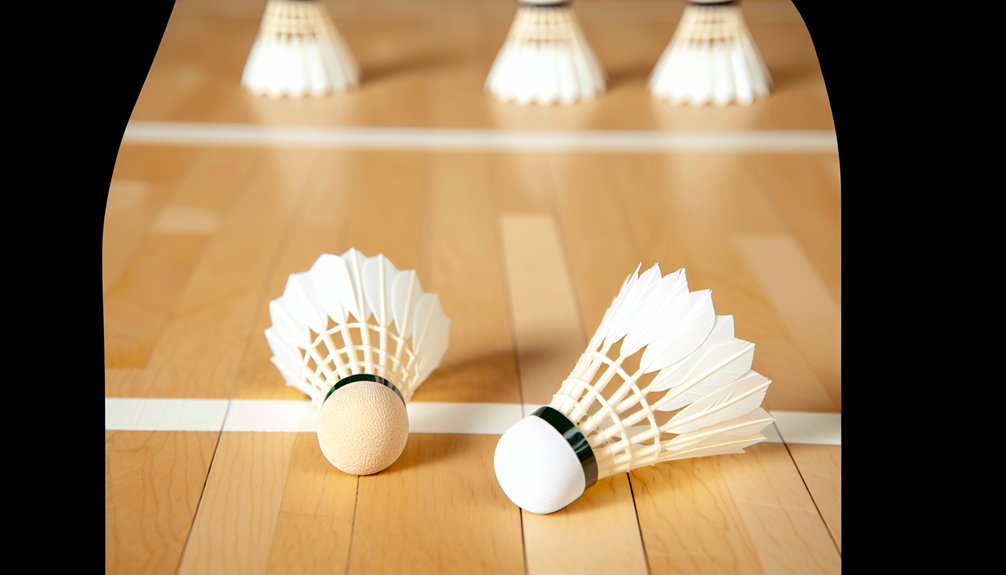
Although both are designed to meet the same flight standards, feather and synthetic shuttlecocks behave very differently regarding speed control, durability, and feel at impact. With feather shuttles, you get tighter aerodynamics, a steeper, more predictable descent, and superior touch feedback—ideal if you’re playing with high-performance tubes like Yonex Aerosensa, Victor Master, or Li-Ning A+.
You’ll notice feathers bite the air, letting you modulate pace and angle with small grip or wrist changes, but they’re fragile under heavy smashing. Synthetics from lines like Yonex Mavis or Victor Nylon trade that fine control for consistency and longevity. They maintain shape far longer, resist breakage in humid halls, and give you a slightly flatter, more forgiving trajectory for training or recreational play.
Decoding Shuttlecock Speed Numbers (77, 78, 79 and Beyond)
Ever wonder what those speed numbers—76, 77, 78, 79—on Yonex Aerosensa or Li-Ning A+ tubes actually change in your game? They’re not about flight height; they’re about how far the shuttle travels at a standardized test swing, compensating for hall temperature and air density. Lower numbers (76) are slower; higher (79) are faster.
Manufacturers like Yonex, Victor, and Li-Ning calibrate these so a clear lands near the back doubles service line under test conditions. In colder halls (denser air), you’ll usually move up a speed (78–79). In hotter halls, you’ll go down (76–77). Choosing the correct speed keeps length of clears, lifts, and smashes consistent, so your timing, defensive base, and precision don’t need constant recalibration.
Matching Shuttlecock Type to Playing Level and Style
If you’re an advanced player, competition-grade feathers (e.g., Yonex Aerosensa, Victor Master, RSL Classic) give you sharper drop-shot bite, truer spin, and more precise length control.
| Playing Profile | Recommended Shuttle Type |
|---|---|
| Beginner, social | Synthetic (nylon) mid-range |
| Intermediate, technique | Higher-end synthetic or entry feather mix |
| Advanced, tactician | Tournament-grade feather |
| Power smasher, doubles | Stiffer-skirt synthetic or solid mid-feather |
How Hall Size, Altitude, and Climate Affect Shuttle Choice
When you’re optimizing shuttle choice, hall dimensions, local altitude, and ambient humidity are just as critical as brand and grade. A fast, drifting shuttle in a compact school hall may force you toward a slower speed code (e.g., Yonex 77 vs 78), while the same model will feel sluggish in a large, draft-free arena or at higher elevations where air density drops. You’ll need to adjust shuttle speed and skirt/feather profile to maintain consistent flight time, effective length on clears, and predictable control across different venues and climates.
Hall Dimensions and Drift
Not all halls play the same, and understanding how dimensions, altitude, and climate interact with shuttlecock design is critical for consistent performance. In long halls with high ceilings, clears travel further and stay aloft longer, so you’ll often favor slightly slower speed numbers or tighter-feathered tournament shuttles from brands like Yonex, Victor, or Li-Ning to restrain carry and drift.


In compact halls, especially with low ceilings, you’ll want faster speeds or more open skirt designs on synthetics to maintain length under compressed flight paths.
| Hall Profile | Recommended Shuttle Tendency |
|---|---|
| Long + high ceiling | Slightly slower, stable feather |
| Long + low ceiling | Medium speed, controlled trajectory |
| Short + high | Medium-fast, responsive flight |
| Short + low | Faster, penetrating synthetic or hybrid |
Altitude, Humidity, and Speed
Although hall dimensions shape the basic flight corridor, altitude and humidity quietly decide how “fast” a given speed number really plays. At high altitude, air density drops, so both Yonex 77 and Li-Ning A+90 speed 77 will fly noticeably faster, often forcing you to step down one speed (e.g., 77 → 76 or 78 → 77).
In humid coastal climates, feathers absorb moisture, open up, and slow down, while synthetics from brands like Victor and RSL remain more stable but can still drag slightly. In very dry halls, feathers stay tighter, cut through the air faster, and feel more “lively,” so you may need to move up a speed. Always test 2 adjacent speeds in match conditions before bulk ordering.
Budget, Durability, and Performance Trade-Offs
Because shuttlecocks are consumables with sharply tiered quality levels, you’ll want to think regarding cost per rally rather than sticker price, balancing budget against durability (how long the skirt and cork maintain structural integrity) and performance (flight stability, speed consistency, and feel on impact). High-end feather models from Yonex, Victor, and Li-Ning use premium cork and carefully graded feathers, giving tighter speed tolerances and more predictable deceleration, but you’ll pay more per tube and break shuttles faster under hard smashes.
When you compare options, frame it as:
- Cost per rally at your typical intensity.
- Durability of feathers or synthetic skirt plus cork resilience.
- Performance: trajectory, spin retention, and tactile feedback on net shots and lifts.
Recommended Shuttlecock Setups for Common Playing Scenarios
Scenario-based selection helps translate specs and brand claims into practical shuttlecock choices for how, where, and how often you play. For indoor club training, you’ll want durable synthetics like Yonex Mavis 2000 or Victor Nylon 300 in medium speed (typically 77) to withstand mishits while keeping a stable trajectory. For league matches or serious sparring, upgrade to mid‑tier feathers such as Yonex Aerosensa 30 or Li‑Ning A+300, speed 77/78 depending on hall temperature. For tournaments and high‑level practice, use premium goose feather shuttles—Yonex AS 40/50, Victor Master No.1, or Li‑Ning A+600—with speed adjusted to 76 in hotter halls, 78 in colder ones. Outdoor or non‑climate‑controlled play favors robust synthetics, one speed slower than your usual indoor choice. When choosing between feather and synthetic options, remember that standardized dimensions like 16 feathers per shuttle and regulated weight ensure consistent flight and feel across reputable brands.