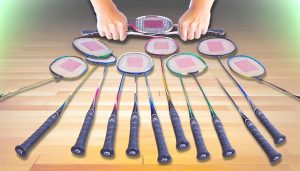
Think of your racket as a shield first and a sword second; when you play a defensive game, every gram and balance point matters. You’re not just blocking smashes, you’re resetting the rally with control, stability, and quick preparation. That means choosing specific weight classes, balance points, shaft flex, and string setups that match your reaction speed and technique—otherwise, your defense will always feel a step behind the shuttle…
Key Takeaways
- Choose a light racket (4U or 5U) with even or slightly head-light balance for faster reactions and easier defensive recovery.
- Prefer an isometric head shape and thin, aerodynamic frame to enlarge the sweet spot and improve quick control shots.
- Select medium to medium-stiff flex to maintain timing consistency for blocks, drives, and lifts without overswinging.
- Use control-oriented strings at 22–25 lbs tension and adjust grip thickness for quick racket rotation and clean contact.
- Test rackets in defensive drills, comparing reaction speed, stability on off-center hits, and ease of switching to counter-attack.
Understanding Defensive Playing Styles and Racket Needs
Control is the foundation of effective defensive badminton, and your racket must support that priority. Your style revolves around buying time, disrupting opponents’ rhythm, and forcing errors through precise placement rather than raw power. That means you rely on quick shifts: from deep lifts to tight blocks, from emergency retrievals to counter-attacks.
First, identify whether you defend mainly with early interception or late recovery. If you step forward to take shuttles early, you need a racket that lets you guide the shuttle accurately under pressure. If you often retrieve from deep or wide positions, your racket must help you stabilize the shuttle and reset the rally.
Across both patterns, you need equipment that rewards touch, directional control, and smooth, repeatable strokes. Heavier rackets can offer increased stability and power that help stabilize defensive shots and absorb shocks during prolonged rallies.
Key Racket Specifications That Boost Defensive Performance
Although “defensive racket” can sound vague, it’s really a specific blend of specifications that make your reactions cleaner and your placement more reliable under pressure. For defense, you’re prioritizing control, recovery speed, and stability over raw power.
First, look at frame profile and aerodynamics. A thinner, streamlined frame cuts air faster, helping you shorten your swing on tight drives and body smashes. Next, check head shape. An isometric head enlarges the effective sweet spot, so your off‑center blocks and lifts stay deep and accurate.
Also examine shaft–frame torsional stability. A racket with good anti‑torsion properties twists less on sudden impact, so your racket face stays aligned for precise redirections, late blocks, and last‑second changes in angle. Many defensive players favor rackets with an Isometric design to maximize sweet spot accuracy and consistency.
Choosing the Right Weight, Balance, and Flex for Quick Reactions
When you’re tuning a racket for fast defense, weight, balance, and flex work together to decide how quickly you can get the frame into position and how cleanly you can return pressure. Prioritize lighter frames (4U or even 5U) so you can reset the racket quickly between consecutive drives and body smashes.


For balance, lean toward even or slightly head‑light. This shortens your reaction time on flat exchanges and helps you change direction in mid‑swing, essential when you’re wrong‑footed.
Choose medium to medium‑stiff flex. Too flexible and your timing becomes inconsistent under fast pressure; too stiff and you’ll struggle to generate length on late defensive lifts. Test whether you can block, drive, and lift comfortably without over‑swinging.
Lightweight rackets also reduce arm and wrist strain, helping you maintain quick responses longer reduced fatigue.
Optimizing Strings, Tension, and Grip for Control and Comfort
Two equipment tweaks have outsized impact on your defensive consistency: string setup and grip configuration. For string type, favor medium-feel, control-oriented strings over ultra-repulsive ones; they give you cleaner contact on fast drives and last longer under frequent blocks. Tension should prioritize a stable, predictable shuttle response: typically 22–25 lbs for most defensive players, slightly higher only if your technique is solid.
Use this guide:
| Style Focus | Recommended Tension | Grip Thickness Aim |
|---|---|---|
| Pure defense | 22–23 lbs | Slightly thicker |
| Counter-attacking | 23–24 lbs | Medium, secure |
| All-round control | 23–25 lbs | Medium–thick, relaxed |
| Net interceptions | 24–25 lbs | Thinner for finger play |
Adjust grip size so you can rotate the racket quickly without squeezing. Modern rackets’ lighter weight and head balance significantly affect how these string and grip choices feel in play.
Practical Tips for Testing and Selecting Your Ideal Defensive Racket
Once you’ve clarified your defensive priorities and dialed in strings and grip, the next step is to test rackets in a way that exposes how they perform under real defensive pressure. Start with controlled drills: rapid multi-shuttle defense, body smashes, and deep corner smashes. Track how consistently you find the sweet spot, how quickly you can change direction, and how stable the frame feels on off‑center contacts.
Next, test changeover speed: defend, then immediately counter‑attack with a drive or block to the net. Notice whether the racket’s balance and weight let you recover your base quickly.
Finally, compare two rackets back‑to‑back within the same drill block, not on feel alone. Let consistency, reaction time, and error rate decide.
Also confirm the racket meets BWF dimensions to ensure it’s legal for competitive play.