You probably don’t realize that the wrong outsole pattern can increase your ACL load on sharp lunges, even if the shoe “feels” grippy. When you choose badminton shoes, you’re really managing how force travels through your feet, knees, and ankles on every cut, jump, and deceleration. The right rubber compound, cushioning profile, and stability features can sharply reduce injury risk—but only if you know what to look for next.
Key Takeaways
- Choose gum-rubber outsoles with clear tread patterns (hex/rounded lugs, herringbone) for high indoor traction without excessive stickiness that strains joints.
- Prioritize midsoles with badminton-specific cushioning and multilayer foams to absorb repeated jumps and landings while keeping the foot stable.
- Ensure a secure heel (firm counter, snug collar) with a comfortable, possibly broader toe box to prevent sprains, nail trauma, and forefoot stress.
- Match shoe flexibility and weight to your play style, balancing lightness for agility with enough structure to support lateral cuts and rapid direction changes.
- Maintain shoes by cleaning outsole grooves, air-drying insoles, and replacing worn pairs early to preserve grip and shock absorption, reducing injury risk.
Understanding Court Surfaces and How They Affect Grip
Although it’s easy to overlook the floor beneath you, the court surface is one of the primary determinants of how your badminton shoes will grip, load your joints, and manage impact forces. Each surface—wood, synthetic PU, vinyl, or cement—changes how your foot interacts with the ground and how quickly forces travel up your kinetic chain.
On well-maintained wooden or synthetic courts, you’ll experience more predictable friction and efficient force transfer, supporting controlled deceleration and safer cutting motions. Dusty or worn surfaces sharply reduce friction, so you’re more prone to slide, overstride, and “catch” the foot unexpectedly, stressing ankles and knees. Conversely, very abrasive surfaces increase “stickiness,” which can overload ligaments during sudden stops or direction changes.
Key Outsole Features for Maximum Traction
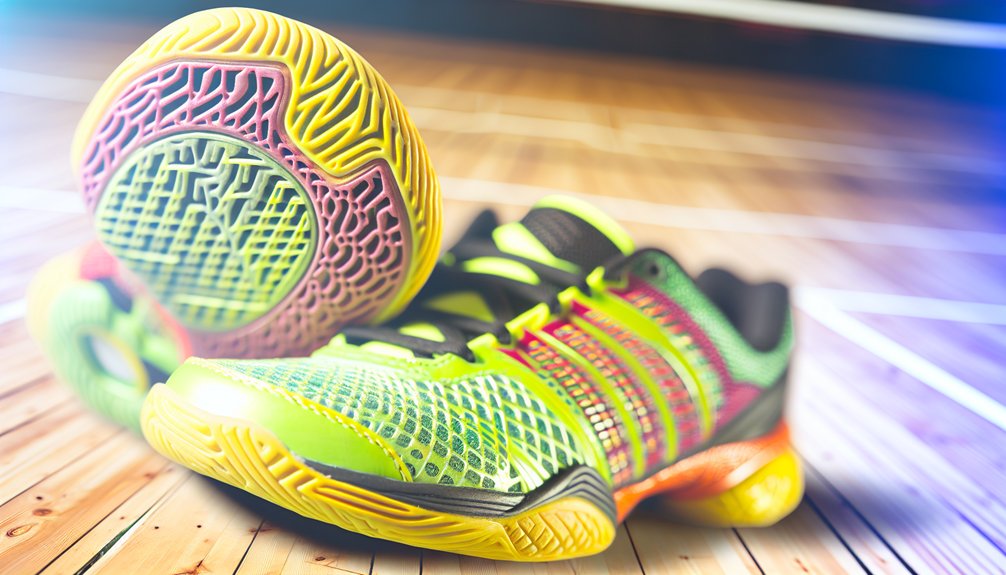
Because every change of direction starts at the shoe–floor interface, the outsole’s design is the primary mechanical link between your foot and the court when it comes to traction. You’re managing shear forces; the outsole pattern, rubber compound, and flex grooves dictate how safely you can decelerate and re-accelerate.
| Feature | What It Does | Injury-Prevention Role |
|---|---|---|
| Gum rubber | Increases friction on indoor courts | Lowers slip risk during rapid cuts |
| Hex/rounded lugs | Enables multi‑directional grip | Reduces uncontrolled foot rotation |
| Herringbone zones | Improves linear and lateral braking control | Limits over‑sliding into lunges |
| Forefoot flex grooves | Allow natural metatarsal flexion under load | Decreases torsional stress at ankle and knee |
Choose an outsole that grips without “sticking,” so joints aren’t forced into abrupt, injurious stops.
Cushioning Technologies to Protect Knees and Ankles
While the outsole manages grip at the floor, the midsole and in‑shoe cushioning determine how effectively impact forces are attenuated before they reach your knees and ankles. In badminton, repeated landings from jumps and rapid decelerations generate high peak loads; inadequate cushioning lets those forces transmit directly into joint cartilage and supporting ligaments.
You’ll want cushioning that’s both compliant and resilient, so it compresses to absorb impact, then rebounds quickly for the next step without feeling mushy or unstable. Prioritize shoes that use sport‑specific foams or gels tuned for forefoot and heel loading patterns typical of badminton.
- Look for multilayer midsoles that combine softer top foam with firmer base foam.
- Check for dedicated heel crash pads for jump landings.
- Make certain forefoot cushioning is substantial for lunges and split‑steps.
Stability and Support Features That Prevent Injuries
To reduce the risk of sprains and overuse injuries, you need shoes that control rearfoot motion through structured ankle and heel support. A well-contoured heel cup and firm collar stabilize the subtalar joint, limiting excessive inversion during rapid changes of direction. Complementing this, midsole stability systems (such as medial supports or torsion shanks) manage pronation and torsional forces so your foot tracks efficiently through each lunge and landing.


Ankle and Heel Support
Although they’re often overlooked, ankle and heel support features are fundamental to preventing common badminton injuries such as sprains, Achilles tendinopathy, and plantar fasciitis. When you lunge, decelerate, or land from a jump, your rearfoot must stay centered over the shoe to avoid excessive inversion, eversion, and torsional stress.
Focus on shoes that lock your heel securely in place without restricting normal joint motion:
- External or internal heel counter: A firm cup that stabilizes the calcaneus and limits sideways wobble during rapid cuts.
- Anatomical heel collar: Sculpted padding that grips your ankle bones, reducing slippage and blister risk.
- Lateral and medial outriggers: Slight sole flare around the heel that widens your base, improving balance during aggressive lateral pushes.
Midsole Stability Systems
Because every change of direction in badminton sends force through the midfoot, midsole stability systems are the primary structures that keep your arch and rearfoot aligned under high load. You’re looking for designs that limit excessive pronation and torsional collapse without feeling rigid or clunky.
| Feature | What It Does | Injury Risk Reduced |
|---|---|---|
| Medial post / shank | Resists arch collapse and inward roll | Plantar fasciitis, medial knee pain |
| TPU midfoot bridge | Controls torsion between rearfoot and forefoot | Ankle sprains, midfoot strain |
| Lateral outrigger | Widens base under 5th metatarsal for side cuts | Inversion sprains, peroneal overload |
When you test shoes, twist them at the midfoot: you want controlled resistance, not a floppy hinge. Prioritize models where stability elements are integrated into the foam, not just cosmetic.
Getting the Right Fit for Your Foot Shape and Play Style
While brand and style often get the attention, proper badminton footwear starts with matching shoe geometry to your foot shape and movement demands. You’re loading joints at high speed, so a poor fit quickly becomes a biomechanical problem, not a cosmetic one. Assess your foot width, arch profile, and toe splay, then choose a last (shoe shape) that mirrors them to minimize shear and hotspot formation.
- If you’ve got wide forefeet or strong toe splay, prioritize broader toe boxes to prevent nail trauma and metatarsal stress.
- For pronated or flat feet, guarantee firm rearfoot containment to limit tibial rotation and plantar fascia overload.
- If you play explosively at the net, favor a snug midfoot wrap to stabilize cutting and lunging.
Weight, Flexibility, and Breathability Trade-Offs
Even before you compare models by brand, you should understand that shoe weight, flex pattern, and upper ventilation are tightly linked and each alters how force is transmitted through your foot and lower limb. Lighter shoes reduce swing weight and fatigue, but they often sacrifice midsole bulk and structural reinforcements, which can increase peak impact loads at the knee and ankle.
Flexibility should match your forefoot stiffness needs: too flexible, and you’ll overload intrinsic foot muscles and plantar fascia; too stiff, and force bypasses natural foot mechanics, stressing the Achilles and shins.
Breathability manages skin temperature and moisture. Poor ventilation promotes blistering and tissue maceration, subtly altering your landing mechanics and raising the risk of sprains and tendinopathies across long training blocks.
How to Test Badminton Shoes Before You Buy
Before you commit to a pair, you’ll need to assess how the shoe interfaces with your foot in real time, starting with an in-store fit assessment that mimics your on-court movement patterns. You should then perform targeted grip and stability checks—short lunges, lateral shuffles, and abrupt stops—to evaluate traction and how well the shoe controls rearfoot and midfoot motion. This structured testing reduces the risk of overuse injuries by ensuring the shoe supports efficient biomechanics under badminton-specific loads.
In-Store Fit Assessment
Once you’ve narrowed your options, a structured in-store fit assessment lets you verify whether a shoe will support your joints and movement patterns under badminton-specific loads. Wear your usual match socks and lace fully; your heel should feel “locked” with no vertical lift when you rise onto your toes or decelerate from a short jog.
- Walk, then perform light lunges in multiple directions; check that your toes don’t jam against the toebox during forward stops, which can cause nail trauma and capsulitis.
- Perform quick side‑steps; your midfoot shouldn’t slide laterally, reducing risk of ankle sprains and peroneal tendon overload.
- Briefly hop on one leg; confirm the collar doesn’t rub the Achilles, preventing insertional tendinopathy and blister formation over longer sessions.
Grip and Stability Checks
Traction and stability determine how efficiently you can transmit force into the floor without slipping, skidding, or over‑twisting joints. On a clean indoor surface, perform slow, then rapid lateral shuffles and lunges. You should feel secure braking and pushing off without the outsole “over‑gripping” and wrenching your knee or ankle.
Next, test single‑leg mini‑hops forward, backward, and diagonally. Watch for any sudden micro‑slips or wobbling at the heel; both indicate inadequate grip or rearfoot control.
Then, with the shoe on, grasp the heel and forefoot and twist in opposite directions. Excess torsional flexibility increases rotational load on the knee. Finally, press around the midfoot sidewalls; they should resist collapse to prevent inversion sprains during aggressive cuts.
Maintenance Tips to Preserve Grip and Shock Absorption
Although badminton shoes are built for aggressive lateral cuts and repetitive landings, their grip and cushioning degrade rapidly without targeted maintenance. Dust, sweat, and midsole fatigue all alter how forces travel through your lower limb, increasing shear at the ankle and impact at the knee.
To preserve traction and shock absorption, treat your shoes as performance equipment, not casual sneakers.
- Wipe outsole grooves with a damp cloth after each session; removing dust restores friction and consistent braking forces.
- Air-dry insoles and uppers fully; moisture breakdown accelerates midsole compression and reduces energy dissipation.
- Reserve shoes strictly for indoor courts; outdoor abrasion hardens rubber, flattens tread, and transmits higher peak loads to your Achilles, plantar fascia, and patellofemoral joint.