When you switch from a Yonex Astrox (head heavy) to a Nanoflare (even balance), you’ll feel the difference in your shoulder within 10 minutes. That’s racket balance at work: it changes how efficiently you transfer force, how quickly you can react at the net, and how consistent your timing is under fatigue. If you want to match your racket’s balance to your technique instead of fighting it, you need to understand one key concept first…
Key Takeaways
- Head-heavy rackets concentrate more mass in the head, boosting power and smash speed but increasing physical demand on the shoulder and forearm.
- Even-balance rackets distribute weight more uniformly, improving maneuverability, grip changes, and control over racket face angle.
- Head-heavy rackets suit rear-court attackers with stable technique who prioritize powerful smashes and clear depth.
- Even-balance rackets benefit beginners and doubles players who need quick reactions, fast drives, and easier defensive play.
- You can fine-tune balance using overgrips or lead tape after testing how each balance affects your timing, stability, and joint comfort.
What Racket Balance Really Is and Why It Matters
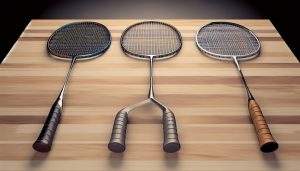
Balance in a badminton racket is the distribution of its mass along the frame, typically described by a “balance point” measured from the base of the handle toward the head. When you support the racket on a thin edge and it just balances, that location is the balance point, usually reported in millimeters.
You should care about balance because it changes how efficiently you can apply force and control motion. From a biomechanics view, balance shifts the racket’s moment of inertia around your wrist and forearm, affecting swing acceleration, deceleration, and joint loading. In practice, the right balance helps you time your strokes, stabilize the racket face at impact, and repeat technique under fatigue, reducing injury risk while maintaining precision. Head-heavy rackets generate more power and concentrate weight toward the head to enhance shot impact.
Key Differences Between Head Heavy and Even Balance Rackets
Although both rackets can share the same overall weight, head heavy and even balance frames behave very differently once you start swinging. You’re really choosing how the mass is distributed along the shaft, which changes how the racket feels during preparation, acceleration, and recovery.
| Aspect | Head Heavy | Even Balance |
|---|---|---|
| Mass distribution | More mass concentrated in head | Mass spread more uniformly |
| Swing sensation | Noticeably “heavier” at impact | More neutral, less top‑end drag |
| Timing window | Rewards committed, early prep | Forgiving if your timing varies |
| Physical demand | Higher stress on shoulder/forearm | Lower cumulative joint load |
| Technical implication | Suits stable, repeatable mechanics | Suits adaptable, all‑round technique |
In coaching terms, you’re trading a pronounced, momentum‑driven head for a more balanced lever that’s easier to standardize across different strokes and shot patterns. A racket’s weight distribution significantly affects maneuverability and fatigue, so match it to your playing style and physical capability.
How Balance Affects Power, Control, and Maneuverability
Once you understand where the mass sits in the frame, you can predict how it’ll translate into power, control, and maneuverability on court. A more head-heavy balance increases the racket’s moment of inertia, so once it’s moving, it generates higher shuttle speed, especially on smashes and clears. The trade-off is slower acceleration and deceleration, so quick re-positioning in fast exchanges becomes harder.
With an even balance, mass is distributed closer to your hand. This lowers swing weight, making grip changes, defensive blocks, and net interceptions faster and more precise. You gain finer control over racket face angle, improving placement and tight net shots, but you sacrifice some “free” power, relying more on efficient technique and timing to achieve depth and penetration. Modern rackets often use carbon fiber construction to improve stability and durability while minimizing added weight.
Choosing the Right Balance for Your Playing Style and Skill Level
When you’re choosing racket balance, start from how you actually win points: your typical shot patterns, tempo, and current physical capacity. If you rely on rear‑court attack, powerful smashes, and high clears, a moderately head‑heavy racket supports greater shuttle momentum, provided your forearm and shoulder strength are sufficient to accelerate and decelerate the frame safely.


If you win more through fast drives, flat exchanges, and net interceptions, an even-balance racket usually optimizes maneuverability and timing precision. At beginner–lower intermediate levels, even balance helps you develop clean technique without overloading the wrist. As your strength, timing, and kinetic-chain efficiency improve, you can gradually shift toward slightly head-heavy if your game trends offensive, or stay even-balance if you specialize in fast, counterattacking play. Lightweight rackets also reduce arm and shoulder fatigue and can improve swing speed for longer, higher‑intensity sessions reduced fatigue.
Practical Tips for Testing and Adjusting Racket Balance
Before you commit to a balance type, you should treat the racket like test equipment and collect some objective feedback from your hand and your shots. Start with neutral drills: clears, flat drives, then fast defensive blocks. Note three things: swing onset (how quickly the racket starts moving), stability on impact, and recovery time between strokes.
Next, perform a simple balance test: place the racket on your index finger and mark the balance point. Compare it to manufacturer specs to understand what “head heavy” or “even” feels like in practice.
To adjust balance, you can: add overgrips (shifts balance towards handle), use thinner grips (maintains or increases head feel), or apply lead tape at 12 o’clock (more head heavy) or under the grip (more even).
Yonex is widely used by professionals and is known for innovation and quality, so consider models from Yonex when testing racket balance.