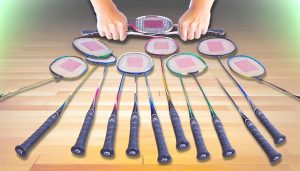
You probably don’t know that the Thruster RYUGA Muse F uses a compact power frame and reinforced head profile that actually shifts the sweet spot slightly higher than the original Ryuga. You’ll feel it most on full-blooded smashes and late rear-court clears, but that extra punch comes with trade-offs in maneuverability, timing forgiveness, and touch. Whether those compromises suit your game depends on how you handle its stiffness, balance, and string setup.
Key Takeaways
- Head-heavy, compact, stiff-shaft frame delivers strong, penetrating smashes when timing and technique are clean, ideal for aggressive attackers who generate their own power.
- Faster, slimmer profile and Dynamic-Sword frame reduce swing drag, making it quicker than many traditional power rackets for doubles and fast intercepts.
- Demanding in defense and late swings; extra head weight punishes poor preparation and rewards players with solid footwork and early racket preparation.
- Best suited to advanced, attacking all‑rounders rather than pure “hammer” smashers; offers power with more control and precision than blunt, ultra‑head‑heavy frames.
- String 1–2 lbs lower than head-light setups and consider a slightly thicker grip to expand the sweet spot and smooth out the stiff, punchy feel.
Specs, Tech Features, and Design Overview
On paper, the VICTOR Thruster RYUGA Muse F is a power-oriented frame that tries to bridge classic head-heavy “hammer” characteristics with modern speed tech. You’re looking at a compact head, stiff shaft, and a distinctly head-heavy balance, but with a slimmer frame profile than the original RYUGA. Compared with the TK-RYUGA II, swing weight feels marginally lighter, hinting at quicker handling. Much like Li-Ning’s head-heavy power-focused rackets, this setup suits big smashers who still want enough speed for fast defensive exchanges and counter-attacks.
Tech-wise, you get PYROFIL-based graphite and other innovative materials layered to stiffen the shaft without adding bulk, plus VICTOR’s Dynamic-Sword style frame edges to cut air drag. The design aesthetics are bolder and more segmented than the standard RYUGA line, but paint durability and grommet reinforcement look merely average against similarly priced high-end power frames.
On-Court Power: Smashes, Clears, and Rear-Court Dominance
While the RYUGA Muse F is marketed as a pure power frame, its rear-court performance is more nuanced and depends heavily on timing and technique. If your smash technique is compact with early preparation, you’ll release genuinely heavy, penetrating shots, but late contact punishes you more than with a Voltric 7 or Astrox 77. The head weight and medium‑stiff profile create a delayed kick; when you sync with it, steep angles feel effortless. On full clears, you’ll notice a slightly higher launch window than the original RYUGA, trading a bit of raw punch for easier length under fatigue. For rear court dominance in doubles, the frame rewards full-body rotation and fast forearm pronation, outperforming even-balanced rackets once you’re set behind the shuttle. This kind of head-heavy, power‑oriented frame really shines when your technique lets you convert its extra mass into greater kinetic energy on every swing.
Control, Touch, and Net Play Performance
When you move into tight exchanges, the RYUGA Muse F’s head weight and shaft response immediately show whether its precision matches or lags behind stiffer, more control-oriented frames. Its touch shots and deception hinge on how consistently the shuttle sits on the string bed, especially on tumbling net shots and hold–flick variations compared with classic front-court specialist rackets. On flat, quick drives, you’ll notice whether the frame’s torsional stability and aerodynamic profile keep the racket face steady under pressure or introduce micro-twists that cost you accuracy. This is also where a stable Dual Optimum system–style frame design really pays off, minimizing torsion and preserving accuracy during fast, flat exchanges.
Precision in Tight Exchanges
Although the Thruster RYUGA Muse F is marketed as a power-oriented frame, its precision in tight exchanges is surprisingly nuanced, especially for an attacking racket in this weight class. You’ll notice how the compact, slightly head-heavy profile stabilizes the face on rushed interceptions, giving you predictable shuttle trajectories when other power frames might spray.
Compared with traditional head-heavy smash sticks, the Muse F offers cleaner precision gameplay in flat drives and forecourt duels. The sweet spot’s a touch denser, so if your technique’s solid, you’ll reap more directional accuracy on punch blocks and stick smashes.
- Feel the confidence to step forward instead of hanging back
- Trust your racket when rallies accelerate beyond comfort
- Experience controlled aggression without sacrificing placement
Touch Shots and Deception
For a power-branded frame, the RYUGA Muse F delivers surprisingly refined touch, but it’s not as instantly “sticky” on the shuttle as softer, head-light control rackets like a Bravesword or Auraspeed. You’ll feel a firmer, quicker rebound, which rewards precise grip changes but punishes lazy fingers on net kills and tight spins.


| Aspect | RYUGA Muse F | Typical Control Frame |
|---|---|---|
| Net tumbles | Crisp, needs fine finger input | Easier, more forgiving roll |
| Lift control | Stable but slightly lively off the face | Slower, higher arc adjustability |
| Drop disguises | Excellent for last-second angle changes | Better for extreme hold-and-slice |
| Touch techniques | Defined feedback, narrower timing window | Softer feel, wider margin for error |
| Deceptive placements | Strong when you vary swing tempo | Stronger on pure racket “hold” |
You’ll favor proactive, finger-led deception over lazy racket softness.
Stability on Quick Drives
Because the frame’s stiffness and mild head-heaviness combine with a very torsionally solid hoop, the RYUGA Muse F feels exceptionally stable on flat, fast exchanges, but it doesn’t quite reach the effortless “set-and-forget” control of the most aero, even-balanced drive frames. On quick drives, you’ll notice the shuttle stays on line even when you’re a little late, a clear payoff of its stability factors: high torsional rigidity, compact head shape, and firm shaft.
At the net, blocks and punch drives sit deep with minimal frame wobble, though rapid forehand–backhand exchanges feel a touch slower than JS12 II or Auraspeed 90K.
- Feeling the racket refuse to twist on a body drive
- Trusting your block under full-pressure attacks
- Owning the midcourt with uncompromised solidity
Speed, Defense, and Drive Exchanges Under Pressure
When rallies tighten and both players start trading full‑court drives, the Thruster RYUGA Muse F reveals a distinctly offense‑skewed bias: it accelerates the shuttle quickly off the stringbed but offers only moderate stability when you’re under sustained pressure. Compared with even‑balanced speed frames, you’ll notice the extra head weight when scrambling, so your speed strategies must prioritize early preparation and compact swings. In flat exchanges, the frame’s aerodynamic profile lets you punch through the shuttle hard, yet recovery into defensive formations can feel half a beat slower than with Bravesword‑style or Jetspeed‑type rackets. Under body‑targeted drives, the head can twist slightly, demanding firmer grips and cleaner technique if you want consistent blocks, counter‑drives, and last‑moment directional changes. Players who rely heavily on fast doubles tactics and quick counter‑drives may need extra focus on early preparation and compact swings to compensate for the racket’s offense‑oriented balance.
Comfort, Feel, and Stringing Recommendations
Comfort on the Thruster RYUGA Muse F leans more “solid and connected” than plush, and how it feels will depend heavily on your string and tension choices. The compact head and stiff shaft transmit impact information very directly, so mishits feel sharper than on softer, more flexible frames. If you’re coming from an even‑balance or mid‑flex racket, you’ll notice more feedback in your forearm. Players moving into this stiffer, head‑heavy profile from entry‑level frames should also pay close attention to string tension to balance power and control without overloading the arm.
For string tension, dropping 1–2 lbs below your usual on head‑light rackets helps broaden the sweet spot and tame vibration. A slightly thicker gauge adds stability without killing bite. Grip size matters too: going one size up can reduce torque in your wrist and smooth out that hard, punchy response.
- Feel every clean strike
- Control the feedback, not the pain
- Tune the frame to your arm
Who Should Use It and Racket Comparisons
If you’re wondering whether the Thruster RYUGA Muse F actually fits your game, you’ll want to match its stiff shaft, compact head, and head-heavy balance to specific swing speeds and tactical preferences. You can benchmark it against rackets like the original Thruster RYUGA, TK-F Enhanced, and Yonex’s Astrox 88D Pro to see how its power profile, sweet-spot forgiveness, and rotational stability stack up. Let’s break down which player types benefit most from this frame and where it sits relative to those established power-control hybrids. Since it’s a head-heavy power frame, it naturally appeals to advanced singles players who like to maintain aggressive play and precise, high‑pressure smashes throughout a match.
Ideal Player Profiles
Although the Thruster RYUGA Muse F carries the “Thruster” badge, it’s best suited to attacking all‑rounders rather than pure hammer‑style power players, and that distinction matters when you’re choosing between it and frames like the original RYUGA, RYUGA II, or Jetspeed/ARS lines. You’ll benefit most if you’ve got an aggressive style built on fast shifts: intercepting drives, follow‑up mid‑court kills, and quick defensive counters that flip into attack.
You should consider this if you generate your own power efficiently but still want extra help stabilizing off‑center smashes and flat exchanges.
- You crave the feeling of “owning” the rally tempo.
- You love stepping in on half‑chances at the net.
- You want power that’s accessible, not exhausting.
Comparisons With Similar Rackets
While the Thruster RYUGA Muse F shares the “Thruster” label and broad attacking intent with the original RYUGA and RYUGA II, its on‑court identity sits much closer to a fast, counter‑attacking platform than a blunt sledgehammer. You’ll feel quicker recovery, easier head control, and less fatigue, especially if you’re not used to extreme head heaviness.
| Aspect | Comparison Insight |
|---|---|
| Racket weight / balance | Slightly lighter swing weight than RYUGA II, closer to 4U speed frames, so you can accelerate from defense to attack faster. |
| Shaft / feedback | Crisper than the original RYUGA; you’ll get more immediate shuttle response but slightly less “leveraged” punch. |
| Handle grip / maneuvering | Slimmer, faster handle grip rotation than most Thrusters; if you finger‑power and change grips rapidly at the net, you’ll benefit more than full‑arm smashers. |