If you want to play faster in 2026’s increasingly physical badminton game, you can’t just rely on racket skills—you need stamina to repeat long rallies, strength to explode off the floor, and mobility to reach extreme positions without breaking down. When you align your conditioning with actual match demands—heart-rate zones, multi-directional lunges, and repeated sprints—you start turning fitness into points on the board. The key is knowing exactly what to train, and when…
Key Takeaways
- Build stamina with 2–3 weekly steady-state runs (25–40 minutes) plus 2–3 high-intensity on-court intervals that mimic badminton rallies and work–rest ratios.
- Improve speed and agility using multi-directional shadow footwork, repeat-sprint drills, and 6-point acceleration tests to track court-coverage progress.
- Develop explosive lower-body strength with heavy split squats, Romanian deadlifts, and 30-second squat-jump tests to enhance jump power and lunge stability.
- Protect joints and boost stroke speed via core anti-rotation work, shoulder stability drills, and dynamic mobility before sessions, plus flexibility work after.
- Optimize recovery and load management by monitoring RPE, weekly hours, jump volume, sleep (7–9 hours), and using light cooldowns with proper carbs, protein, and hydration.
Understanding the Demands of Modern Badminton
Although badminton looks fluid and effortless at elite levels, modern play places intense, quantifiable demands on your body: repeated accelerations and decelerations, multi‑directional lunges, powerful jumps, and rapid overhead strokes, all under severe time pressure. Across a match, you’ll accumulate hundreds of high‑intensity efforts, with work‑to‑rest ratios often near 1:1, pushing heart rate above 85% of max.
You need repeat‑sprint ability to cover 6–8 meters in under two seconds, then recover quickly for the next rally. Lower‑body strength supports explosive push‑offs, deep defensive lunges, and controlled landings. Core and shoulder strength stabilize your trunk and protect your rotator cuff during smashes exceeding 250 km/h. Mobility in hips, ankles, and thoracic spine lets you reach extreme positions without losing balance or speed.
Testing Your Current Fitness Level
To train like a serious badminton athlete, you first need simple, reliable tests that reflect on-court demands such as repeated sprints, multi-directional changes, and explosive jumps. You’ll use badminton-specific field tests to measure key qualities like acceleration, agility, and endurance, then record your scores in a consistent format. By tracking these metrics over time, you can see whether your program’s actually improving match-relevant performance or needs adjustment.
Simple Badminton Fitness Tests
Ever wondered how fit you actually are for badminton, not just “in general”? Start with three simple, court‑relevant tests.
First, stamina: do a 12‑minute “Yo‑Yo” style court run—shuttle from baseline to short service line and back, following a timer or steady beeps. Count total shuttles; higher scores reflect better match endurance.
Second, acceleration and change of direction: perform a 6‑point shadow drill (front‑right, front‑left, rear‑right, rear‑left, mid‑right, mid‑left) for 30 seconds at full speed, returning to center each time. Count completed movements.
Third, lower‑body strength and power: do a 30‑second continuous squat‑jump test with proper form. Record jump count and whether height noticeably drops.


These tests expose badminton‑specific fitness strengths and limitations.
Tracking Progress Over Time
One test session doesn’t tell you much unless you repeat it in a structured way and track the numbers. To see real badminton gains, you’ll need consistent protocols and clear targets. Test every 4–6 weeks, under similar conditions: same warm‑up, court, time of day, and racket.
Use your results to guide training:
1. Record performance
Log shuttle‑run times, repeated‑sprint results, heart rate recovery, jump height, and mobility scores. Use the same distances and work‑to‑rest ratios you face in matches.
2. Analyze trends
Look for faster court times, fewer performance drops across sprints, and improved recovery within 60 seconds.
3. Adjust training focus
If speed plateaus but recovery improves, shift toward neuromuscular power and change‑of‑direction drills specific to badminton footwork patterns.
Building Game-Ready Stamina and Endurance
Although badminton rallies look short, game-ready stamina and endurance demand a powerful aerobic base layered with repeat-sprint capacity and rapid recovery between points. You’re training to sustain high-quality movement deep into the third game, not just to survive warm‑up.
Anchor your week with 2–3 steady-state sessions (25–40 minutes at conversational pace) to raise aerobic capacity and improve cardiac efficiency. Then add 2–3 interval sessions that mirror match demands: for example, 15–20 seconds of all‑out court movement (multi‑shuttle, ghosting patterns), followed by 20–30 seconds rest, repeated in sets of 8–12.
Prioritize on-court conditioning over generic cardio so footwork, rhythm, and shot preparation stay sharp under fatigue. Track heart rate and perceived exertion to keep sessions targeted and progressive.
Strength Training for Explosive Power and Stability
Stamina lets you stay in the fight; strength lets you hit harder, move faster, and stay stable under pressure. For badminton, your focus isn’t bodybuilding; it’s producing force quickly, then controlling your body after impact and landing. Integrating strength work with aerodynamic rackets and modern frame technologies helps you better convert physical power into faster, more efficient shots on court.
Use strength work to drive smash velocity, sharper lunges, and rock-solid balance on recovery:
- Lower-body power – Prioritize heavy split squats, front squats, and hip-dominant lifts (Romanian deadlifts) 2–3 times weekly to build force for takeoffs and strong braking under load.
- Upper-body speed–strength – Combine push presses, incline presses, and rotational cable work to translate leg drive into faster, heavier strokes.
- Core and pelvic stability – Train anti-rotation and anti-lateral-flexion (Pallof presses, suitcase carries, side planks) to keep your trunk stable during overheads and deep lunges.
Agility, Footwork, and Change-of-Direction Speed
Because badminton is played in short, violent bursts of movement rather than steady running, your agility and footwork have a bigger impact on performance than raw speed in a straight line. You’re reacting to unpredictable shuttle trajectories, so you need to accelerate, brake, and re-accelerate in fractions of a second while staying balanced to hit.
Prioritize split-step timing, multi-directional lunges, and fast recovery to base. Agility-ladder work and cone drills are useful, but make them shuttle-specific: add visual cues, random calls, or coach feeds so you’re reading and moving, not just memorizing patterns. Train deceleration with controlled stops from diagonals and side-shuffles. Short, high-intensity court sprints (2–6 seconds) with incomplete rest mirror rally demands and build repeatable change-of-direction speed.
Mobility, Flexibility, and Injury Prevention
To keep your joints moving efficiently through every lunge, jump, and overhead reach, you’ll need a structured approach to dynamic mobility warm-ups and badminton-specific flexibility. Research shows that better hip, ankle, and thoracic mobility not only improves court coverage but also reduces load on your knees, shoulders, and lower back. You’ll also integrate targeted injury-prevention strength drills to reinforce vulnerable areas like the rotator cuff, knees, and ankles so you can train and compete with fewer setbacks.
Dynamic Mobility Warm-Ups
Although it’s tempting to jog a few laps and start hitting, high-level badminton demands a dynamic mobility warm-up that prepares joints, muscles, and neural pathways for explosive, multi-directional movement. Static stretching alone doesn’t elevate temperature, reaction speed, or joint control enough for rapid lunges, jumps, and rotations.
Use targeted, rhythmic drills that mirror badminton footwork and racket actions:
- Ankle–knee–hip series: Walking lunges with overhead reach, lateral lunges, and quick ankle rolls to prime deceleration and push-off mechanics.
- Torso and shoulder integration: Arm circles, scapular push-ups, and trunk rotations to stabilize overhead strokes and prevent shoulder overload.
- Court-specific activation: Skipping, side shuffles, and split-step bounces to ingrain reactive footwork patterns and sharpen first-step quickness.
Flexibility for Court Coverage
Prioritize hip flexor, adductor, and glute flexibility so you can push explosively out of wide lunges. Ankle dorsiflexion range improves your ability to load the front leg without your heel popping up, keeping your base stable. Thoracic rotation lets you turn quickly for overheads and round-the-head shots. Post-session static stretching—3–4 sets of 20–30 seconds per key muscle group—helps maintain tissue length, supporting smoother direction changes, deeper lunges, and more efficient court coverage.
Injury-Prevention Strength Drills
Strong, well-balanced muscles act like built‑in armor for badminton’s high‑impact, stop‑start movements, reducing the strain on your knees, ankles, shoulders, and lower back. Targeted strength work lets you absorb lunges, cuts, and landings with less joint stress, so you stay available to train at high volume.
Use strength drills that mirror badminton patterns and emphasize control through range, not just load:
- Knee & ankle armor: Split‑squat isometrics and single‑leg Romanian deadlifts to stabilize lunges and decelerations.
- Rotator‑cuff stability: External rotations and scapular push‑ups to protect overhead smashes and repeated clears.
- Core and hip control: Anti‑rotation presses and lateral band walks to keep your trunk steady during rapid change of direction and recovery steps.
On-Court Conditioning Drills for Match Fitness
When you shift from general fitness to on-court conditioning, your drills need to mirror the movement patterns, intensities, and work-to-rest ratios of real badminton rallies. Prioritize high-intensity intervals, short recoveries, and full-court coverage.
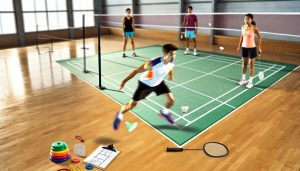
Run multi‑shuttle shadow drills: 10–15 seconds of maximal footwork to pre-set corners, 20–30 seconds rest, repeated 8–12 times. Emphasize split-step timing, hip–knee flexion, and efficient directional changes.
Add “transition suicides”: sprint from base to rear court, recover to base, then to forecourt, maintaining posture and racket-ready position. Work in 4–6 sets of 30–40 seconds.
Finish with lateral shuffle intervals along the baseline, touching cones with your racket. Focus on low stance, quiet feet, and controlled deceleration to build repeatable, match-specific speed.
Recovery, Nutrition, and Load Management
Although hard training builds your game, it’s the way you recover, eat, and manage load that determines whether those sessions translate into sustained performance or chronic fatigue. For badminton’s explosive rallies and frequent tournaments, you need systems, not guesswork.
- Recovery: Prioritize 7–9 hours of sleep, plus short post-session routines: 5–10 minutes of low‑intensity cycling or walking, light mobility, then hydration and protein within 1 hour to support muscle repair.
- Nutrition: Center meals on lean protein, whole‑grain carbs, fruit, and fluids. Around intense sessions, use fast‑digesting carbs plus electrolytes; avoid heavy fats immediately before play.
- Load management: Track weekly on‑court hours, RPE (1–10), and jump volume. Aim for gradual increases (≤10%/week) and schedule at least one lighter “reload” day to prevent overuse.
Weekly Training Templates for Different Player Levels
Because badminton demands speed, power, and repeatability in the same week, you need a training structure that balances court time, strength work, conditioning, and recovery without guessing. For beginners (2–3 sessions/week), use: 2 technical court days plus 1 mixed day (light strength, movement drills, intervals), always leaving at least 48 hours between hard sessions.
If you’re an intermediate (4–5 sessions), try: 2 technical/tactical days, 1 strength–power day, 1 shuttle-conditioning day, and 1 lighter mobility/recovery court session.
For advanced or tournament phases (5–7 sessions), anchor the week around 2–3 high-intensity court sessions, 2 strength–power sessions, 1 speed–agility session, and 1 dedicated recovery day. Adjust weekly volume using RPE, sleep quality, and jump height trends.