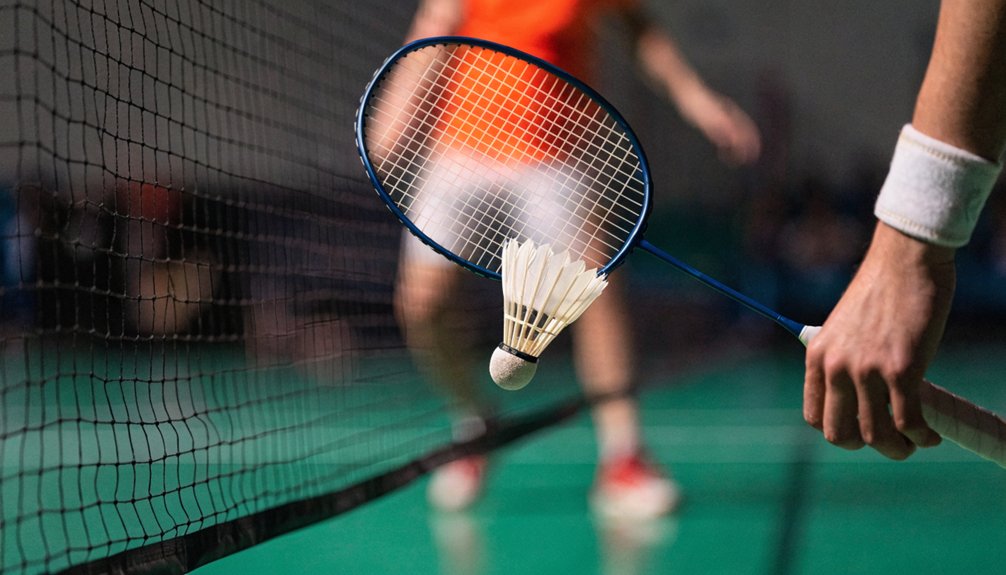
If your net shots keep sitting up or drifting mid-court, you’re leaking points you don’t need to lose. To tighten your touch, you’ll need a relaxed but precise grip, clean contact just above the tape, and footwork that puts you behind the shuttle early. Small changes in finger pressure, racket angle, and body height shift your control dramatically—and once you adjust those, you’ll see why some players dominate the front court.
Key Takeaways
- Use a relaxed, adaptable grip so the racket face stays stable at impact, allowing soft, precise contact just above the tape.
- Shorten your swing to a compact forward poke, minimizing lift and keeping the shuttle tight instead of popping up.
- Arrive early with explosive first step and low stance, setting your body before contact to improve accuracy and disguise.
- Practice slow, repeatable net taps and one-step approach drills, focusing on consistent shuttle height and bounce control.
- Diagnose common errors—open racket face, tight grip, long swing—and adjust angle, tension, or motion immediately during practice.
Net Shot Touch: What It Is and Why It Matters
Although it’s often described as “feel,” net shot touch is a highly trainable blend of racket control, fingertip sensitivity, and precise shuttle contact that determines how accurately you can play tight, spinning shots at the tape. You can think of it as your ability to control shuttle speed and trajectory within a few centimeters, under pressure.
Touch matters because it directly shapes point patterns. When your net shot dies just below tape height, you force predictable lifts and create attacking chances. When it sits up or travels too far, you lose the initiative or get counter-killed. High-level touch also lets you disguise direction and spin, disrupting your opponent’s read and timing. Improving this single attribute raises both your defensive stability and offensive conversion rate.
Core Net Shot Technique: Grip, Contact, and Feel
Three components define a reliable net shot: a relaxed, adaptable grip, a clean contact point, and a soft but decisive “finger push” through the shuttle. Hold the racket with a loose basic grip you can rotate slightly forehand or backhand. Your fingers, not your arm, should control the racket head. Developing this kind of touch depends on mastering quick grip changes so you can adapt instantly to different shuttle positions at the net.
Meet the shuttle as high and as close to the tape as possible, usually just in front of your leading foot. The racket face stays slightly open, moving mainly forwards, not upwards. At impact, squeeze the fingers briefly, then relax again. This micro‑acceleration gives precision without excess power. Keep your wrist stable but supple, allowing tiny angle changes. Train slow, repeatable motions so the grip pressure, contact height, and finger push feel automatic.
Why Your Net Shots Pop Up (And How to Fix Them)
When a net shot pops up instead of skimming tape‑height, it’s almost always caused by excess lift from your racket angle, swing path, or grip tension. If the racket face is even slightly open, the shuttle climbs. Close the face a few degrees so the string bed “covers” the shuttle and shapes a downward vector.
A long, brushing swing also adds lift. Shorten the motion: a compact forward poke with almost no follow‑through. Let the shuttle’s own speed do the work. Dialing in your forehand grip so the handle sits like a relaxed handshake reduces tension and helps you control the racket face angle at the net.
Use this table to diagnose and correct:


| Symptom | Technical Correction |
|---|---|
| Shuttle arcs high, lands mid‑court | Close racket face; contact fractionally earlier |
| Shuttle tumbles long, no spin | Relax fingers; reduce swing length |
| Shuttle sits up on tape | Contact higher; apply sharper fingertip squeeze |
Footwork and Timing for Tighter Net Shots
Two things dictate how tight your net shots can be: how early you arrive and how cleanly you time the contact. Your first step must be explosive, pushing off the non-racket leg, with your hips already turning toward the shuttle. Stay low, center of gravity forward, so you can brake and stabilize just before impact. Land the lunge with your knee aligned over your toes, then let the racket move last, not first. You’re aiming to meet the shuttle just as it starts to drop, not while it’s still rising. In tight rallies, staying calm and blocking out mind games from loud or aggressive opponents helps you keep your timing and touch consistent at the net.
- You split-step as your opponent hits, not after.
- You glide forward, then decelerate into a stable lunge.
- Your head stays still during contact.
- The shuttle leaves your strings almost parallel to the tape.
Drills to Train Soft, Consistent Net Shots
Build your net touch with drills that isolate feel, repetition, and feedback so softness becomes automatic under pressure. Start with stationary net taps: stand one step from the net, feed yourself shuttles, and brush them so they pass just over the tape, landing before the service line. Track height and bounce; stop if the shuttle sits up. You can also experiment with different grip materials to find a handle feel that gives you better control and consistency on delicate net shots.
Next, do one‑step approach drills. Begin at the T, move out with your net footwork pattern, play a soft brush, recover fully, and repeat for 10–20 shuttles per set, each side.
Finish with pressure ladders: your partner lifts, you play a tight net, they lift again only if your shuttle lands within a target zone. Increase speed while maintaining same contact softness.