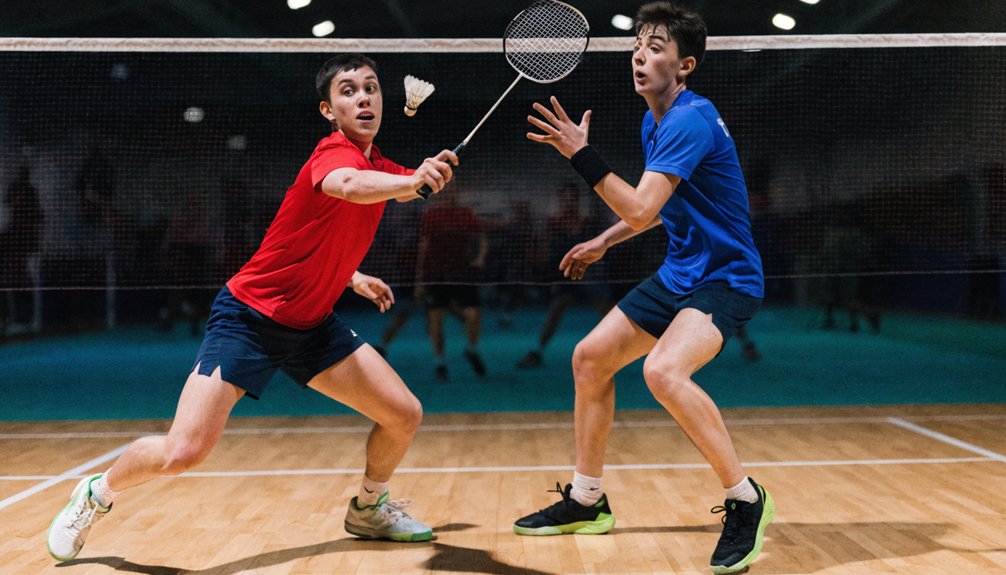
If you want your doubles game to feel coordinated instead of chaotic, you’ll need more than quick reflexes—you’ll need a clear communication system with your partner. That means agreeing on roles based on strengths, standardizing simple calls, and using body position as a constant signal of intent. Once you start treating every rally as shared decision-making rather than two singles games on one court, you’ll see why precise communication often decides who wins…
Key Takeaways
- Set clear roles and targets before playing, agreeing who leads from the rear court and who stabilizes at the net in key situations.
- Use simple, standardized verbal calls (“mine,” “yours,” “switch,” “up/back”) spoken early, ideally before the opponent hits.
- Develop non-verbal cues like eye contact, stance width, and racket position to signal attacking intent, rotation, or holding position.
- Build habit of quick between-rally check-ins: confirm serve/receive plans, patterns, and any adjustments after miscommunication.
- Review match clips or key rallies together, identify communication breakdowns, and turn fixes into specific, practiced protocols.
Set Shared Doubles Goals And Roles
Before you step on court as a pair, define exactly what you’re trying to achieve and how each of you will contribute to it. Translate vague aims like “win more” into measurable targets: increase attack opportunities, force more weak lifts, or control mid-court exchanges.
Assign roles based on strengths. If you’ve got the heavier smash, you prioritize rear-court attack while your partner stabilizes the net. If your partner’s defense is stronger, they absorb pressure while you prepare to counterattack. You can even tailor these roles around your rackets’ characteristics—using a stiffer-shaft racket for the rear-court attacker and a more flexible-shaft racket for the front-court player to better balance power and control.
Pre-agree patterns: who serves more on the deuce side, who takes third-shot kills, who initiates rotation when under pressure. Clarify decision authority in tight moments so you’re not debating tactics mid-rally but executing a shared match plan.
Improve Non-Verbal Doubles Communication And Court Awareness
Once goals and roles are defined, your partnership has to run on fast, silent information. You’re building a visual language that both players decode instantly. Prioritize eye contact between rallies, stance cues just before the serve or return, and micro-adjustments in distance that reveal who owns which space. In high-pressure matches, this quiet visual language also helps both players stay locked into their game plan and ignore opponents’ disruptive mind games and celebrations.
Use your peripheral vision to track your partner’s base, not just the shuttle. When you sense them shifting back, you automatically compress forward; when they close the net, you widen and deepen your base.
- Read partner stance width to infer attacking vs. neutral intent
- Use racket angle to signal readiness for drives vs. lifts
- Maintain constant micro-adjustment of spacing lines
- Train “snapshot awareness” by checking partner position every shot
Use Simple Doubles Calls During Points
Although non-verbal cues carry most of the load in fast exchanges, you still need a small, consistent set of spoken calls to resolve ambiguity under pressure. Limit your vocabulary so it’s fast, loud, and unambiguous. Common systems use “mine/yours,” “leave,” “switch,” and “up/back” or “side/side.” Define each term precisely before playing.
Use “mine/yours” only for marginal interceptions, never routine shots, so you don’t overload your partner. “Leave” must mean you’re 100% sure the shuttle’s going out. Decide which of you can overrule on those calls.


Standardize tone and timing: call early, on or just before the opponent’s contact, not as the shuttle crosses. Practice mini-rallies focused solely on clean, single-word calls.
Adjust Doubles Strategy Together Mid-Rally
When a rally extends beyond the first two or three shots, you and your partner must treat it as a live problem to solve, continually updating roles, formations, and shot choices based on evolving patterns. You’re co‑processing information: shuttle height, opponent balance, and your own court coverage. Micro‑calls and body cues let you pivot strategy without chaos. In sports like badminton and other racket sports, clear communication and coordinated role‑switching are fundamental to maintaining an effective tactical formation.
Use compact, pre-agreed triggers:
- Shift to front–back when you force a weak lift; rear player announces “mine” while front player tightens the net line.
- Slide into side–side when you’re under pressure, prioritizing width and buying time with high, safe clears.
- Exploit exposed space immediately after any opponent dive or scramble.
- If both of you lose structure, reset with a neutral, high clear and rebuild formation.
Review Doubles Matches To Fix Communication Gaps
Pause each incident and answer three questions:
1) What was the tactical situation (serve/receive, attack/defence, formation)?
2) What did each of you expect the other to do?
3) Which specific call or cue would’ve prevented the breakdown?
Convert these into simple protocols: standardized shouts, clear front–back or side–side ownership zones, and default receivers for ambiguous shots. Rehearse those scenarios in drills so the new communication rules become automatic under pressure. You can also agree on who uses more head-light rackets or power-focused gear so your communication protocols naturally match each partner’s strengths during fast exchanges.