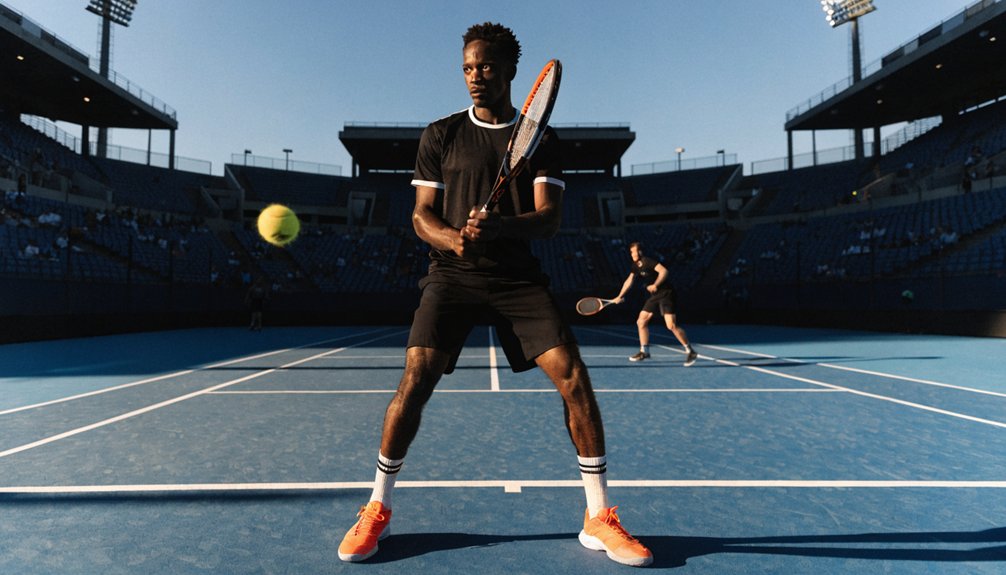
If you want to win more singles, you can’t rely on power alone; you need a precise base position and the patience to repeat it under pressure. Your recovery spot, court geometry, and shot tolerance should dictate every movement, not impulse. When you understand how to adjust your base to different opponents and use margin instead of risk, rallies start to feel slower and more predictable—yet that’s only the starting point for…
Key Takeaways
- Keep a dynamic base position slightly biased toward your opponent’s stronger wing, minimizing open angles and reducing recovery distance after each shot.
- Adjust depth based on opponent style: deeper versus heavy or flat hitters, farther forward versus moonballers to take balls early.
- Treat recovery as part of every stroke: hit, move back toward your base, and time a split step with your opponent’s contact.
- Build patience by defining neutral balls, aiming high over the net with safe margins, and setting rally-length goals before pulling the trigger.
- Use heavy, deep crosscourt shots to control patterns, change direction only from balanced positions, and step inside the baseline to attack short balls.
Why Smart Positioning Beats Raw Power in Singles
Although sheer strength can produce occasional winners, smart positioning consistently wins singles because it optimizes your court coverage, shot selection, and time to react. When you’re correctly positioned relative to the ball, opponent, and court geometry, you reduce distance traveled, lower recovery time, and expand your tactical options on every shot. Just as choosing the right racket involves balancing attributes like weight distribution and shaft flexibility rather than fixating on power alone, effective singles play relies on balanced positioning decisions instead of chasing outright winners. You can systematically exploit angles, target open space, and apply pressure without overhitting. Raw power forces you into higher risk: smaller margins over the net, more balls near the lines, and greater vulnerability if you’re stretched wide or pulled forward. Positioning lets you absorb pace, redirect with control, and maintain neutral or dominant court states, so you’re dictating patterns instead of reacting desperately, regardless of your maximum racket speed.
Find Your Ideal Singles Base Position
Your singles base position isn’t fixed on the classic center mark; it’s a dynamic spot that shifts based on your opponent’s patterns and your own strengths. You’ll learn to stand a half-step or more toward their stronger wing or preferred direction, cutting off their high-percentage lanes. From this optimized base, you’ll cover passing angles with fewer steps and stay balanced for both offense and defense.
Adjusting to Opponent Tendencies
When you understand how an opponent patterns their shots, you can shift your singles base position a few steps in or out, or laterally, to cut off their highest‑percentage plays. Track where their neutral rally ball lands, where they miss, and what they do under pressure. If their rally ball is consistently short, creep a step inside the baseline; if it’s heavy and deep, give ground.
Note where they favor (forehand or backhand) and bias your base position slightly toward that wing. Against a player who runs around their backhand, shade toward that side so you’re not surprised. Keep adjustments small and test them for several points. You’re not guessing; you’re continually recalibrating your “default” spot to exploit their reliable habits.
Covering Angles Efficiently
Instead of reacting from random spots behind the baseline, you should establish a precise singles base position that minimizes exposed angles and maximizes court coverage. Start from a point slightly behind the baseline, roughly on the bisector of the opponent’s available angles, not simply the ball’s lateral position. After every shot, recover toward the line connecting the ball and the center of your baseline, then bias one step toward your weaker side.
Calculate risk: if you’ve hit deep and cross‑court, shift a half‑step toward the open line; if you’ve hit short or down the line, recover closer to the geometric center. Prioritize covering the largest reachable angle, not equal distance. Practice shadow recoveries, emphasizing small, efficient adjustment steps over big, wasted movements.
Adjust Your Base for Different Opponent Styles
Although the basic idea of a solid singles base remains constant, you must shift its depth, width, and lateral bias based on the opponent’s style to optimize court coverage and shot preparation. Against a heavy baseline hitter, set your base one to two steps deeper, centered, with your split‑step timed for heavier pace and higher bounce. Versus a flat hitter who takes the ball early, hold a slightly deeper, narrower base to buy reaction time and defend through the middle. Against a consistent moonballer, move your base forward inside the baseline, prepared to take balls on the rise. Versus a net‑rusher or serve‑and‑volleyer, cheat your base a half‑step forward and slightly toward the likely volley direction. Adjust as patterns clarify. Just as top badminton players subtly adapt their stance to counter mind games and psychological tactics, you should treat your base position as a flexible tool that responds to an opponent’s emerging patterns and mental pressure.


Build the Patience to Outlast Your Opponent
Your court position only works to your advantage if you’ve built the mental discipline to stay in points longer than your opponent. You need a clear, repeatable process. First, define a “neutral ball” as any shot that doesn’t clearly push you off balance or move your opponent considerably. On neutral balls, your default decision is to maintain margin, not accelerate. Just like choosing the right badminton racket for your level, building patience means matching your shot selection to your current strengths instead of forcing low-percentage winners. Before each return game, set a numeric patience goal: for example, you won’t pull the trigger before a six-ball rally unless you receive a clear short ball. Count shots in your head: “1–2–3…” to anchor your tempo. When you feel rushed, narrow your focus to height, depth, and spin, not winners. Evaluate success by rally length and error patterns, not just games won.
Recover to Your Base After Every Shot
Treat recovery as part of the stroke, not something you do afterward. As the racquet finishes, your feet must already be initiating recovery. Use a split step synchronized with your opponent’s contact, then move with small adjustment steps back toward your ideal base: usually a few feet behind the baseline and slightly biased toward the side you just left exposed.
Track three elements instantly: ball depth, opponent’s contact point, and their body balance. These dictate whether your base shifts a step forward, backward, or laterally. Never admire your shot or pause; your first movement is always away from the sideline toward center coverage.
Train this by shadowing: hit, recover to base, split, react. Make it automatic, not optional.
Shot Selection Rules to Win More Singles Points
When you simplify your shot selection into a few non‑negotiable rules, singles becomes much easier to control under pressure. First, attack only balls that you can meet in front of your body with balanced footwork; if you’re late or stretched, reset the point instead of forcing. Second, direct most neutral balls cross‑court, exploiting the longer distance and higher net, and go down‑the‑line primarily when you’ve created clear advantage. Third, match spin to situation: use heavier spin when defending or on the run, flatter drives only from stable positions. Fourth, on short balls, commit to an aggressive pattern: approach to the weaker wing, then cover the open court. Finally, on wide defensive balls, prioritize high‑percentage direction back cross‑court to buy time. Over the long run, this disciplined shot selection works best when paired with consistent footwork drills that keep you balanced enough to execute your patterns under pressure.
Use Depth, Height, and Margin for Safer Aggression
Shot selection rules give you a framework, but you convert that framework into actual winning patterns by controlling depth, height over the net, and margin from the lines. Think “deep, high, safe” on most neutral and slightly offensive balls. Aim your rally balls three to four feet inside each baseline and two to three feet inside the sidelines. Use a net clearance of at least three feet on neutral balls and four to five feet when you’re defending. When you attack, you can lower net clearance slightly, but still avoid the tape. Combine this with heavy topspin so the ball drops inside the court despite higher trajectories. Your mindset: you’re not aiming for lines; you’re shrinking the court safely while still pushing opponents back. Just as racket balance in badminton improves control and reduces errors, treating depth, height, and margin as your “balance points” in singles rallies lets you attack safely while keeping unforced errors low.
Control Rally Patterns With Smart Court Positioning
To control rally patterns, you must link your shot selection to precise court positioning, adjusting your depth between shots to manage time and pressure. You’ll use deeper, heavier balls to push your opponent back, then shift your position inside the baseline as you shorten the court with a more aggressive, earlier contact point. From there, you can use sharp angles to pin the opponent outside the singles sideline, opening predictable patterns into the open court for the next ball. Just as in badminton, where quick grip changes allow players to adapt to different shuttle positions during fast rallies, your ability to adjust court position between shots lets you continually shape and control the unfolding pattern of play.
Adjust Depth Between Shots
Although many players obsess over pace and spin, it’s your ability to adjust depth between shots that truly dictates rally patterns and gives you tactical control of the court. You must constantly shift your base position relative to your opponent’s strike zone: step in on short, rising balls and recover deeper when their contact is heavier and later.
Use depth to script the exchange. Deep, high‑percentage balls neutralize; shorter, dipping balls invite errors and rushed swings. Calibrate your recovery so you’re never stranded inside the court after a neutral ball.
| Situation | Ideal Contact Depth | Base Recovery Line |
|---|---|---|
| Defending | 1–2 m behind baseline | 2–3 m behind baseline |
| Neutral rally | At/just behind baseline | 1–1.5 m behind baseline |
| Attacking mid‑court | Inside baseline | On or just behind T |
Use Angles To Pin
Once your depth is reliable, angles become the tool that lets you pin opponents into predictable patterns and open the court on your terms. You’re no longer trading straight, neutral balls; you’re shaping diagonals that drag them away from their base position.
Aim crosscourt first, using the extra court length for margin. From a neutral rally, drive a heavy, crosscourt ball that lands near the sideline and service line intersection. As they’re pulled wide, recover slightly closer to the opposite open side, anticipating the shorter, defensive reply.
When you’ve stretched them, change direction only off balanced, comfortable contact. Redirect down the line with a controlled, lower‑risk angle, then step inside the baseline to finish into the larger, uncovered space.
Common Positioning and Patience Mistakes Costing You Matches
Even when your strokes are solid, you’ll bleed points if your positioning and shot tolerance don’t match the demands of high-level singles. You stand too close to the sidelines after a wide ball, leaving the opposite corner undefended. You retreat straight back instead of recovering on a diagonal toward the opponent’s best reply. Your base drifts forward when you’re under pressure, so you get passed or lobbed. Incorporating tools like the Dual Optimum system and other stability-focused racket technologies can support sharper recovery steps and more consistent base positioning.
You also misjudge when to end points. You over-attack from neutral balls, compressing your reaction time and lowering margin over the net. Conversely, you guide the ball passively when you should apply controlled pressure, inviting the opponent to step in. Poor shot tolerance—quitting a rally early—turns winnable neutral exchanges into cheap errors.
Simple Drills to Train Singles Positioning and Patience
You’ve seen how poor recovery routes, drifting court position, and impatient shot selection leak points; now you need structured, repeatable work to correct them. Use these drills to hard‑wire movement patterns and decision discipline. Good court dimensions awareness also sharpens your sense of safe targets and recovery depth in singles.
- Cone Recovery Lines – Place cones on your ideal singles base. After each fed ball, strike, then recover through the cones before the next feed. Emphasize split‑step timing.
- Shadow Rally Patterns – Without a ball, rehearse cross‑court, down‑the‑line, and neutral recovery sequences for one minute each, focusing on stance, balance, and depth targets.
- Three-Ball Patience Drill – In cooperative hitting, you can’t attempt offense until you’ve hit three deep, margin‑safe balls in a row.
- Width-Depth Callouts – Partner feeds; you must announce “safe” or “attack” before contact based on ball height, depth, and your court position.