If you want to return smashes with control instead of just blocking on instinct, you need compact racket preparation that’s precise, repeatable, and fast under pressure. That means a stable, low base, a neutral grip you can adjust instantly, and a short, efficient swing that still transfers power. When you sync this with disciplined footwork and early shuttle contact, your defense turns dangerous—because then you’re not just surviving the smash anymore…
Key Takeaways
- Adopt a low, balanced ready position with racket in front of your chest to minimize reaction time to smashes.
- Use a neutral grip with relaxed fingers, quickly rolling to forehand or backhand while keeping racket preparation compact.
- Limit backswing to hip-width and focus on short, controlled swing paths that convert the shuttle’s pace rather than generating your own power.
- Time a light split-step as the opponent strikes, then use small shuffle steps to keep the shuttle in front of your body.
- Shorten follow-through on blocks to recover to base quickly and be ready to counterattack off weak or off-balance replies.
Why Compact Racket Prep Beats Big Swings
When you’re dealing with an opponent’s smash, compact racket preparation outperforms big swings because it minimizes reaction time, stabilizes your contact point, and preserves balance under pressure. With a short preparation, you keep the racket close to your body, reduce travel distance, and convert incoming pace instead of trying to generate your own. You’re aiming for an efficient “block‑and‑redirect” action rather than a full stroke. A big swing lengthens your timing window, exposes your shoulder, and makes late contacts far more likely. Compact prep lets you adjust to small shuttle deviations, maintain a consistent strike zone in front of your body, and keep your base stable for the next shot. This directly increases control, accuracy, and recovery speed. By keeping your motion compact, you also improve your ability to contact the shuttle in the Sweet Spot, maximizing both control and repulsion on defensive returns.
Set Up a Compact Ready Position
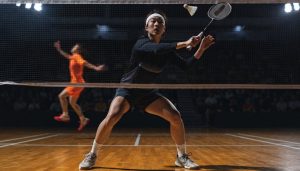
A compact ready position starts with a low, balanced base, racket in front of your body, and minimal wasted motion. Set your feet slightly wider than shoulder-width, with your weight on the balls of your feet, heels light, knees flexed. Keep your hips and shoulders square to the incoming shuttle, chest lifted, and core engaged so you can explode in any direction.
Hold your racket hand in front of your torso, roughly at chest height, elbow comfortably bent, shaft pointing slightly upward and forward. Your non-racket hand balances the stance and helps track the shuttle. Keep your racket head inside your shoulder width, never drifting behind you. Stay on a light split-step as your opponent strikes, then recover immediately back into this compact shape. This stable, efficient base also helps you stay composed under mind games and psychological tactics, so opponents’ distractions don’t break your preparation rhythm.
Simple Grip Tweaks for Compact Smash Defense
Instead of locking into one rigid hold, you’ll return smashes better by using small, precise grip adjustments that keep your racket compact and fast. Start from a neutral grip: thumb slightly angled on the wider bevel, index finger relaxed, other fingers wrapping lightly. This lets you switch instantly between forehand and backhand defense without widening your swing. Mastering these subtle changes builds on the basic forehand grip and backhand grip principles used for all standard strokes.
For forehand defense, roll the grip a few degrees so the V between thumb and index shifts slightly toward the racket edge. Maintain a soft finger pressure so you can tighten just at impact.
For backhand defense, slide the thumb higher on the bevel, pressing with the pad, not the tip. Keep the handle more in your fingers than your palm to minimize tension and increase reaction speed.
Shorten Your Backswing Without Losing Power
Although it feels counterintuitive at first, you’ll return smashes faster by shortening your backswing to a compact preload rather than a full draw. Think “short set, long acceleration.” From your neutral ready position, move the racket back only until the shaft is roughly parallel with your forearm and the head just outside your hip or shoulder line. Keep the elbow slightly in front of your body, wrist relaxed, and forearm loaded for pronation or supination. Power comes from a rapid sequence: forearm rotation, then snap of the fingers and wrist, not from a big loop. Train this by shadow swings beside a mirror, checking that the racket never travels behind your torso line, yet still accelerates explosively through the contact zone. To make this compact motion even more efficient, pair it with a stable, aerodynamic frame using features like an Aero Frame Technology profile so the racket moves quickly through the air with minimal drag.


Time the Smash: Hit It in Front of You
When you return a smash, the shuttle must be contacted slightly in front of your hitting shoulder, never beside or behind your body line. This forward contact keeps your swing compact, lets you use forearm pronation efficiently, and stops the shuttle from jamming your body. Yonex’s head‑light Nanoflare Series can also help you get your racket into this forward contact position faster by reducing air resistance and enhancing maneuverability.
You’ll time this by reading the shuttle’s descent early and setting your racket head in a “ready-to-fire” position just before impact, not holding it static too long or rushing late.
| Focus Area | Ideal Detail | Common Error |
|---|---|---|
| Contact Point | 10–20 cm in front of shoulder line | Letting shuttle drift onto body |
| Impact Height | Chest to upper-rib level | Reaching too low |
| Swing Path | Short, forward, slightly upward or flat | Big, looping counter-swing |
| Grip Adjustment | Relaxed, tighten only at impact | Gripping too hard throughout |
| Shuttle Judgment | Move early to meet shuttle at peak controllable arc | Reacting only after bounce-back |
Use Your Non-Racket Hand for Smash Balance
To stabilize your body against the shuttle’s impact, you’ll use your non-racket hand as a guiding arm that tracks the incoming smash and helps set your shoulder line. By extending and adjusting this arm, you create a counterbalance that keeps your torso centered instead of collapsing backward. This balance lets you absorb power efficiently through your stance and core, so you can redirect the smash with a controlled, compact stroke. Coordinating your guiding arm with quick grip changes on the racket helps you adapt smoothly to different smash angles while maintaining control and responsiveness.
Guiding Arm For Stability
Balance starts with your non-racket arm acting as a counterweight and visual guide during the smash return. As your opponent initiates the smash, align your non-racket shoulder and arm toward the shuttle, elbow slightly bent, palm facing forward or slightly up. This alignment stabilizes your trunk and frames the shuttle’s trajectory.
Keep your guiding arm active, not rigid. Track the shuttle with your eyes while your non-racket hand “points” through its line of flight. As you lower into your base, let the guiding arm help you maintain an even shoulder line, preventing torso tilt and late racket preparation.
Time the retraction: as the shuttle descends, smoothly draw your guiding arm back, synchronizing with your compact racket set for an efficient, controlled response.
Counterbalance To Absorbing Power
Your non-racket hand doesn’t just guide; it also absorbs and redistributes the smash’s incoming force so your body doesn’t collapse or over-rotate. As the shuttle approaches, set your non-racket arm slightly forward and out, elbow bent, palm relaxed, roughly level with your chest. Think of it as a counterweight that stabilizes your trunk.
When you receive the smash, let your non-racket arm move subtly backward as your racket arm moves forward. This paired action creates rotational balance around your spine, preventing your shoulders from spinning open too early. Keep your scapula engaged and ribs “stacked” over your hips so the force travels through your core, not just your shoulder.
Finish with both arms decelerating together, restoring neutral balance.
Footwork for Compact Smash Defense
When you build compact smash defense, footwork is the constraint that shapes everything else—racket preparation, timing, and shot selection. You’re not trying to move more; you’re trying to move earlier, shorter, and cleaner so the shuttle enters a stable hitting zone without last‑second reaching. This cleaner movement pairs especially well with head-light rackets, whose superior maneuverability and control help you react quickly while maintaining a compact defensive shape.
To train this, focus on four precise elements:
- Base position: Stand slightly behind the court’s center, hips open, weight on the balls of your feet, ready for small diagonal pushes.
- Split step timing: Land your split as the opponent starts their downswing, not on impact.
- Micro-adjustments: Use 1–2 quick shuffle steps, never lunges, to keep the shuttle in front of your body.
- Recovery discipline: After contact, push back to base immediately, avoiding wide, energy-wasting steps.
Turn Compact Defense Into Counterattacks
Once your footwork keeps you compact under pressure, you can start turning solid defense into active counterattacks. You’ll read smash patterns to anticipate lines and tempo, use compact block positioning to stabilize your base, then load your legs and core so your racket can shift instantly from neutral blocks to sharp counters. The goal isn’t just to survive the smash, but to convert the defender’s stance into an immediate attacking platform. Matching this tactical approach with a suitable head light racket can further speed up your defensive reactions and help you transition more explosively into counterattacks.
Reading Smash Patterns
Pattern recognition turns chaotic smash defense into predictable, programmable responses that you can attack from. You’re not reacting randomly; you’re mapping your opponent’s habits and linking them to specific counter options. Focus on three inputs: approach footwork, contact point, and racket path. These tell you where the shuttle will land and how aggressively you can counter.
Use a simple match checklist:
- Track preferred smash lanes: straight, body, or cross from each corner.
- Note follow‑up patterns: rush the net, stay back, or recover neutral.
- Link each pattern to a pre-planned counter: drive, hard block, or punch clear.
- Rehearse “if‑this‑then‑that” sequences in multishuttle, so your compact preparation instantly launches the right counter under pressure.
Compact Block Positioning
A compact block position turns passive survival into an immediate launchpad for counterattack. You’ll use your compact racket prep to “catch” the shuttle early, stabilize it, and keep options open. Stand slightly crouched, center of gravity low, with your chest facing the shuttle. Elbows stay inside shoulder width; forearms form a V in front of your torso.
| Key Element | What You Do Precisely |
|---|---|
| Grip | Relaxed, neutral grip; tighten only on impact. |
| Racket Height | Head around chest level, slightly in front of body. |
| Contact Zone | Take shuttle in front hip-to-shoulder window. |
| Follow-through | Minimal, forward-stable, no big swing. |
Keep movements micro: short preparation, short block, quick reset to ready.
Transitioning To Counterattack
While the compact block position keeps you safe, its real value is how quickly it lets you flip from survival to pressure. As soon as you stabilize the incoming smash, you’re already preparing to counterattack: compact frame, neutral grip, balanced base, and eyes reading the next contact point.
Use this sequence to turn defense into offense:
- Track the opponent’s recovery; look for off-balance landings or open space.
- Shorten your follow-through on the block so the racket returns instantly to neutral.
- Step into the shuttle with your non-racket leg to convert absorption into forward momentum.
- Drive or punch-clear decisively to the weaker side, aiming early contact in front of your body.
Repeat under multi-shuttle to automate this shift.
Solo and Partner Drills for Compact Prep
Consistency starts with drills that isolate your body’s checkpoints for a compact return, then pressure-test them in realistic patterns. Begin solo: shadow 20–30 returns per set, racket starting in your compact “ready pocket.” Emphasize minimal take-back, stable head, and split-step timed to an imagined contact. Add wall work: feed firm drives at shoulder height, keeping swings abbreviated and recovering instantly to compact prep.
For partner drills, run a “smash–block–recover” pattern. Your partner smashes to defined zones; you block with compact prep, directing the ball crosscourt or middle, then immediately reset. Progress to random smash locations, but keep the same short preparation. Finish with tempo ladders: partner increases pace every 5 feeds while you maintain identical preparation size and timing.
Common Compact Prep Mistakes and Fixes
Now that you’ve built some habits with drills, you need to eliminate three efficiency killers: over-swinging on returns, late racket preparation, and a misaligned ready position. You’ll learn how each error disrupts your compact prep mechanics and costs you reaction time and control. Then you’ll apply targeted fixes so your first movement, swing path, and base stance all support a fast, stable smash return. By pairing compact preparation with a lightweight racket, you improve swing speed and maneuverability so your smash returns stay quick, controlled, and less fatiguing over long rallies.
Over-Swinging On Returns
Even when you recognize the server’s patterns and react on time, an over-long, full “groundstroke” swing on returns destroys your margin and timing. The ball’s on you too fast for a big loop, so you must strip the motion down and let the serve’s pace work for you.
To correct over-swinging, focus on:
- Backswing limit – Stop your racquet hand no farther than hip-width behind your body line; think “short turn, not pull-back.”
- Compact path – Drive the racquet mostly forward with a slight wrap, avoiding low-to-high windshield-wiper flourishes.
- Contact focus – Prioritize clean, early contact in front of your hip over extra racquet speed.
- Finish discipline – Finish around shoulder height, with elbows in, preventing the follow-through from getting long and loopy.
Late Racket Preparation
You can shorten your swing and still miss returns badly if the racket isn’t loaded on time. Late preparation forces a panicked, wristy jab instead of a compact, decisive block. Your goal is simple: racket set by the time the ball crosses the net. That micro‑deadline stabilizes contact and upgrades your read on the incoming smash.
Track the opponent’s shoulder and racquet drop; the instant you see them “go up,” lock your own racket into a short, prepared position. From there, it’s just a micro‑swing through the line of the ball, not a scramble.
| Emotion | Performance Cue |
|---|---|
| Panic | Racket moving after bounce |
| Hesitation | Long backswing under pressure |
| Frustration | Frequent late contacts |
| Resolve | Racket set before bounce |
| Confidence | Quiet, crisp blocks |
Misaligned Ready Position
Although your swing might be compact and your preparation on time, a misaligned ready position quietly sabotages the entire return. If your shoulders, grip, and stance don’t match the incoming smash line, you’re forced into late, compensatory movements that destroy precision.
To realign your ready position, focus on:
- Angle your shoulders so your chest faces slightly cross-court, letting you rotate efficiently into both forehand and backhand blocks.
- Set your racket head in front of your sternum, neutral grip, strings facing the shuttle’s expected trajectory.
- Keep your elbows slightly forward of your body, forming a relaxed “frame” that shortens reaction distance.
- Place your weight on the balls of your feet, with a narrow, dynamic stance that enables explosive lateral recovery.