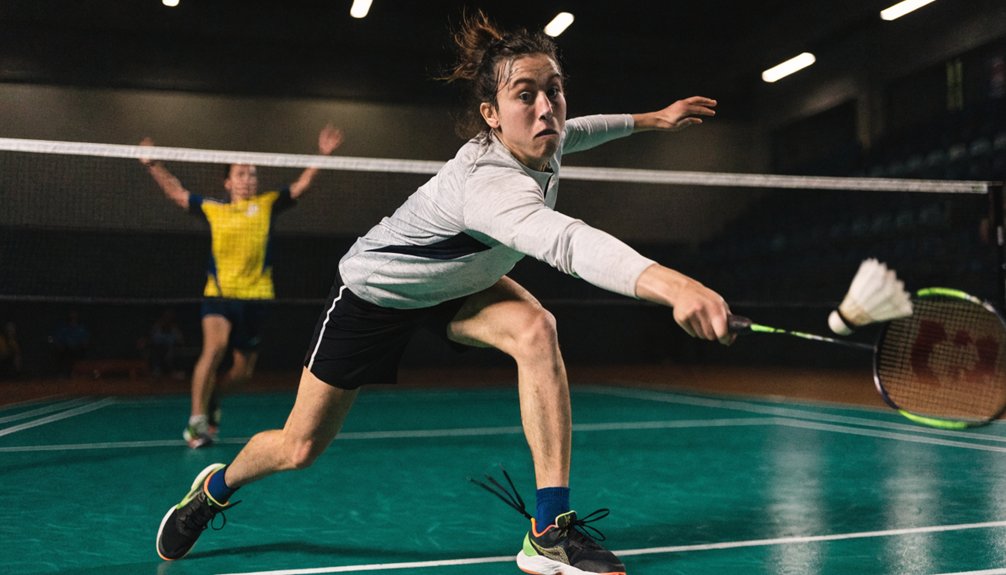
Your badminton defence often collapses not because you’re too slow, but because your stance, grip, and shot choices don’t match the pace and angle of the attack. If your racket isn’t in front, your blocks float, and your drives sit up to be killed. With a lower base, neutral grip, and “soft hands,” you can turn smashes into controlled blocks and counter‑drives. The key is knowing exactly when each option keeps you alive—or puts you in charge.
Key Takeaways
- Stay in a low, athletic stance with a neutral grip so you can react quickly to both forehand and backhand smashes.
- Use “soft hands” on blocks: relax your fingers, meet the shuttle early, and guide it downwards to keep returns below net height.
- For drive defence, stand slightly squarer, keep the racket in front, and use short, compact forearm movements to return shuttles flat and fast.
- Choose blocks for steep smashes and drives for hip‑high attacks, prioritizing control, shuttle height, and placement over power.
- Practise multishuttle block and drive drills with randomized feeds to automate grip changes, timing, and balanced recovery after each shot.
Why Your Badminton Defence Breaks Down
When your badminton defence breaks down, it’s rarely because of a single big mistake; it’s usually a chain of small technical and tactical errors that compound under pressure. You’re often late because you anticipate the wrong angle, read the opponent’s preparation poorly, or commit too early to one side. That delay forces you into reaching swings and off‑balance contact, which kills shuttle control. Under pressure, you also default to “safe” high lifts instead of purposeful blocks and drives, giving attackers another full‑power jump‑smash. Misjudged shuttle height is another cause: you try to drive shuttles that are dipping too low or block ones that are still rising, producing mid‑court sitters. Each of these errors is correctable once you identify its specific pattern. Elite players also know that defensive breakdowns aren’t only technical—opponents can use mind games like shouting, celebration, and deliberate delays to distract you, make you rush decisions, and turn small errors into decisive points.
Core Badminton Defence: Stance, Grip, Ready Position
To stabilise your defence, you need an athletic stance that keeps your hips low, weight on the balls of your feet, and your centre of gravity slightly forward so you can explode equally to forehand or backhand. At the same time, your racket hand should sit in a true neutral grip—thumb and index finger relaxed around the handle’s bevel—so you’re not locked into forehand or backhand and can switch micro-angles instantly. Mastering this neutral grip as a base makes it easier to transition smoothly between different grips during fast defensive rallies. Let’s correct your default posture and grip habits so your “ready position” actually prepares you for fast, late, and deceptive attacks.
Athletic Defensive Stance
Although most players think defence starts with the racket, it actually starts with an athletic stance that lets you explode in any direction without delay. Stand slightly staggered, dominant foot half a step back, feet just wider than shoulder‑width. Distribute weight through the balls of your feet, heels light, so you can push off instantly.
Bend your knees so your hips sit just above knee level, not upright and not a deep squat. Keep your torso slightly forward from the hips, chest open, back neutral, eyes level. This aligns your centre of mass for lateral and diagonal pushes.
Correct common faults: feet too narrow (you’ll tip), weight on heels (you’ll react late), or standing tall (you’ll lose stability and reach).
Neutral Grip Readiness
Your stance sets your base, but your grip decides whether that base turns into an effective block, drive, or counter‑attack. Neutral grip readiness means you’re pre‑set to rotate slightly toward forehand or backhand without re‑gripping. Hold the handle closer to your fingers, not deep in the palm, with a relaxed “C” shape so you can tighten on impact.
| Key Element | Correct Cue | Common Fault to Fix |
|---|---|---|
| Hand Position | Thumb resting lightly on bevel edge | Thumb flat (too backhand‑biased) |
| Finger Spacing | Small gaps, index slightly higher | All fingers glued, no control |
| Wrist Angle | Neutral, racquet head slightly forward | Dropped racquet, wrist collapsed |
| Tension Level | 3/10 relaxed, squeeze only on contact | Constant tight grip, slow reactions |
Drill by shadowing blocks/drives, checking you’re not shifting to full forehand or backhand too early.


Defensive Blocks in Badminton: Soft Hands Under Pressure
When a smash is coming at your body or racket side, a defensive block with “soft hands” lets you absorb the shuttle’s pace and redirect it with control instead of just sticking your racket out and hoping it goes back. Hold a neutral grip, but relax your fingers so the racket can yield slightly on impact. Your mistake is often gripping too tight, causing the shuttle to pop up. Set the racket face slightly open, in front of your body, with a compact forearm motion and minimal backswing. Meet the shuttle early, close to the tape height, and guide it downwards to the net, not upwards. Aim for tight, slow blocks that force your opponent to move forward, breaking their attacking rhythm and buying you recovery time. Developing consistent soft blocks also helps you find the sweet spot more often, giving you better control and reducing mishits under pressure.
Drive Defence in Badminton: Turn Defence Into Attack
Soft blocks are great for neutralising heavy smashes, but you also need a drive defence that sends the shuttle back fast and flat, putting the attacker under pressure. For drive defence, stand slightly more square, racket hip a fraction forward, and hold your racket in front of your body line. Use a compact preparation: elbow in front, racket head around net height, neutral grip you can rotate slightly forehand or backhand. Contact the shuttle early, in front of your hip, with a short forearm pronation/supination rather than a big swing. Aim flat and fast to the opponent’s racket shoulder or non-racket hip. Avoid lifting your elbow, slicing, or following through too long; those errors slow the shuttle and open space. Choosing a racket with a suitable weight distribution and grip size can make it easier to control your drive defence under pressure.
Badminton Defensive Shot Selection: Block, Drive, or Lift?
Your defensive shot selection starts with reading the attacker’s base position, racket preparation, and body rotation so you can predict whether the next space they’ll cover best punishes a block, drive, or lift. You then choose the safest reply by prioritising shuttle height, length, and width control so you don’t leave an open channel for their straight kill or midcourt intercept. From there, you correct your instinct to just “put it back” and instead use angle, pace, and placement to turn defence into a controlled counter-attack whenever their recovery is late or their balance is compromised. In these situations, pairing smart shot selection with an appropriate racket weight and balance can improve both defensive stability and the power of your counterattacks.
Reading Opponent’s Position
Although defence often feels reactive, high‑level players build it on anticipation by constantly reading the attacker’s position before choosing to block, drive, or lift. You’re not just reacting to the shuttle; you’re decoding the striker’s posture, spacing, and recovery options.
Key cues to read:
- Base position and spacing – If your opponent lands close to their rear corners, they’re slower to forward shots; blocks exploit this. If they recover centrally and high, they’re ready to intercept drives.
- Shoulder and racket orientation – A closed shoulder limits straight‑line coverage; pushes and drives past the racket shoulder become stronger. An open stance covers the straight channel but exposes cross‑court.
- Weight transfer and recovery momentum – If they’re falling backward, expect weaker follow‑up coverage; if they’re already stepping in, fast counter‑drives are riskier.
Choosing The Safest Reply
Once you can read the attacker’s position, the next edge comes from mapping those cues to the safest defensive reply: block, drive, or lift. Your default should be: block when the smash is steep and the attacker’s base is tight to the net; drive when the shuttle is hip‑high and the attacker’s base is slightly back; lift when you’re late or forced wide.
Prioritise shuttle control over ambition. If the smash lands below net height, stop forcing flat drives; you’ll just pop the shuttle up. When you’re off‑balance, lift high and deep to the opponent’s weaker overhead. When blocking, aim tight and slightly cross to pull them off their base. Only drive when you’ve got a stable stance and can keep the shuttle below tape height.
Turning Defence Into Attack
When you’ve stabilised your basic defence, the next upgrade is learning how to convert a “survival” block, drive, or lift into a momentum‑shifting counterattack. The key is recognising when the attacker’s quality drops: slower smash, poor base recovery, or contact behind their body. Your goal isn’t just returning, it’s taking the initiative with controlled precision.
- Read contact quality: if their smash is late or off‑balance, angle your block tighter or punch‑block at their non‑racket shoulder to force a lift.
- Use drives selectively: drive flat only when you’re balanced and can target hips/elbow, otherwise you’ll feed their counter.
- Turn lifts into traps: lift high and cross only when you’ve recovered base and bait a predictable, weaker follow‑up.
Drills to Automate Your Defensive Blocks and Drives
Build automatic, reliable defence by drilling blocks and drives until your responses become reflexive, not conscious. Start with multishuttle block feeds: your feeder smashes alternately to forehand and backhand; you focus on split step timing, compact grip change, and meeting the shuttle in front of your body with a slightly open racket face. Track whether your recovery step finishes before the next shuttle’s hit. Practicing these drills across the full badminton court dimensions helps you learn defensive spacing and movement that transfer directly to real match play.
Next, run drive–defence patterns. Your partner drives flat to your mid‑court, then suddenly smashes; you must read the cue, switch from panhandle to bevel grip, and keep blocks below tape height.
Finish with randomised “chaos” drills mixing smashes, half‑smashes, and drives. Prioritise staying side‑on, low, and balanced, never drifting upright after contact.