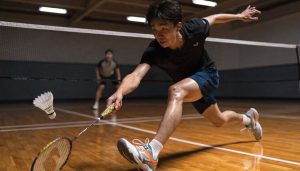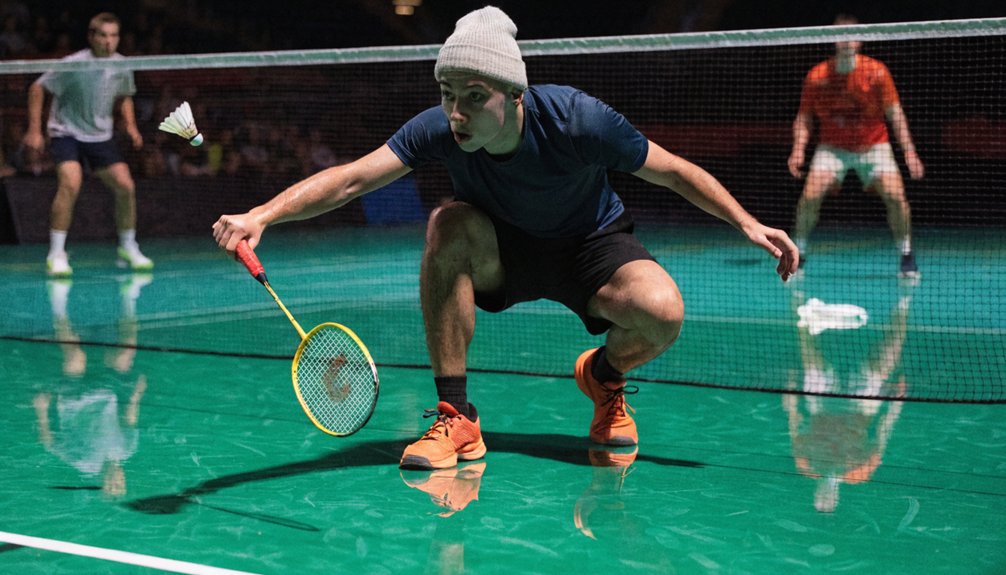
Studies suggest over 80% of amateur badminton players tighten up and change their technique in the last five points of a game. You’ve likely felt your grip stiffen, your footwork slow, and your shot selection become reactive instead of planned. Staying calm isn’t about “relaxing,” it’s about running a clear mental and tactical system under pressure. Once you understand how to control that system, those final points start to look very different…
Key Takeaways
- Treat pressure as normal competition stress; train regularly in “pressure blocks” so your nervous system learns to perform reliably in tight-score situations.
- Detach from the score and focus on controllables: shuttle quality, positioning, and clear tactical intent for the next rally.
- Trust your training and avoid overthinking technique; use simple cue words to trigger your automatic, practiced movement and shot patterns.
- Standardize a between-rally ritual with breathing, grip check, and stance reset to lower heart rate and refocus attention.
- On game points, simplify tactics to high-percentage shots, commit fully to your decision, and use rehearsed routines for serving and receiving.
Why Tight Badminton Points Feel So Stressful
When the score’s tight in badminton, your stress spikes because your brain interprets each rally as a high-stakes threat to status, effort invested, and expectations. Your nervous system shifts into a “threat” mode: heart rate rises, breathing shortens, and fine-motor control degrades, which undermines delicate shots like net kills and tight drop placements. You also experience cognitive overload. You’re tracking score, patterns, opponent tendencies, your tactical plan, and your own fatigue. Under pressure, your brain prioritizes loss-avoidance over ideal decision-making, so you default to safe, predictable shots or reckless winners instead of executing percentage plays. Social evaluation intensifies this. You anticipate judgment from coaches, partners, or teammates, so one rally feels like a verdict on your entire ability. On top of this, opponents may ramp up mind games and psychological tactics—like loud celebrations or deliberate delays—to hijack your focus and push your stress response even higher in these tight moments.
Build a Calm Badminton Mindset Under Pressure
To build a genuinely calm mindset under pressure, you must first normalize tight situations as a standard part of competitive badminton rather than a threat. Instead of letting the score dictate your emotions and shot selection, you’ll learn to detach from the scoreboard and anchor your focus to the current rally and tactical plan. From there, you’ll stabilize your confidence by trusting your training, relying on rehearsed patterns and automatic skills rather than improvising from a place of panic.
Normalize Pressure Moments
Although pressure feels like something to escape, it’s actually a performance condition you must normalize if you want a calm badminton mindset. You don’t eliminate pressure; you train your nervous system to operate reliably inside it. Treat tight points as standard operating environments, not exceptional crises.
Use this simple framework:
| Situation Type | Target Response Pattern | Training Method |
|---|---|---|
| Game Point | Short exhale, set play, commit swing | Serve+1 or receive+1 rehearsed patterns |
| Rally Pressure | Early prep, neutral contact, reset | Multi‑shuttle under time constraints |
| Momentum Shift | Slower routines, clear decisions | Simulated “mini-matches” in practice |
In practice, deliberately create “pressure blocks”: start at 18–18, race to 3 points, repeat. Log your heart rate, errors, and decisions to make pressure feel measurable, expected, and controllable.
Detach From Scoreboard
Instead of obsessing over the score, you need to treat it as just another data point, not a verdict on your ability or the outcome. When you stare at the numbers, your nervous system upshifts: heart rate climbs, decision speed drops, errors spike.
Detach by shifting your primary focus to controllable variables: shuttle quality, base position, strike timing, and tactical intent on the next rally. Use the score only to inform macro decisions—serve type, return risk level, or when to apply tactical pressure—not your emotional state.


After every rally, run a quick mental protocol: breathe, note the score once, then instantly translate it into a simple objective such as, “solid first shot, win the attack,” and lock onto that execution.
Trust Your Training
Anchor your composure by treating pressure as the moment your training is supposed to run, not the moment you start inventing new solutions. Under stress, your brain wants to override engrained motor patterns with conscious micromanagement. That’s when timing breaks down, grips tighten, and decision speed collapses.
Instead, give yourself a clear command: “Run the system.” That means defaulting to the footwork patterns, shot sequences, and serve routines you’ve rehearsed. You’re not trying to be creative; you’re executing a pre-tested algorithm.
Before service, recall one specific training cue: split early, hit in front, recover to base. During rallies, evaluate success by execution quality, not outcome. When you trust the process, your nervous system stabilizes and your game holds under pressure.
Smart Shot Choices Under Pressure in Tight Games
In tight moments, you stabilize your game by prioritizing high-percentage shots instead of forcing spectacular winners. You choose trajectories and placements with low error probability—deep clears, solid blocks, and controlled drops—then repeatedly direct them toward your opponent’s technical or movement weak zones. By trusting your training and consistently aiming for the Sweet Spot on your racket, you maintain power and control without overhitting, which keeps your execution reliable when the score is tight.
Prioritize High-Percentage Shots
Although the scoreboard and crowd can tempt you into forcing winners, tight games demand that you prioritize high-percentage shots that you can execute reliably under pressure. Your goal isn’t to hit the most spectacular stroke; it’s to choose patterns with low error probability and stable mechanics.
Default to shots you’ve automated through training: deep clears, fast flat drives, tight but safe net shots, and body-directed smashes. Under stress, shorten your swing, reduce deception, and favor trajectories that give you margin above the tape and inside the lines. Avoid over-rotating for full-power smashes or ultra-fine net kills unless they’re clearly on. By repeatedly selecting these conservative, repeatable options, you stabilize rally length, reduce unforced errors, and give your decision-making a calmer, more objective foundation.
Target Opponent’s Weak Zones
Rather than spraying “safe” shots to generic areas, you’ll stay calmer in tight moments by systematically attacking your opponent’s weakest zones and patterns. Before the end-game, observe: slow backhand corner, late recovery after deep clears, poor forehand net, or hesitation on body smashes.
Under pressure, narrow your decision tree: 1–2 primary targets, plus 1 backup. For example: deep clear to backhand rear court, then fast push to open forecourt. Repeat this sequence until they adjust.
Use simple cues to execute: “backhand rear,” “body smash,” “front backhand.” Calling the target in your mind reduces panic-driven improvisation. When you know where you’re going before you hit, you free mental bandwidth, stabilize nerves, and convert tight points with disciplined, repeatable patterns.
Breathing Routines to Reset Between Points
Because rallies in badminton are short and intense, a precise breathing routine between points becomes a critical tool for stabilizing heart rate, sharpening focus, and clearing tactical noise. Your goal isn’t relaxation; it’s controlled arousal at an ideal competitive level.
As soon as a rally ends, turn away from the net and execute a fixed pattern: inhale through the nose for four counts, hold for two, exhale through the mouth for six. The longer exhale activates parasympathetic response, reducing excess tension while keeping you alert. Synchronize this with a brief internal cue: on the inhale, register the score and game situation; on the exhale, release the previous rally’s outcome. Repeat for 1–3 cycles so each new point starts with a reset physiological and mental baseline.
Simple On-Court Rituals to Stay Calm
Use compact, time‑bounded rituals between rallies:
- Face the back court, smooth strings, adjust grip.
- Step to your towel mark, wipe, then re‑set stance.
- Bounce on your toes twice, exhale, call your next shot pattern.
These micro‑sequences should be identical regardless of score. Developing calm, consistent routines around a quick grip check also reinforces your ability to adjust grips efficiently under pressure.
| Ritual Element | Purpose | Duration |
|---|---|---|
| Grip check | Reinforce tactile control | 2–3 sec |
| String alignment | Visual focus cue | 2 sec |
| Deep exhale | Lower heart rate, relax shoulders | 3 sec |
| Stance reset | Restore base position | 2 sec |
| Cue word (“sharp”) | Prime aggressive, clear intent | 1 sec |
Handle Game-Point Nerves and Close the Match
Once your between-rally ritual is automatic, you can apply the same structure to the highest-pressure moments: game points and match points. First, standardize your sequence: breath, cue word, tactical decision, serve/receive routine. Don’t improvise; rely on rehearsed patterns so your body executes while your mind stays narrow and task-focused.
On game point, simplify your tactics. Choose your highest-percentage patterns: safest serve target, most reliable return, and your best two-shot follow-up. Commit fully; hesitation creates loose shots and late preparation. Watching how top players perform under pressure in BWF World Tour finals can give you concrete models of simple, high-percentage patterns to copy.
Control attentional focus. Before the point, zoom out: score, opponent’s tendencies, wind or drift. As you step to position, zoom in: shuttle, contact point, first two steps. Treat game point as “just this rally,” not a verdict on your ability.
Practice Drills to Stay Calm in Tight Badminton Games
When you want your composure to hold under real pressure, you’ve got to rehearse those stress responses in a controlled way, not just hope they appear in matches. Design drills that elevate heart rate, constrain time, and simulate score pressure while forcing you to execute precise patterns. Integrate grip awareness into these drills by consciously switching between the forehand grip and backhand grip, so your hand position stays automatic even under stress.
Use specific protocols:
- Multi‑shuttle defense: 30–45 seconds of continuous smashes, focusing on exhale timing and compact swings.
- “Game‑point” serves: start every rally at 19–19; call the score out loud and run your full serve routine.
- Pressure combinations: set targets, e.g., 8/10 net kills; restart if you drop below.
- Fatigue rallies: shadow‑footwork intervals followed immediately by accuracy hitting, training decisions under exhaustion.
Always pair each drill with a fixed breathing cue and a concise tactical reminder.