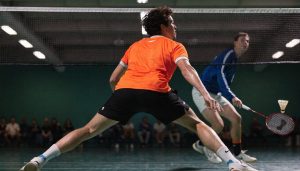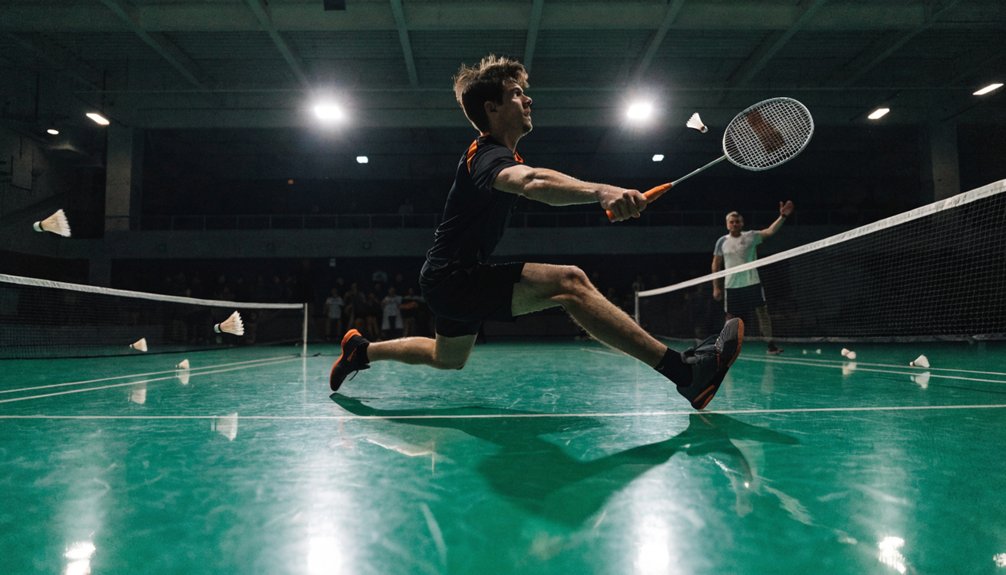
If you keep getting pinned in the rear corners, you’re not just “slow,” you’re likely mismanaging base position, shot selection, and recovery patterns. Your first fix isn’t power, it’s a neutral, explosive ready stance and smarter use of height and depth to reset rallies. Then you’ll refine how you pivot out of corners and choose shots that stop opponents hunting your backcourt… but that starts with one key adjustment you might be ignoring.
Key Takeaways
- Use high, deep, and safe clears from the rear corners to reset the rally instead of forcing risky smashes or fast drops.
- Maintain a neutral, balanced ready position and adjust your court base based on shuttle height and opponent’s position.
- Standardize rear-court footwork: efficient crossover steps back, then recover on a curved line to a slightly forward-central base.
- Prioritize neutral, low-risk patterns like straight clears and controlled slower drops, especially when under pressure in the corners.
- Train with multi-feed and shadow footwork drills emphasizing split-step timing, explosive first step, and re-centering before the opponent strikes.
Quick Fixes to Stop Getting Trapped in Rear Corners
When you’re repeatedly getting stuck in the rear corners, your first priority is to simplify your responses and buy time with high, deep, and safe clearances that reset the rally. Prioritize height over pace, sending the shuttle above your opponent’s striking zone and well inside both sidelines.
Next, standardize your recovery footwork pattern. After each rear-court stroke, immediately push off the outside leg, execute a decisive chasse or crossover, and get back toward the center before watching your shot.
Use neutral, low-risk patterns: straight clears from wide positions and cross-court only when fully balanced. Under pressure, default to deep clears, not ambitious smashes or tight drops. Your short-term goal is to neutralize the rally, reduce corner exposure, and force the opponent to create the next opening. A lightweight racket with an even-balance setup can make it easier to accelerate out of those deep corners and recover to base without overloading your arm.
Fix Your Ready Position and Court Base
To stop getting pinned in the rear corners, you’ll need a neutral stance that keeps your center of mass stable yet primed for explosive movement in any direction. From there, you’ll adjust your court base dynamically based on shuttle height, opponent’s position, and the patterns you’ve already forced. Finally, you’ll learn to read your opponent’s contact so you’re shifting your base and loading your legs a fraction of a second before the shuttle even leaves their strings.
Ideal Neutral Stance
Although players often obsess over strokes and footwork patterns, your neutral stance—both your ready position and your court base—is the foundation that keeps you from getting pinned in the rear corners. Think of it as your “default blueprint” between shots.
Stand slightly staggered, feet just wider than shoulder-width, weight on the balls of your feet, heels light. Keep your hips and shoulders square to the shuttle, knees flexed, and your center of gravity low but dynamic, ready to spring in any direction.
Hold your racket high in front of your body, elbow relaxed, with the head around chest height, prepared to shift instantly between forehand and backhand. Your eyes stay level, tracking the opponent’s preparation, not the shuttle’s last bounce.


Adjusting Your Base
Instead of treating your neutral stance as fixed, you should constantly adjust your court base based on the shuttle’s location, your shot quality, and your opponent’s options. After any rear-court shot, don’t drift back to center blindly; shift your base slightly toward the side you exposed less. If you played a deep, high clear, recover closer to true center. If your shot was shorter or weaker, bias your base a half-step toward the most dangerous open space.
Use the tramlines and service lines as reference points. After straight shots, recover along the same line, then re-center. After cross-court shots, recover diagonally to a base that still protects the opposite rear corner. Maintain your neutral stance angles while you slide this base dynamically.
Reading Opponent’s Contact
Once your base is adjusting dynamically, the next upgrade is reading the opponent’s contact so your feet move before the shuttle leaves their strings. Lock your eyes on the racket–shuttle interaction, not the shuttle’s flight. Track three cues: racket preparation, swing path, and contact point height.
From your base, hold a neutral split step just as they start their forward swing. If the racket face opens under the shuttle, load for rear-court movement; if it closes or chops, prepare for downward or fast shots. A higher contact point usually means steeper angles; lower contact, more lifts or clears.
Train this by shadowing: call the likely shot before contact, then move immediately, refining your first step direction.
Sharpen Your Rear-Court Footwork and Recovery
Exploit precise rear-court footwork to prevent getting pinned in the corners and to accelerate your recovery to base. You’re aiming for minimum steps, controlled balance, and a consistent recovery path. From base, pivot your hips first, then initiate a powerful first step with the outside leg, keeping your center of gravity low and knees flexed. Incorporating aerodynamic rackets can further increase shot speed and give you extra time to recover from deep corners.
Use split-step timing so both feet land as your opponent strikes, then explode toward the shuttle. Land the lunge heel–toe, with the front knee tracking over the toes, then push explosively off the back leg to return to base on a curved recovery line, not straight.
| Focus Element | Key Technical Cue |
|---|---|
| Split-step | Land on balls of feet, neutral stance |
| First step | Drive off inside edge of push-off foot |
| Lunge | Long, low, stable, chest upright |
| Recovery | Pivot hips first, then shuffle back |
Smart Defensive Shots From the Rear Corners
Shift your focus from simply reaching the shuttle to choosing defensive shots that neutralize pressure and buy you time to recover from the rear corners. From both backhand and forehand sides, your primary options are high clears and controlled, slower drops that land safely. Prioritize a high, deep clear crosscourt when you’re off-balance; it increases shuttle flight time and pulls the opponent away from the center. Use a straight clear when you’re late but stable, minimizing angle exposure. When clearing isn’t possible, play a soft, tight defensive drop with higher trajectory, emphasizing height over disguise. Contact the shuttle slightly in front of your body, with a relaxed grip and compact swing, to maintain control and reduce mishits under heavy pressure. Staying calm and committing to these shot choices also helps you resist common mind games that aim to rush your decisions in the rear court.
Neutralizing and Attacking Shots to Escape Pressure
From the rear corners, you don’t just want to survive—you want to use neutral lifts and clears to break your opponent’s rhythm and regain positional balance. When their base or preparation is weak, you’ll counter‑attack from the corners with fast, directed shots that immediately put them under pressure. And when the rally tempo is too high, you’ll reset with soft shots that land tight and low, forcing them to lift and handing you the attack. By focusing on hitting the Sweet Spot cleanly under pressure, you’ll gain both power and control to escape the rear corners more effectively.
Neutral Lifts And Clears
When you’re trapped deep in a corner, neutral lifts and clears let you reset the rally or seize initiative instead of just “getting it back.” A neutral lift is a high, deep shot that removes your opponent’s immediate attacking options and buys you time to recover to base; a more aggressive clear uses height, length, and angle to push them off balance or force them late behind the shuttle.
Technically, focus on contact point and trajectory. Hit the shuttle slightly in front of your body, with a relaxed but accelerating forearm and full follow-through. Prioritize height first, then length. Aim 0.5–1 racket-length inside the rear tramlines for safety under pressure. When you’ve more time, flatten the trajectory slightly and target corners to stretch your opponent’s base.
Counter-Attacking From Corners
Neutral lifts and clears give you breathing room, but the next level is turning that defensive corner into a launchpad for counter-attack. From the rear court, your goal is to strike early, use the shuttle’s height, and drive it through space your opponent’s just vacated. You’re not just surviving; you’re flipping initiative.
| Situation | Counter-attacking response |
|---|---|
| Opponent over-commits forward | Fast, flat lift or punch clear to opposite rear corner |
| Opponent recovers centrally | Steep, fast drop to sidelines to pull them wide |
| Opponent shifts to your corner | Cross-court clear using full rotation and pronation |
Technically, load on your outside leg, rotate hips, contact slightly in front, and keep a compact swing. Strategically, choose the line that maximizes their movement and denies easy interception.
Resetting With Soft Shots
Although blasting your way out of the corner is tempting, you’ll escape pressure more reliably by learning to reset with soft, controlled shots that disrupt your opponent’s rhythm without gifting them an easy kill. Prioritize height, depth, and spin over pace. Open the racket face, relax your grip, and play a high, slow lift that peaks above your opponent’s contact point, forcing them to hit while moving back.
Use neutralizing shots—high cross-court clears, soft blocks, and slice drops—to steal time to recover to base. Aim cross-court from wide positions; the extra distance increases your margin and pulls them off balance. When they’re off the T, step forward aggressively, ready to convert the reset into the next attacking opportunity.
Match Tactics to Stop Opponents Targeting Your Rear Corners
Instead of simply trying to retrieve every deep shuttle, you need match tactics that proactively deny your opponent clean access to your rear corners. First, bias rallies toward their backhand: fast, flat clears and half-smashes to that side reduce their ability to angle you off court. Second, vary length and trajectory so they can’t pre-position for punch clears. Mastering the badminton service rules helps you start rallies in patterns that limit how effectively opponents can attack your rear corners.
| Tactical Focus | Practical Application |
|---|---|
| Serve & return | Use tight, low serves; push aggressively to rear backhand. |
| Rally direction | Play 2–3 shots in one channel, then fast cross. |
| Tempo control | Alternate slow, high clears with sudden flat pressure. |
| Net dominance | Spin net shots to force predictably shorter lifts. |
| Positional base | Recover slightly forward–central, not deep–central. |
Drills to Stop Getting Stuck in the Rear Corners
Build specific drills that hard-wire the footwork, anticipation, and shot patterns you need to escape rear-court pressure instead of just “running more.” In this section, you’ll use structured patterns—multi-shuttle, shadow footwork, and constrained sparring—to rehearse fast split-steps, efficient crossover/China jump mechanics, and immediate counter-attacking replies from both rear corners. Choosing a racket with suitable maneuverability and stability can further support these rear-court escape drills by improving control under pressure.
Run a 6–8 shuttle multi-feed: deep clear, deep clear, then a sudden fast drop to force recovery and re-acceleration. Shadow 10 reps each side with strict timing: split-step on an imaginary opponent’s contact, then explosive crossover and balanced landing.
Use constrained sparring where you must:
- turn defense into attack within 2 shots
- never play two clears in a row
- hit every smash to lines
- re-center before opponent hits
- call your escape pattern aloud before moving