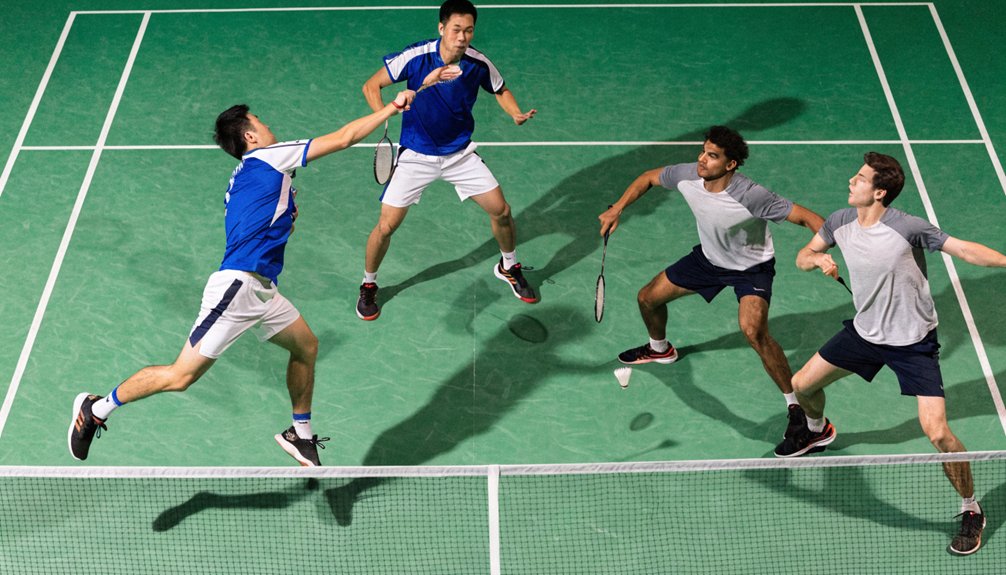
Like two gears in a watch, if you and your partner don’t rotate cleanly in doubles, the whole mechanism jams. You’ll cut down on confusion by knowing exactly who attacks, who covers, and how you both shift after every serve, return, and lift. When your spacing, footwork paths, and verbal cues line up, shots feel easier and rallies stay under control. The key is learning simple, repeatable patterns that you can apply under pressure.
Key Takeaways
- Clearly define roles each rally: rear player attacks from the back, front player controls the net, and adjust only when the shuttle’s direction forces it.
- Use simple rules: move side‑by‑side after any upward shot, front‑back after any strong downward shot, and avoid crossing unless the shuttle passes mid‑court.
- Communicate every change with short calls like “up,” “down,” “switch,” or “stay” before or as you hit, so both players rotate together.
- Maintain staggered spacing, never standing in one line; give each player a “lane” to prevent collisions and confusion over who takes which shuttle.
- Practice structured rotation drills (serve–attack–cover, side‑side to front‑back on lifts, shadow movements) to make positioning automatic under pressure.
Badminton Doubles Rotation Basics
When you play doubles, rotation is simply how you and your partner change roles and positions so there’s always one player pressuring the shuttle and one supporting. You’re not just switching sides randomly; you’re reacting to where you hit and where the shuttle will travel next.
First, define roles: attacker (front or mid-court, looking to intercept) and cover player (slightly deeper, securing rear-court and gaps). After you hit, ask: “Am I the dangerous one, or is my partner?” If you’ve played a steep, threatening shot, move forward and occupy attacking space. If you’ve lifted or cleared, recover backward and protect the rear.
Keep your spacing staggered, avoid standing level, and always leave clear lanes for each other’s movement.
Serve Rotation: Who Takes Which Shots
Rotation isn’t just for rallies; it starts the moment the serve is hit, and the pair that understands “who owns what” on every serve wins a lot of cheap points. First, agree that the server always owns the front half on their serving side and any straight reply. The partner owns the rear court and all cross-court replies. Building this understanding on solid basic grips helps both players react quickly and hit the right shot from their assigned area.
When you’re serving, lean slightly forward, racket up, ready to pounce on tight returns: net kill, net lift, or straight push. Don’t chase crosses behind you; trust your partner. As the non-server, stand staggered: half-step back, body square, racket up. You take smashes, drops, and clears from both mid and rear court, prioritizing the cross side. Communicate this division before every service run.
Return Rotation: Where to Move After the Return
After you return serve, your first priority is to recover into a compact side‑by‑side stance that keeps both you and your partner balanced and inside the sidelines, with your racket up and feet light. From there, you’ll read the quality and height of your return and the opponent’s preparation to decide whether you should stay flat or quickly slide into a front‑back formation. You’ll need clear cues—such as a weak lift you create or a forced block from the opponents—to know who steps forward to pressure the net and who drops a half‑step to protect the rear court. Smart rotation also depends on having quick reflexes so you can react instantly to fast drives and smashes in doubles exchanges.
Prioritizing Side-By-Side Recovery
Instead of ball-watching your return, you should treat the split-second after you hit as a trigger to recover side‑by‑side and re-balance the court. Your default is parallel coverage unless the rally clearly forces something else. That means you and your partner aim to stand roughly level, each owning a half-court channel.


To make this automatic, lock in these habits:
- Land forward, push back: As your return stroke finishes, use your landing step to push off and shuffle into your side-by-side zone.
- Check partner’s line: Glance quickly; mirror their depth so no central gap appears.
- Use a small split-step: Time it with the opponent’s hit to stabilize and react both sides.
- Guard straight first: Prioritize your straight sideline, then help on midcourt.
Transitioning Into Front-Back
Although side‑by‑side is your default recovery, you should immediately assess whether your return’s quality earns an attacking front‑back shape: if you’ve driven or pushed down at their feet, forced them to lift under pressure, or jammed their body with a fast, flat reply, you should close forward and claim the net while your partner slides slightly back and central to guard lifts and drives.
Your first step is always toward balance: land the return, then explode one step forward with your racket up, elbow in front, ready to pounce on any loose reply. Don’t over‑close; stay about a racket length from the service line so you can cut off both cross and straight blocks. Communicate early—call “up” or “back”—so your partner adjusts instantly.
Simple Positions for Attack, Defense, and Neutral
Now you’ll lock in three simple formations: a clear front-back shape when you’re attacking, a solid side-side wall when you’re defending, and a neutral stance that lets you switch between them instantly. In attack, you’ll learn exactly how far the rear player should stand behind the midline and how close the front player should guard the tape to convert half lifts. In defense, you’ll position both players just behind the service line, offset from center, so you can take smashes early while still covering pushes and drops. To make these formations even more effective, choose a racket with the right racket balance and weight for your level so your swings stay quick and controlled during fast doubles exchanges.
Clear Front-Back Attack
When your pair’s attacking pattern is clearly front–back, you should lock into three simple reference positions: an attacking shape, a defensive shape, and a neutral shape that you can switch from instantly. In clear front–back attack, you’re trying to “pin” opponents with steep hits and fast placement, then keep pressure through disciplined spacing.
Use these four cues:
- Rear player stays just behind the shuttle, split-stepping after each hit, not drifting too deep.
- Front player stands just behind the service line, racket up, covering net kills and mid-court blocks.
- If the shuttle lifts high, rear player centers slightly; front player narrows, ready for smashes or drops.
- After any soft shot you play, both of you recover toward neutral base positions, never watching your shot.
Solid Side-Side Defense
Solid side-side defense is your doubles safety net for surviving smashes and turning defense into attack with one clean counter. Stand roughly one step behind your service line, shoulder-width or slightly wider, and keep your partner matched on the opposite half. Your outside foot stays a bit back, knees flexed, racket up at chest height, slightly in front of your body.
You cover your straight side and midline; your partner mirrors you. Move with small split steps on every opponent hit, then push off explosively toward the shuttle. Prioritize blocking smashes downward to midcourt, straight or cross, forcing the attacker to lift. When a lift appears, instantly call “front-back,” with the blocker moving forward and the partner rotating behind to attack.
How to Rotate Between Front–Back and Side–Side
To rotate cleanly, lock in these rules:
- When you or your partner hit up, both recover to side–side: split step on your own half, racket up, ready for smashes.
- When you or your partner hit down, the striker moves forward, the non-striker shifts back to cover both rearcorners.
- If you’re late, don’t go forward; stay side–side until you regain control.
- Call “up” or “down” as you hit to synchronize the rotation instantly.
Using the correct forehand grip and backhand grip helps you maintain control and power during these quick rotational changes.
Switching Sides in Doubles Rotation Without Collisions
Although front–back and side–side rotations give you structure, you still need clear rules for swapping left–right sides so you don’t run into each other mid-rally. First, agree that the player moving forward always has right-of-way; the retreating player must open their body and rotate behind. When you’re crossing, take a curved path that goes slightly backward, not a straight line at the net.
Use clear triggers: switch sides when you or your partner are forced wide and play a high, defensive shot crosscourt, or when a drive exchange pulls you sharply off your lane. As you start switching, call “mine” or “switch” early. Keep your racket up, eyes forward, and feet small and fast so you can adjust mid-move.
Common Doubles Rotation Mistakes and Quick Fixes
When rallies speed up, most doubles rotation errors come from late decisions and vague roles, not lack of effort. You fix them by tying your movement to clear shuttle cues and court zones, not guesswork. After you hit, instantly “lock in” where you must recover: straight or cross, front or rear.
Four frequent mistakes and fast technical fixes:
- Both stay back after lifting: Rear player hits, then recovers half‑step forward; partner retreats into the opposite rear corner.
- Both rush the net on a weak block: Only the hitter follows in; partner holds rear base.
- Crossing on every drive: Only switch if your shot goes past mid‑court.
- Static bases: Adjust two quick shuffle steps after each opponent’s contact. For more examples of how top pairs apply these patterns under pressure, study doubles matches from the BWF World Tour where rotation and roles are especially clear.
Communication Tips to Stay in Sync in Doubles
Even with perfect footwork and tactics, your doubles rotation breaks down fast if you and your partner don’t communicate in real time and in simple, agreed terms. First, define clear code words: “mine,” “yours,” “switch,” “stay,” “up,” “back,” “left,” “right.” Say them early, not as you hit. For example, call “switch” as you’re moving, so your partner can rotate, not react late.
Use role calls in each rally: rear player leads attack calls (“down,” “follow,” “cross”), front player leads defense and block calls (“net,” “push,” “leave”). Keep your voice short, firm, and consistent. Add non-verbal cues: racket up at the net signals you’re covering forecourt; stepping wider signals you’re taking the round-the-head side.
Easy Practice Drills to Master Doubles Rotation
Three simple, structured drills will hard-wire your doubles rotation so it becomes automatic under pressure. First, run a “serve–attack–cover” pattern: you serve, your partner intercepts the third shot, you instantly drop to mid-court, then recover to base. Focus on split-stepping as your partner hits.
Use these four core drills each session:
- Front–back rotation rally: one always attacking, one always covering rear; rotate only when a clear is forced.
- Side–side to front–back switch: start defensive, then on any lift, front player sprints forward, rear player slides back.
- Three-shot rotation: after every third stroke, you must change formation.
- Shadow rotation: no shuttle; call “lift,” “drop,” “drive,” and move instantly to correct zones.