Like a chess player guarding the center, you need disciplined net positioning in doubles if you don’t want to get picked off. You’ll align your inside foot near the singles sideline, shade toward the ball, and adjust your distance based on pace and height. You’ll also sync movement with your partner, protect against lobs, and choose smarter targets. Once you understand how to blend these elements, every point at net starts to look very different…
Key Takeaways
- Stand halfway between the net and service line, inside foot on the singles sideline, prioritizing middle coverage over extreme angles.
- Use a constant split-step and small adjustments, shading toward the ball without fully mirroring your partner’s position.
- Read ball speed and height: close on slow/high balls, hold neutral, retreat on heavy, low drives or when partner is pulled wide.
- Keep the paddle near net height, chest facing the likely ball path, and aim volleys through the middle or at opponents’ feet.
- Drill poaches, reaction volleys, and constrained games regularly to sharpen first-step speed, anticipation, and confident, decisive net movement.
Stop Getting Picked Off: Core Doubles Net Positioning
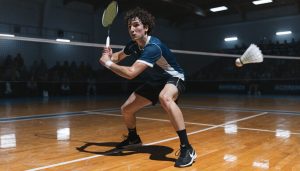
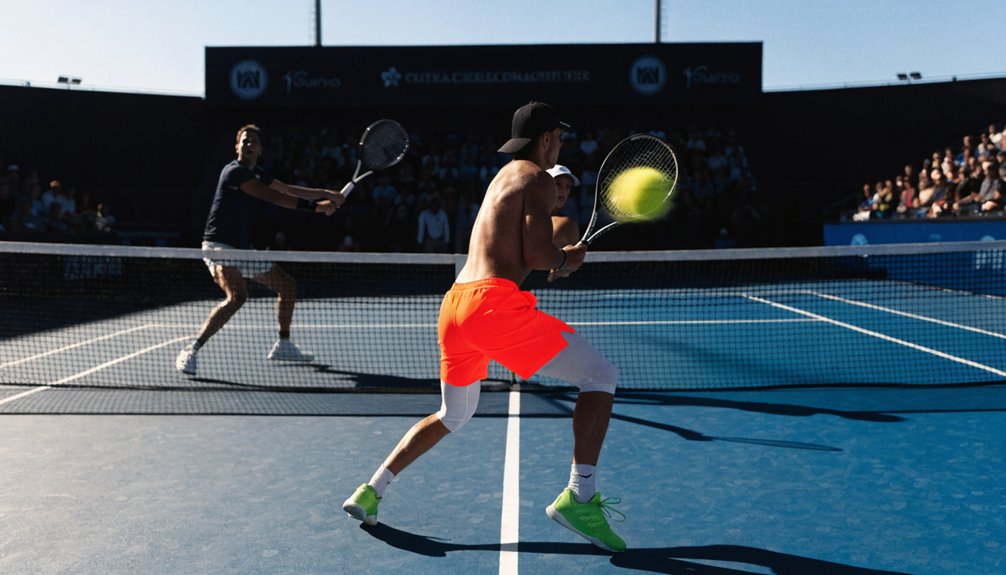
When you’re at the net in doubles, your primary job isn’t just “to volley,” it’s to own the highest‑percentage space without exposing easy lanes. Start by aligning your inside foot roughly on the singles sideline, halfway between service line and net. That lets you cover middle first while still reaching most angle replies. You don’t mirror the ball perfectly; you “shade” toward it. As the ball goes cross‑court, shift one step toward the middle, tightening your volley angles and shrinking the opponent’s safest target. Keep your paddle height near net tape level, slightly in front of your body, with your chest facing through the ball’s likely path, not the sideline. Small, split‑step adjustments prevent over‑committing and keep your center of mass balanced. Just like in badminton doubles, where coordinated strategic positioning lets partners cover both front and back court efficiently, your net stance should complement your partner’s court coverage rather than copy it.
Read the Ball: When to Close, Hold, or Retreat
Although your default goal at net is to move forward and pressure, your exact depth should change with the ball you see: that’s your read. You close when the incoming ball is slow, high, or wide outside the middle corridor, because your opponents’ angles and pace options shrink. Take two to three explosive steps in, expecting a volley above net height. You hold when the ball is neutral: medium pace, good depth, or struck from inside the baseline. Stay in your established attacking position, racquet up, ready for either a dip or a drive. You retreat when you read danger: heavy pace, low trajectory, or your partner pulled off the court. Take quick recovery steps back, prioritizing reaction time and defensive height. At the same time, be aware that your movement and presence at net can act as subtle mind games that pressure opponents into rushed decisions and errors.
Move in Sync With Your Doubles Partner at Net
At net, your first priority is to move as a coordinated unit by shadowing your partner’s position laterally and in depth. You’ll use clear verbal and nonverbal cues to signal shifts and full switches, so neither of you leaves a lane uncovered. This synchronized movement lets you seal the middle together, forcing low-percentage passes and reducing open space.
Shadow Your Partner’s Position
Two net players function best as a single moving unit, and that’s exactly what “shadowing” your partner achieves. You don’t mirror every step, but you track their lateral position and adjust your own by a similar amount. When your partner shifts right, you slide right; when they close the net, you close a step too, keeping angles sealed.
| Situational Cue | Partner’s Move | Your Shadow Response |
|---|---|---|
| Ball pulled wide cross | Slides 2–3 steps wide | Match width, protect middle first |
| Short ball middle | Closes diagonally forward | Close forward, tighten volley gap |
| Defensive lob by you | Retreats to service line | Drop back in parallel, guard angles |
Shadowing eliminates free lanes and presents a unified wall.
Communicate Shift And Switches
Even when your positioning and shadowing are solid, your net game breaks down without clear calls for shifts and switches. You need pre-agreed verbal cues (like “switch,” “through,” “yours”) and hand signals behind the back before each serve or return. Decide who owns which patterns: wide serve vs. body serve, lob vs. driven return, cross vs. line ball.
On reaction balls, your communication must be early and decisive. Call “switch” the instant you’re pulled wide or forced back, so your partner can slide and re-balance the formation. Avoid vague sounds; use short, specific words and repeat if necessary. Between points, quickly debrief: which cues worked, which caused hesitation, what adjustment you’ll use on the next point.


Cover Middle As Unit
While most players obsess over “my side” and “your side,” strong doubles teams treat the middle as shared airspace that both net players control in sync. You and your partner must slide as a connected unit, not as two isolated defenders. As the ball travels crosscourt, you both shift a half-step toward the anticipated contact point, sealing the middle first, alleys second.
Track three cues: ball direction, opponent’s contact point, and your partner’s position. Your split-step timing and recovery angle should mirror your partner’s, keeping racket tips ready to intersect anything driven middle.
- How to read ball trajectory and pre-shift together
- Micro-footwork patterns for synchronized lateral coverage
- Drills to calibrate spacing and identical ready positions
Beat Lobs and Passing Shots Without Backing Off
Attack the net with the mindset that lobs and passing shots are problems to solve, not reasons to retreat. You neutralize them with positioning, cues, and disciplined movement, not fear. First, set your base a step behind the service line, knees flexed, weight forward, so you can explode diagonally—up for the volley or back for the overhead. Read early: a rising, slower swing and open racquet face often signal a lob; a fast, low-to-high drive with closed face signals a pass. On suspected lobs, pivot and sprint with crossover steps while keeping the ball in front of you. On passes, close aggressively, shorten your swing, and volley through the court. Commit decisively; hesitation creates the very openings opponents want. Just like in badminton, where mastering strategic positioning and anticipation lets players cover the court without retreating, you can use smart net positioning in doubles to neutralize both lobs and passes.
Choose High-Percentage Targets From the Net in Doubles
Once you’re holding your ground against lobs and passes, the next edge comes from where you send the ball, not just how cleanly you hit it. From the net, you’re looking for large, stable targets that limit your risk and your opponents’ options. Prioritize hitting through the middle, at feet, or deep to the weaker baseline player, using compact, controlled volleys.
Use these high-percentage targets:
- Middle of the court: shrink angles, create confusion, and keep both opponents pinned behind the ball.
- At the feet of the incoming or closing player: force half-volleys and floating replies you can finish on the next shot.
- Crosscourt deep to the weaker groundstroker: use the longer diagonal for margin and extract short balls.
Poach, Fake, and Apply Pressure in Doubles Net Play
Poach decisively from the net and you turn routine crosscourt rallies into immediate threats. You’re reading three cues: the opponent’s contact point, racquet path, and body alignment. When you see a predictable crosscourt ball, explode diagonally, racquet out front, and cut off angle first, power second. Commit; half-steps get you burned.
Use fake poaches to distort patterns. Take two strong shuffle steps as the opponent prepares, then recover back. Do this early in games so they constantly question the crosscourt. Your goal isn’t constant interceptions; it’s forcing lower-percentage passes.
Apply pressure between points: hold an aggressive position inside the service box, show your racquet, and keep your split-step precisely timed. Make every crosscourt ball feel dangerous, even when you stay. Adopting a relaxed forehand grip at the net helps you react quickly to both flicks and pushes without straining your wrist.
Drills to Train Confident, Aggressive Doubles Net Play
Build your net game with drills that hardwire reading cues, explosive movement, and calm decision-making under pressure. Start with a “3-ball poach series”: feed a neutral ball, then two rapid-fire balls you must intercept, finishing every sequence with a volley target no larger than a service box corner. Emphasize split-step timing and first-step speed.
Use constrained games to sharpen aggression without leaking errors:
- 2-on-1 at net vs baseline: you can only score with poaches or put-aways.
- “No middle” drill: you and partner must volley wide, forcing sharp angles and disciplined positioning.
- Reaction-volley ladder: coach or partner randomizes feeds (hip, shoulder, shoe tops); you call “forehand/backhand” early, then drive through contact.