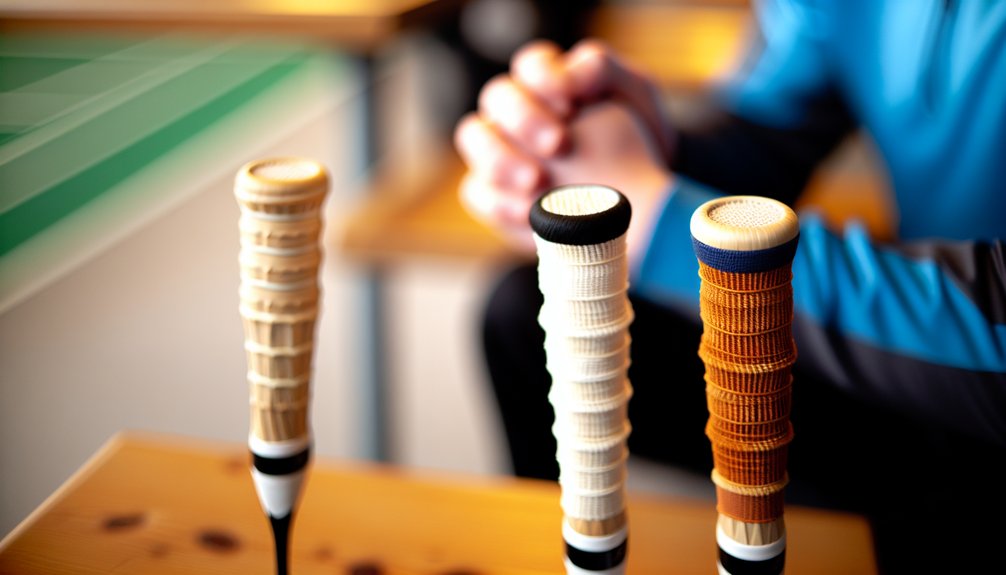
If you’re serious about improving in 2026, you can’t treat your badminton grip as an afterthought. The choice between a replacement grip and an overgrip changes racket balance, feedback, and how securely you hit under pressure. Grip thickness affects how quickly you can react, how stable your shots feel, and how much effort you waste holding the handle. Once you understand how these elements interact, your setup choices will look very different.
Key Takeaways
- Replacement grips form the primary cushion layer on the wood, setting final handle size, balance, vibration absorption, and long-term comfort.
- Overgrips are thin, replaceable layers for fine-tuning tack, moisture control, and minor thickness changes; typically 1–2 layers maximum.
- Grip thickness directly affects power, control, and racket speed: thinner favors finger power and rotation, thicker adds stability but slows head speed.
- Optimal thickness lets fingers wrap comfortably with a small gap to the palm, matching hand length (about 17–19.5 cm) and desired maneuverability.
- Use a thin replacement + ultra-thin overgrip for speed attackers, or a medium replacement + semi-tacky overgrip for balanced all-round play.
Why Your Badminton Grip Matters More Than You Think
Although footwork and power often get the spotlight, your badminton grip quietly controls almost every aspect of your performance—from shuttle control and shot accuracy to deception, swing speed, and injury risk. Grip quality sets your racket’s angle, contact point, and stability, which directly determines whether the shuttle lands in or drifts out. If your grip’s too loose, the racket wobbles on impact and you lose precision. If it’s too tight, you slow your forearm rotation and reduce racket-head speed. A correctly configured grip lets you change between forehand, backhand, and neutral positions instantly, so you can disguise shots and react earlier. It also distributes load through your fingers instead of your wrist, reducing strain during fast, repetitive strokes. Mastering how to change grips quickly during rallies lets you adapt your racket angle to any shuttle position and maintain control under pressure.
Replacement Grips: Features, Pros, and Best Use Cases
When you start customizing your handle, replacement grips are your primary layer—the one that directly builds thickness, shapes feel, and determines how securely the racket sits in your hand. You apply them straight onto the wooden handle, so every millimeter of material alters leverage, finger position, and shot precision. Use replacement grips when you want a durable, stable foundation. They’re ideal if you’re finalizing handle size, correcting factory shape, or rebuilding an old, slippery core. Unlike removable overgrips, this under grip layer directly influences racket balance, vibration absorption, and long-term comfort.
Picture how different options affect control:
- Thick, cushioned foam compressing under your palm on powerful smashes
- Tacky polyurethane locking your fingers in during late defensive digs
- Slightly ribbed textures guiding finger placement for net kills
- Firm, minimal-cushion wraps transmitting shuttle feedback instantly
- Sweat-resistant surfaces maintaining consistent friction deep into matches
Overgrips: When and Why to Layer Up
Once your replacement grip sets the base thickness and shape, overgrips let you fine‑tune feel, tack, and moisture control without rebuilding the handle. You’ll use them to make rapid, low‑cost adjustments as your hand size, tape build‑up, or seasonal humidity changes. Use an overgrip when the handle feels too thin, the surface loses definition, or you need predictable traction during intense rallies. One layer usually adds about half a grip size; two layers are the practical maximum before control suffers. Incorporating overgrips into your setup is a cost‑effective way to experiment with grip size so you can balance power and precision as your game develops.
| Situation | Overgrip Strategy |
|---|---|
| Handle slightly too small | Add 1 layer; overlap evenly |
| Testing new thickness | Add/remove layers between sessions |
| Tournament play | Start with fresh, uniformly stretched wrap |
Rotate or replace as soon as edges fray or the surface compresses.
Tacky Vs Dry Grips: Matching Texture to Sweat and Playstyle
When you choose between a tacky or dry grip, you’re really controlling how the racket behaves under sweat, acceleration, and rapid grip changes. You’ll first need to understand how a tacky grip improves hold, stability, and power transfer, especially during explosive strokes. Then you’ll compare that to the benefits of a dry grip, which manages moisture, reduces slippage over long matches, and supports quick, precise grip adjustments.
Understanding Tacky Grip
Tacky grip is engineered to feel slightly sticky so the handle stays locked in your hand through fast swings, sudden direction changes, and heavy sweat. You’re using a micro-textured, slightly adhesive surface that increases friction without requiring extra squeeze force, so your forearm stays looser and faster.


When you choose a tacky grip, you’re aiming for a specific feel:
- The handle almost “glues” to your palm on explosive smashes.
- Finger power transfers cleanly on quick grip changes at the net.
- The racket doesn’t twist on off‑center defensive blocks.
- Fast mid‑rally regrips feel controlled, not slippery or jerky.
- You maintain a consistent contact point even as the session progresses.
You’ll replace tacky grips once the surface smooths or attracts too much dust.
Benefits of Dry Grip
If tacky grips feel too sticky or start to snag during fast adjustments, a dry grip gives you a cleaner, lower-friction interface with the handle. You can rotate the racket quickly for forehand–backhand changes, essential in fast drives, interceptions, and flick returns.
Dry grips work best if you’ve moderate or low sweat and rely on finger power and grip switching. They reduce micro-sticking, so your fingers can “walk” along the handle without delay, improving net kills and late grips for deception.
You’ll also gain more consistent release timing on power smashes, since the handle doesn’t cling to your palm. If your hand stays reasonably dry, you’ll get stable control without overgripping, which reduces forearm fatigue and improves racket-head speed.
Grip Thickness: How It Changes Power, Control, and Maneuverability
Grip thickness directly alters how efficiently you transfer power, how precisely you control the shuttle, and how fast you can move the racket head. If the grip is too thick or too thin for your hand, you’ll lose power transfer, touch, and stability on tight technical shots. Next, you’ll see how to size your grip to optimize power, feel, and maneuverability for your playing style. Choosing a thickness that matches your hand size and preferred forehand grip or backhand grip helps maintain comfort while maximizing control and power.
Power Transfer and Grip Size
Although it’s easy to overlook, grip thickness is one of the key levers that controls how efficiently you transfer power from your body to the shuttle. If the grip’s too thin, you’ll over‑squeeze, wasting forearm energy. If it’s too thick, you’ll lose forearm rotation range and reduce racket head speed.
Visualize how different sizes alter power transfer:
- A hammer‑like, thicker grip for full, committed smashes from the rear court.
- A slimmer, whippy handle for explosive forearm pronation on steep attacks.
- A firm, secure thickness that lets you accelerate without conscious squeezing.
- A “locked-in” size that keeps the racket stable at impact under heavy loads.
- A size where your fingers close comfortably, with a small gap between fingertips and palm.
Control, Feel, and Precision
While power often gets the spotlight, grip thickness quietly dictates how much control and “feel” you actually have over the shuttle. A thinner grip improves tactile feedback: you sense string-bed angle, shuttle impact, and micro-vibrations more clearly. This helps you fine-tune net shots, tight blocks, and deceptive holds because you’re reading the contact point in real time.
If the grip’s too thick, you lose that nuance. Your fingers can’t micro-adjust as easily, so you tend to over-rotate or mistime slices and tumbles. Aim for a thickness that lets you wrap your fingers comfortably around the handle with a slight gap between fingertips and palm. That gap allows precise finger tightening for accurate placement without over-squeezing or steering the racket.
Maneuverability and Racket Speed
One of the fastest ways to change how quickly you can whip the racket through the air is to adjust grip thickness. A thinner grip lets your fingers wrap deeper, improving finger power and rapid racket rotation. A thicker grip stabilizes the handle but slows forearm pronation and supination, reducing peak racket-head speed.
Visualize how thickness changes maneuverability:
- A thin handle slipping cleanly between your fingers on rapid drives
- A compact grip snap for late interceptions at the net
- A thicker handle anchoring your palm on heavy rear-court clears
- Micro-adjustments in grip pressure during fast defensive blocks
- Quick grip shifts between forehand and backhand in flat exchanges
Test progressively thinner overgrips until speed improves without sacrificing secure hold.
Choosing the Right Size: Hand Measurements and Practical Tests
Two simple checks—measuring your hand and performing quick grip tests—ensure you select a badminton grip size that maximizes control, power, and comfort. First, measure from your palm’s base crease to the tip of your ring finger. As a rule of thumb, 17–18 cm suits thinner setups, 18–19.5 cm medium, and above 19.5 cm thicker grips.
Use this table as a quick visual guide:
| Hand Length (cm) | Target Feel |
|---|---|
| 16–17 | Very maneuverable |
| 17–18 | Fast, precise |
| 18–19 | Balanced all-round |
| 19–20 | Stable, powerful |
| 20+ | Maximum cushioning |
Then perform a “pencil test”: with your normal forehand grip, you should fit a pen-width gap between fingers and palm; if not, adjust thickness. For extra accuracy, you can also check your size using the standard eastern forehand grip test by ensuring there’s just enough space for another finger between your index finger and thumb.
Building Your Ideal Setup: Popular Grip Combinations for 2026
In 2026, the most effective grip setups are built by layering a thin base with a performance overgrip tailored to your style, rather than relying on a single thick grip. You’re aiming to control three variables: total thickness, surface friction, and shock feel. Start from your measured handle size, then use combinations to fine‑tune. This lets you match grip feel to your racket’s weight distribution and shaft stiffness so the whole setup works with your swing rather than against it.
Think regarding loadout “profiles”:
- Speed attacker: thin replacement + ultra‑thin tacky overgrip for rapid forehand–backhand changes.
- Control player: medium replacement + slightly cushioned overgrip for stable finger control.
- Front‑court specialist: thin replacement + dry overgrip for precise net kills and pushes.
- Rear‑court smasher: cushioned replacement + thin tacky overgrip to absorb impact.
- All‑rounder: medium replacement + medium‑thin, semi‑tacky overgrip for balanced feel.
Care, Maintenance, and When to Change Your Grip
Although grip choice shapes how the racket feels on day one, its care and replacement schedule determine how well that performance lasts. You should treat the grip as a consumable performance part, not a permanent fixture. Wipe sweat and dust off with a dry towel after every session; avoid detergents that degrade the surface.
Change frequency depends on hours played, sweat level, and desired tack:
| Play / Sweat Profile | Replacement Interval* |
|---|---|
| 3–4h/week, low sweat | Overgrip: 3–4 weeks |
| 6–8h/week, medium sweat | Overgrip: 1–2 weeks |
| 10h+/week, heavy sweat | Overgrip: every 2–4 days |
*Replace replacement grips roughly every 2–4 overgrip cycles.
Visually, change grips when color fades, surface hardens, or you feel slipping on explosive changes of direction.