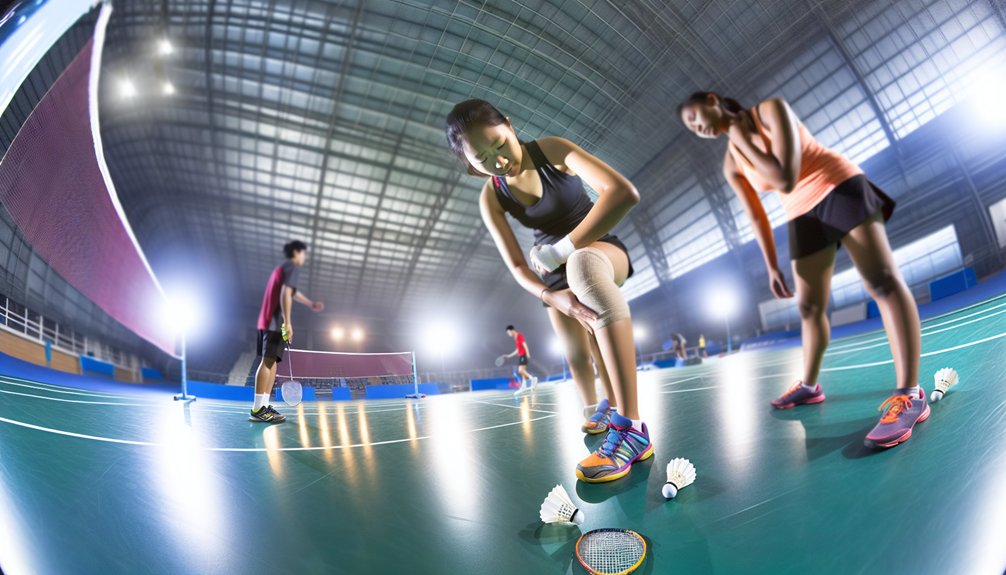
Every leap, lunge, and smash writes a story in your joints—sometimes in scar tissue. When you play badminton, your wrist tendons, rotator cuff, patellofemoral joint, and lateral ankle ligaments absorb repetitive high-velocity forces that quietly accumulate microtrauma. If you don’t manage warm-up, load, and recovery with clinical precision, overuse syndromes and sprains become almost predictable. To understand which simple changes most effectively protect your wrist, shoulder, knee, and ankle, you’ll need to know…
Key Takeaways
- Warm up 5–10 minutes with light jogging, dynamic joint circles, and controlled lunges to prepare wrist, shoulder, knee, and ankle tissues for loading.
- Use proper stroke mechanics and neutral wrist positioning; avoid locked wrists and excessive forearm pronation to reduce tendon overload and acute wrist trauma.
- Strengthen rotator cuff, scapular stabilizers, and forearm muscles with bands and light dumbbells to protect the shoulder and wrist during repetitive overhead shots.
- Improve knee and ankle stability with slow split squats, lateral band walks, single-leg calf raises, and controlled landing drills to handle explosive changes of direction.
- Monitor early warning signs—persistent ache, morning stiffness, swelling, or joint “giving way”—and reduce load or seek assessment before minor issues become serious injuries.
Understanding Badminton’s High-Impact Joint Demands
Badminton places substantial, repeated load on the ankle, knee, and hip joints due to explosive lunges, rapid decelerations, and frequent directional changes on a relatively hard court surface. You repeatedly cycle through deep lunge positions where the ankle moves into dorsiflexion with inversion/eversion stresses, the knee enters high flexion with valgus or varus moments, and the hip undergoes combined flexion, adduction, and internal rotation.
You’re also exposed to high ground‑reaction forces during jumps and landings, which transmit proximally through the tibiofemoral and patellofemoral joints into the lumbopelvic region. Poor neuromuscular control or fatigue increases abnormal joint loading, especially in frontal and transverse planes. Over time, these cumulative microstresses can overload ligaments, tendons, articular cartilage, and subchondral bone.
Common Wrist Injuries and How They Develop
As a badminton player, your wrist is exposed to repetitive loading that can cause overuse tendon strain in the wrist flexors, extensors, and radial/ulnar deviators. When your grip size, grip strength, or stroke mechanics are suboptimal, you increase torsional stress across the radiocarpal and midcarpal joints, predisposing you to tendinopathy and chronic pain. In addition, sudden impact forces from falls, racket clashes, or mis-timed shots can produce ligament sprains and acute soft-tissue trauma around the carpal bones.
Overuse and Tendon Strain
| Tendon region | Typical overload pattern | Clinical consequence |
|---|---|---|
| Dorsal radial (ECRB/ECRL) | Repetitive backhands, hard clears | Lateral wrist tendinopathy |
| Volar radial (FCR) | Forceful forehand drives, smashes | Volar wrist pain, gripping weakness |
| Ulnar (ECU) | Rapid pronation with ulnar deviation | Ulnar‑sided wrist pain |
| Thumb extensors (APL/EPB) | Frequent flick serves, net kills | De Quervain‑type symptoms |
| TFCC region | Load in ulnar deviation at end‑range | Deep ulnar wrist ache, clicking |
Poor Technique and Grip
Although wrist pain is often blamed on “weak joints,” it’s far more often the result of poor stroke mechanics and maladaptive grip patterns that overload specific carpal and tendinous structures. When you lock the wrist or overuse finger flexors, you increase compressive and shear forces across the radiocarpal joint, especially the scaphoid, lunate, and TFCC, predisposing you to chronic symptoms.
- Excessive forearm pronation during smashes overloads the extensor carpi radialis brevis, promoting lateral tendinopathy.
- A panhandle grip for overhead shots forces end-range ulnar deviation, irritating the ECU tendon and ulnar-sided wrist.
- Constant tight gripping elevates baseline flexor tone, reducing perfusion and accelerating micro-tearing at the medial epicondyle.
- Poor split-step timing makes you “arm” the shuttle, amplifying torque through the midcarpal row and volar ligaments.
Impact Trauma and Sprains
Poor mechanics and maladaptive grip patterns don’t just cause overload injuries; they also set you up for acute impact trauma and sprains when you fall, collide, or mis-hit the shuttle. When your wrist is locked in excessive radial or ulnar deviation at impact, force transmission bypasses the muscular stabilizers and goes straight to the ligaments and carpal bones.
You’re most at risk for sprains of the radiocarpal ligaments, the scapholunate complex, and the triangular fibrocartilage complex (TFCC). A sudden fall onto an outstretched hand or a violently off‑center smash can drive the carpus into forced extension and pronation, overloading these structures. Repeated submaximal sprains then destabilize the joint, alter proprioception, and increase the likelihood of fractures or chronic ligamentous laxity.
Shoulder Strain, Overuse, and Rotator Cuff Risks
Because badminton demands repetitive overhead motions at high speed, the shoulder—especially the rotator cuff and scapular stabilizers—is highly susceptible to cumulative microtrauma, tendinopathy, and strain. You repeatedly load supraspinatus, infraspinatus, teres minor, and subscapularis during smashes and clears, often in end‑range abduction and external rotation, where tensile and shear forces peak.


Overuse arises when tissue loading exceeds your cuff’s capacity, leading to subacromial impingement, bursal irritation, and partial‑thickness tears. Early signs are night pain, reduced internal rotation, and weakness in eccentric control.
- Differentiate sharp, localized pain from diffuse post‑exercise soreness.
- Monitor side‑to‑side strength symmetry in external and internal rotation.
- Watch for scapular dyskinesis, winging, or early shrugging on elevation.
- Note any progressive loss of overhead range or reduced smash velocity.
Knee Pain, Ligament Stress, and Jumping Mechanics
As footwork and repeated jump-smash actions accumulate, your knees are exposed to patellar tendinopathy, meniscal irritation, and excessive load on the ACL and MCL. You can substantially lower this risk by using landing mechanics that control knee valgus, limit anterior tibial translation, and maintain hip–knee–ankle alignment on impact. Targeted strengthening of the quadriceps, hamstrings, gluteals, and calf complex, along with progressive loading of ligaments and tendons, helps improve joint stability and tissue resilience under match conditions.
Common Badminton Knee Injuries
While the shoulder often gets attention in badminton, the knee is actually one of the most vulnerable joints, with injury patterns closely linked to lunging, rapid directional changes, and repeated jumping and landing. You place high, repeated loads on the patellofemoral joint, cruciate ligaments, and menisci, especially on hard courts or with fatigued quadriceps and glutes.
- Patellofemoral pain syndrome – anterior knee pain from maltracking and overload of the patellar cartilage.
- Patellar tendinopathy (“jumper’s knee”) – micro‑tears at the inferior patellar pole from repetitive explosive take-offs.
- Meniscal tears – twisting in deep lunge positions stresses the medial and lateral menisci, causing joint-line pain and locking.
- Ligament sprains (ACL/MCL) – valgus collapse and rotational forces during cutting or deceptive footwork overload primary stabilizers.
Safe Jumping Landing Mechanics
Knee injuries in badminton often emerge at the moment you leave the ground or absorb force on landing, when joint loads on the patellofemoral cartilage, cruciate ligaments, and menisci peak within milliseconds. To protect these structures, you need controlled mechanics throughout take-off and landing.
When you jump, keep your trunk slightly flexed, hips hinged, and knees tracking over the second toe, avoiding dynamic valgus (knees collapsing inward) that elevates ACL and MCL strain. Land on the balls of both feet, then let the ankle, knee, and hip flex together, spreading impact through the kinetic chain. Aim for quiet, soft landings; loud impacts usually reflect stiff-knee patterns and higher tibiofemoral forces. Finally, avoid excessive knee-forward positions; prioritize hip flexion to attenuate load.
Strengthening Ligaments and Tendons
Although landing mechanics determine how forces move through your joints, your long‑term resilience in badminton depends on the load‑tolerance of the ligaments and tendons that stabilize the knee. You’re trying to condition the ACL, MCL, meniscotibial attachments, and especially the patellar and quadriceps tendons to withstand repeated jump‑land cycles.
To target these tissues, emphasize slow, high‑tension loading that respects pain limits.
- Perform Spanish squats or wall sits (45–60 seconds) to load the patellar tendon isometrically.
- Add slow tempo squats and split squats (3–4 seconds down) to increase tendon stiffness.
- Use single‑leg Romanian deadlifts to strengthen hamstring and posterior‑capsule support.
- Progress to submaximal pogo jumps and low‑height drop landings, focusing on quiet, symmetric contacts.
Ankle Sprains, Instability, and Court Movement Errors
Because badminton demands rapid multi‑directional footwork and repeated single‑leg landings, the lateral ankle ligaments—especially the anterior talofibular ligament (ATFL) and calcaneofibular ligament (CFL)—are exposed to high inversion and rotational loads that make sprains the most common lower‑limb injury in the sport. When you decelerate poorly, let your knee collapse medially, or plant on a supinated foot during a lunge, you sharply increase tensile stress on these ligaments.
Recurrent sprains can leave you with mechanical laxity and functional instability: impaired proprioception, delayed peroneal activation, and reduced eversion strength. Faulty court patterns—over‑crossing steps, late split‑steps, and landing with your center of mass outside your base of support—further overload the subtalar and talocrural joints, reinforcing a cycle of instability and maladaptive movement.
Early Warning Signs You Should Never Ignore
Recognizing subtle symptoms before they escalate is what separates a minor ankle issue from a season‑ending sprain. You need to monitor small changes in joint behavior, not just obvious pain. Early signs usually reflect tissue overload at the tendons, ligaments, or joint capsule long before structural failure.
1. Persistent, localized ache
Focal pain at the lateral ankle, patellar tendon, rotator cuff, or wrist extensors after play indicates micro‑tearing and inadequate recovery.
2. Morning stiffness or “start‑up” pain
Joints that feel tight or painful during the first steps or swings suggest low‑grade synovial or tendon irritation.
3. Subtle instability or “giving way”
Momentary loss of ankle or knee control implies compromised mechanoreceptors and ligament integrity.
4. Swelling or warmth
Mild, recurrent effusion or heat signals ongoing inflammatory response.
Warm-Up Routines Tailored for Wrist, Shoulder, Knee, and Ankle
When you warm up for badminton with joint‑specific intent, you’re not just “getting loose”—you’re systematically increasing blood flow, synovial fluid circulation, and neuromuscular activation in the wrist, shoulder, knee, and ankle. You’ll reduce tissue stiffness, improve proprioception, and lower strain on tendons and ligaments.
Begin with 3–5 minutes of light jogging or skipping, then target joints.
Wrist: perform slow flexion–extension, radial–ulnar deviation, and pronation–supination, 10–15 reps each.
Shoulder: use controlled arm circles in multiple planes and scapular retraction–protraction drills.
Knee: execute dynamic heel raises, gentle terminal knee extensions, and controlled mini-squats within pain‑free range.
Ankle: perform dorsiflexion–plantarflexion, inversion–eversion, and ankle circles, emphasizing mid‑range control over end‑range forcing.
Strength and Mobility Training With Minimal Equipment
Even without access to a gym, you can build the strength and mobility that protect your joints from badminton‑related overload. Prioritize controlled, full‑range movements that target the specific tissues stressed by lunges, jumps, and overhead strokes.
1. Wrist–forearm complex
Use a light dumbbell or water bottle for wrist flexion, extension, and radial–ulnar deviation, 2–3 sets of 12–15 reps, to fortify flexor–extensor tendons and improve load tolerance.
2. Rotator cuff and scapular stabilizers
With a resistance band, perform external rotation, scaption, and row variations, emphasizing scapular upward rotation and posterior cuff endurance.
3. Quadriceps and hip abductors
Do slow split squats and lateral band walks to stabilize the knee via stronger gluteus medius and vastus medialis.
4. Ankle plantarflexors and invertors/evertors
Single‑leg calf raises and banded eversion/inversion enhance dynamic ankle stability.
Recovery Habits and Long-Term Joint Protection Strategies
Building strength and mobility is only part of protecting your joints; how you recover between sessions largely determines whether those tissues adapt or break down. Prioritize 7–9 hours of sleep; growth hormone pulses during deep sleep drive collagen synthesis in wrist ligaments, rotator cuff tendons, menisci, and ankle stabilizers.
Use 5–10 minutes of low‑intensity cycling or walking post‑play to enhance synovial fluid circulation through the shoulder, knee, and talocrural joints. Within two hours, ingest 20–40 g protein and complex carbohydrates to support tendon, muscle, and cartilage repair.
Schedule at least one low‑load day weekly, emphasizing gentle range‑of‑motion and isometrics. Track early warning signs—morning stiffness, reduced end‑range, localized tenderness—and deload 30–50% before they progress into structural overuse injury.