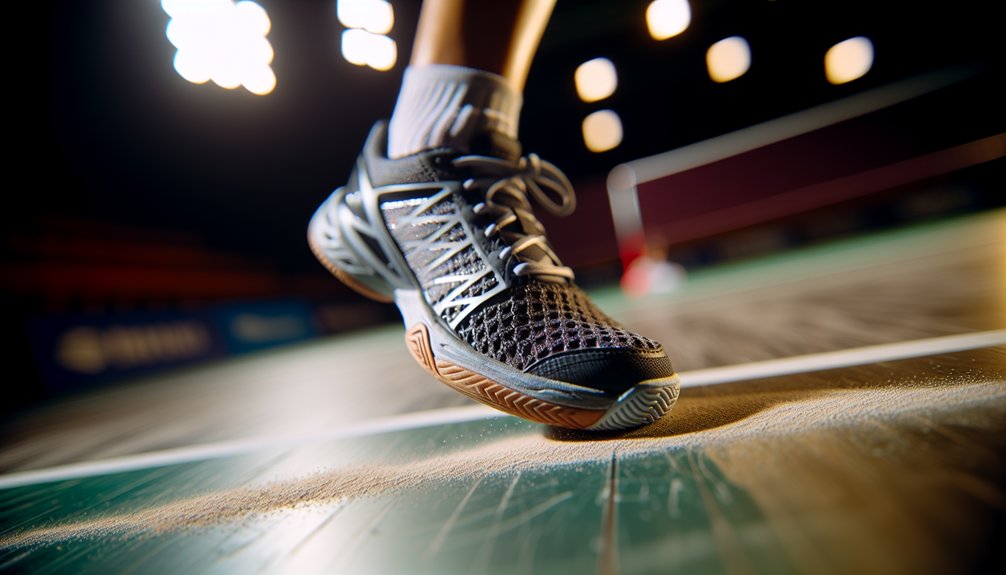
When you switch from a generic indoor court shoe to the Yonex Power Cushion 65 Z Gen 4, you’ll notice the narrower, more sculpted fit immediately. The structured mesh upper locks your midfoot in more securely than many wider, softer competitors, while the Power Cushion midsole keeps impact low without feeling mushy. On wood, traction feels almost “bitey”; on synthetic, it’s smoother and more controlled—yet that contrast is only part of the story.
Key Takeaways
- Moderate–narrow fit with tight heel/midfoot lockdown; best for neutral-to-narrow or tapered feet, wide forefeet may need half-size up.
- Power Cushion midsole gives firm, responsive underfoot feel with strong impact protection and minimal bottoming out on repeated lunges.
- Forefoot feels stable and “locked-in” thanks to dense mesh, PU overlays, and asymmetrical lacing focused on medial support.
- On wooden courts, traction is very sharp and aggressive, demanding regular sole-wiping to manage dust and sweat buildup.
- On synthetic courts, grip is smoother with a brief, controlled micro-slide, offering predictable stops and reduced joint stress during hard direction changes.
What’s New in the Yonex Power Cushion 65 Z Gen 4 for 2026
Although the overall design language will look familiar, the Yonex Power Cushion 65 Z Gen 4 for 2026 introduces several structural and material updates that distinguish it from the previous generation. You’re getting design innovations primarily in the midsole and outsole systems, where Yonex refines cushioning geometry, shank configuration, and rubber compounds. You’ll notice performance enhancements in vertical shock absorption and forefoot energy return, attributed to a re‑tuned Power Cushion stack and revised density layering. Compared with the Gen 3, torsional rigidity is slightly increased, targeting more stable lateral stops without a large weight penalty. To fully capitalize on these shoe updates, pairing them with high-quality rackets like Yonex’s Astrox or Nanoflare series helps maintain optimal performance and reduce injury risk across your entire setup. The outsole pattern’s been reshaped for more consistent grip shifts, especially on aggressive direction changes, while flex grooves are redistributed to maintain smoother toe‑off mechanics under load.
Upper Design, Materials, and Lockdown Support
While the midsole and outsole carry most of the headline updates, the Yonex Power Cushion 65 Z Gen 4’s upper quietly shifts the fit and support profile in more noticeable ways than the visuals suggest. You’re getting a denser, more structured mesh-and-synthetic package that’s clearly stiffer than many speed-oriented models, but still ventilated through targeted breathable mesh zones.
| Area | Design Focus | On-Court Effect |
|---|---|---|
| Forefoot | Layered mesh + PU overlays | Crisper toe-off stability |
| Midfoot | Asymmetrical lacing chassis | Stronger medial lockdown |
| Heel counter | Rigid internal cup | Enhanced rearfoot containment |
| Collar padding | Sculpted foam rims | More consistent ankle support |
| Tongue | Semi-gusseted construction | Reduced lace pressure, less slip |
Fit Profile by Foot Shape and Sizing Tips
So where does the Power Cushion 65 Z Gen 4 actually sit on the spectrum from narrow, race-fit shoes to broad, comfort-first models? You’re looking at a moderate–narrow last, closer to performance-oriented badminton shoes than to wide, recreational trainers. The forefoot volume’s controlled, which suits tapered or Egyptian foot shapes, while square or wide forefeet may feel constrained unless you choose the wide (W) variant. Heel and midfoot lockdown are comparatively tighter than many Yonex comfort lines, so if you’ve got low-volume or narrow heels, you’ll benefit most. For sizing recommendations, start with your true length in Yonex, but consider half-size up if you’ve a wide forefoot or use thick socks. High insteps should also test half-size up to avoid lace bite. Players who favor quick direction changes and explosive lunges often pair this kind of fit with a racket that has carefully chosen racket weight and balance to keep their overall movement sharp and efficient.
Underfoot Feel, Cushioning, and Responsiveness
When you assess the Yonex Power Cushion 65 Z Gen 4, you’re really judging how its Power Cushion system balances impact protection against court feel. You’ll want to know whether the midsole absorbs hard landings and lunges more effectively than previous 65 Z generations while still keeping you connected to the floor. It’s also important to reflect on how efficiently the foam and shank structure return energy, particularly in comparison with other mid-tier and flagship Yonex models.
Power Cushion Impact Protection
Impact protection in the 65 Z Gen 4 centers on Yonex’s signature Power Cushion midsole, which’s tuned to balance shock absorption with court feedback rather than pure softness. Compared with older 65 Z generations, you’ll notice a firmer calibration under the forefoot and more targeted heel cushioning, designed to manage high‑impact landings from jumps and sudden decelerations.
You’re getting a multi‑layer configuration where the primary Power Cushion compound is sandwiched with denser stabilizing foam. This lets the shoe compress on vertical impact yet resists bottoming out on repeated lunges. Versus ultra-plush competitors, you sacrifice a little initial softness, but you gain better impact consistency over long sessions. If you’re prone to knee or heel irritation, this tuning feels significantly more protective.
Court Feel and Energy
Although the 65 Z Gen 4 leans on the same Power Cushion platform as its predecessors, its on‑court feel is noticeably firmer and more direct, prioritizing energy return and stability over plush comfort. You’ll sit closer to the floor, which improves feedback from the court but reduces the “pillowy” sensation you might know from earlier 65 Z versions.


Underfoot, the midsole compresses less and rebounds faster, so court responsiveness is higher, especially on the first step out of lunges and split‑steps. Vertical impact is still moderated, yet you’ll notice more of the floor’s texture on hard stops. Compared with softer all‑round models, this setup favors efficient energy transfer and directional changes, suiting aggressive, front‑court players more than those wanting maximum softness.
Court Grip on Wooden Vs Synthetic Indoor Surfaces
When you’re evaluating the Yonex Power Cushion 65 Z Gen 4, you need to take into account how its outsole compound and tread pattern interact differently with sealed wooden courts versus synthetic PU or PVC flooring. You’ll notice variations in initial bite, braking stability, and lateral grip as surface friction, dust accumulation, and floor elasticity change between these environments. Understanding these differences helps you adapt your footwork, stopping angles, and maintenance routines to optimize grip on both surfaces. Just as with choosing between lightweight rackets and different balance types, tailoring your shoe setup and court-care habits to the specific surface can significantly enhance performance and reduce fatigue over long sessions.
Traction on Wooden Courts
Two indoor surfaces dominate badminton play—finished wooden courts and synthetic PVC or PU mats—and the 65 Z Gen 4’s traction behaves subtly differently on each. On wooden surfaces, you’ll notice the fine-tuned interaction between the shoe’s hexagonal outsole pattern and the varnished grain, especially during split-step loading and deceleration.
The rubber compound generates high friction under clean conditions, so you can apply more aggressive traction techniques—deep lunges, cut steps, and recovery shuffles—without micro-sliding. Forefoot grip feels immediate, while the slightly flatter rearfoot profile stabilizes heel plants on dry, dust-free boards.
However, wooden courts magnify dust and sweat films. You’ll need more frequent sole-wiping to maintain ideal bite, and you may prefer slightly shorter braking distances compared with how you’d calibrate your movement elsewhere.
Performance on Synthetic Flooring
On synthetic PVC and PU mats, the 65 Z Gen 4’s outsole delivers a slightly different grip profile than on wood, prioritizing consistent contact over raw bite. You’ll notice the synthetic performance is more uniform across dusty or mildly worn areas, as the rubber compound and tread geometry interact with the smoother surface through increased surface-area contact rather than edge penetration.
Compared with wooden courts, traction differences appear most during explosive stops and diagonal pushes. On wood, you get a sharper “lock‑in” sensation; on synthetic, the grip curve is smoother, with a micro‑sliding phase before full hold. This can feel marginally less aggressive but more predictable, reducing abrupt load on your ankles and knees during repetitive, high‑intensity direction changes.
Adapting Grip Between Surfaces
Shifting between wooden and synthetic courts with the 65 Z Gen 4 means you’ll need to subtly recalibrate how you load and release your footwork to exploit the shoe’s traction profile. On wooden courts, the softer, often dust-prone surface lets the rubber compound bite quickly, so you can commit to more aggressive deceleration and shorter braking distances. You’ll rely on micro-adjustments in the forefoot to maintain grip consistency during rapid direction changes.
On synthetic courts, where friction can feel more linear and sometimes “stickier,” you should moderate your stopping angle and extend your slide phase slightly. This leverages the outsole’s court adaptability, preventing over-grip that can stress your knees, while still allowing powerful push-offs through the midfoot and heel.
Stability, Transitions, and On-Court Movement
Although cushioning is the headline feature, the Power Cushion 65 Z Gen 4’s real performance edge emerges in how it manages stability and shifts during multidirectional play. You’ll notice improved lateral stability from the reinforced midfoot shank and widened forefoot base, which reduce torsional flex compared with many mid-tier Yonex models. Under fast split-steps, the shoe keeps your ankle centered, so you’re not fighting roll or wobble when you plant.
The outsole geometry and responsive midsole create explosive changes from defense to attack. Heel-to-toe transfer feels more linear than in the 65 Z Gen 3, with less energy “lost” in compression. When you cut, recover, and re-accelerate, the platform stays neutral, letting you load aggressively without over-correcting your foot position.
Durability, Wear Patterns, and Maintenance
Beyond how the 65 Z Gen 4 moves, its long-term value depends on how the materials endure under frequent play. You’ll notice the high-abrasion rubber and reinforced medial toe cap concentrate protection where drag and lunges are most aggressive. In durability testing, the outsole typically outlasts the upper mesh, which can fray first along flex points.
Under controlled wear analysis, the heel and lateral forefoot show the earliest smoothing of tread if you favor explosive cuts. You’ll extend lifespan by rotating pairs, brushing off court dust to preserve grip edges, and air-drying instead of heat-drying. Inspect glue lines and eyelets regularly; addressing early separation with proper adhesive or lace replacement will delay structural breakdown and keep cushioning performance consistent.
Who This Shoe Suits Best and Key Alternatives
Even if it’s marketed as an “all-round” model, the 65 Z Gen 4 is best suited to competitive players who prioritize explosive lateral movement, stable landings, and a relatively low-to-the-ground ride over maximum plushness. You’ll benefit most if you play singles or fast men’s doubles, have neutral-to-narrow feet, and like a precise, locked‑in forefoot. Players who lean into aggressive, attacking styles will appreciate how this profile pairs with the head-heavy racket designs and rapid-repulsion frames common in modern badminton setups.
In performance comparison against the Aerus Z and Eclipsion Z, the 65 Z Gen 4 trades ultra‑light speed and maximal cushioning for a balanced stability–agility profile. User feedback consistently highlights confident stops on hard lunges and predictable grip on aggressive cuts.
| Model | Best For | Key Trade‑Off |
|---|---|---|
| 65 Z Gen 4 | All‑round competitive stability | Less plush than Eclipsion |
| Aerus Z | Maximum speed, ultra‑light feel | Lower durability, support |
| Eclipsion Z | Cushioning, strong ankle support | Heavier, higher ride |