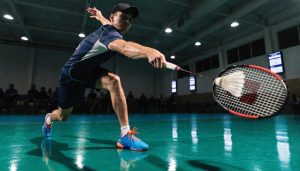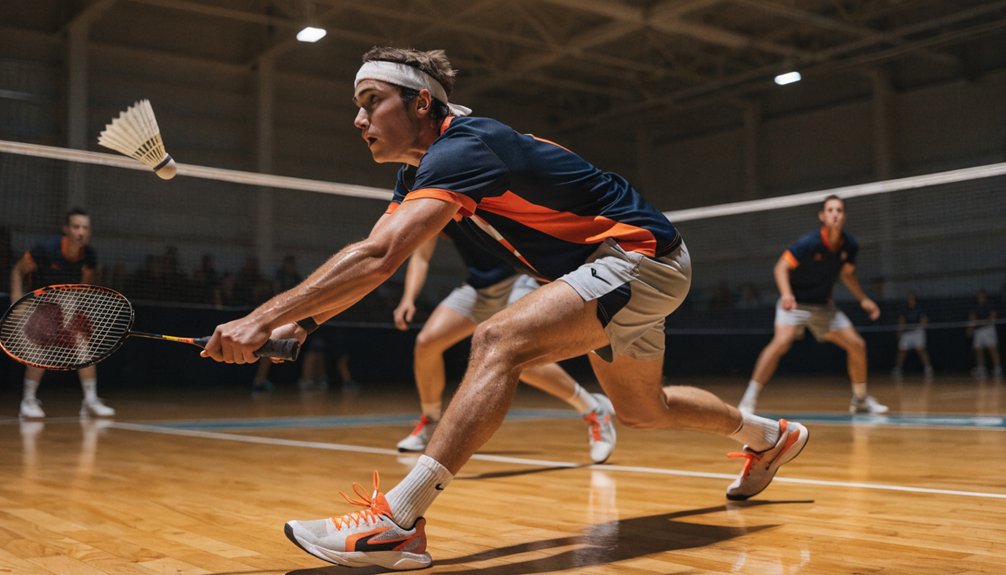
It’s no coincidence that the players who dominate flat exchanges all seem to “react faster” than everyone else—you’re actually watching superior preparation, not superhuman reflexes. If your ready position is a fraction too tall, your grip a touch too tight, or your split-step mistimed, you’ll always feel late on drives and pushes. Refine those details, and your reactions change dramatically—but only if you also address one often-overlooked factor.
Key Takeaways
- Hold a relaxed, neutral ready position with racket slightly above net height, elbows forward, and eyes on the opponent’s contact point.
- Time a light split-step with the opponent’s hit, then explode with a short first step to take the shuttle early.
- Use a loose grip (3–4/10 tension), tightening only on impact for faster racket acceleration and smoother grip changes.
- Keep racket preparation compact at hip–rib height with the head just above the hand to minimize travel distance.
- Train with fast flat drive drills (wall or partner) emphasizing minimal swing, precise placement, and quick recovery to base.
Ready Position Tweaks for Faster Flat Reactions
When rallies stay flat and fast, your ready position isn’t just “neutral” – it’s a pre‑loaded trigger for instant counter‑attack. You’re shaping how quickly you see, decide, and fire. Hold the racket slightly higher than net height, with the tip forward, not up, so you minimize travel distance to both forehand and backhand. Keep your grip relaxed, around 3–4 out of 10 tension, so you can switch forehand–backhand instantly. Using a lightweight racket with good maneuverability here reduces arm fatigue and lets you maintain this quick, reactive position deep into long, fast rallies.
Angle your racket face a few degrees closed, prepared to drive, not lift. Elbows stay slightly in front of your torso, never pinned back, letting you intercept instead of chase. Your head stays still, eyes level with the tape, reading early cues from your opponent’s shoulder, racket preparation, and contact point.
Footwork Tweaks for Faster Flat Exchanges
For faster flat exchanges, your footwork needs a neutral split-step that keeps your hips square and weight evenly loaded on both balls of the feet. From this position, you can fire a short, explosive first step in any direction without wasted motion or false steps. You’re not trying to cover distance; you’re trying to create just enough space, just fast enough, to strike early and take time away from your opponent. Pairing this with a racket that offers aerodynamic frame design and a maximized sweet spot lets you convert that quick first step into earlier, cleaner contact on the shuttle.
Neutral Split-Step Position
Think of the neutral split-step as your “ready-to-fire” position that trims milliseconds off every flat exchange. You land as your opponent hits, not before, not after. Feet are just wider than shoulder-width, toes slightly open, weight centered over the balls of your feet, heels light. Knees are flexed, hips hinged, torso slightly forward to preload your calves and quads.
Keep your stance truly neutral: don’t bias your weight to forehand or backhand. In flat exchanges, the shuttle can go either side at equal speed, so an even distribution of weight preserves reaction options. Your racket foot shouldn’t creep back; align both feet so you can push in any direction with symmetrical force and minimal adjustment.
Short, Explosive First Step
Explode out of your split-step with a short, sharp first push rather than a long reaching lunge. That compact step keeps your center of mass under control, so you can brake and redirect if the shuttle changes direction. Emphasize a powerful drive from your outside leg, landing the first step slightly wider than shoulder-width to create a stable base.
Keep the foot low to the floor, almost “skimming” the surface, to minimize airtime and wasted motion. Think “push, then glide,” not “reach and recover.” Your goal isn’t distance; it’s rapid acceleration into an efficient hitting position.


Drill this by reacting to random feeds: one explosive step, hit, then instantly recoil back into your neutral split, ready for the next flat exchange.
Racket Prep Tricks for Flat, Fast Shots
Although many players focus on swing power, your flat, fast shots are won or lost in the milliseconds before you hit the shuttle—how you prepare your racket dictates everything that follows. Efficient racket prep compresses your stroke, sharpens your timing, and keeps both attack and defense instantly available. Using a relaxed, handshake-style forehand grip or thumb-dominant backhand grip helps you switch quickly between sides while maintaining control in fast exchanges.
- Hold the racket around hip–rib height, slightly in front of your body, with a neutral grip. This “ready box” minimizes travel distance to interceptions.
- Keep your racket head just above your hand, not dropped or fully raised. A compact “C-shaped” preparation lets you snap forehand or backhand with minimal telegraphing.
- Pre-load your fingers, not your arm. Light tension in thumb, index, and middle fingers allows micro-adjustments, explosive tightening at impact, and rapid recovery for the next flat exchange.
How to Read Flat Rallies Faster
To read flat rallies faster, you need to lock onto your opponent’s contact point and the instant direction of their racket face. By training your eye to pick up these early cues, you’ll predict whether the shuttle’s coming straight, across, or into your body before it crosses the tape. Then you can attack the shuttle on the rise instead of reacting late from a neutral or defensive position. This quicker reading of the shuttle also helps you stay composed under mind games and psychological tactics, so opponents’ shouting or delays don’t derail your reactions.
Anticipating Opponent’s Contact
When flat rallies accelerate, you don’t actually need faster reflexes so much as earlier information, and that comes from reading the opponent’s contact. You’re trying to “see” the shot the instant the strings meet the shuttle, not once it’s already flying past you.
- Watch the hitting arm, not the shuttle. Track shoulder rotation, elbow height, and racket path as the swing unfolds so you can pre‑classify drive, push, or block before impact.
- Use grip and racket-face clues. A panhandle, tightened forehand grip, or slightly open face often signals straight, punchy drives; a neutral grip with compact motion suggests softer, controlling shots.
- Sync your split-step with their contact. Land just as they strike so your first step exploits what you’ve already read.
Recognizing Shuttle Flight Cues
You’ve learned to read the opponent at contact; now you need to confirm that prediction with what the shuttle actually does in its first meter of flight. Lock your eyes on that zone, not the racket. In flat exchanges, this early flight reveals height, line, spin, and pace.
Micro‑cues matter: a shuttle rising even slightly signals drive or lift potential; a dipping trajectory demands early interception. Watch for lateral drift indicating slice or cross, so you can adjust your hitting zone rather than chase the shuttle.
Link these cues to automatic footwork: tiny split‑step adjustments, racket preparation in front of your body, and a compact swing. Train with multi‑shuttle flat feeds, calling “straight” or “cross” as you move.
Common Flat-Exchange Mistakes (And Fixes)
Although flat exchanges look simple from the outside, many rallies break down because players repeat a few avoidable errors: standing too upright and far from the shuttle’s path, gripping the racket too tightly, swinging with big arm motions instead of short forearm/finger actions, and hitting aimlessly back to the opponent’s “strike zone.” These habits slow your reaction speed, delay your contact point, and give your opponent time to intercept. Because flat exchanges demand quick movements along the singles court width, understanding how much lateral space you must cover helps you choose more efficient posture and spacing.
- Poor posture and spacing – Stay low, with knees flexed and chest slightly forward, and position your body close to the shuttle’s anticipated line.
- Excess grip tension – Relax your fingers, tightening only at impact for faster racket acceleration.
- Predictable targeting – Drive away from the opponent’s racket hip, shoulder, or body-line.
Solo and Partner Drills to Sharpen Reaction Speed
Correcting flat-exchange mistakes is only half the job; the real speed gains come once you stress your reactions with targeted drills. For solo work, stand midcourt, feed shuttles off a wall using short, flat drives, and maintain a compact stance. Focus on minimal racket preparation, quick split-steps, and clean contact in front of your body. Vary height and pace to challenge adjustment speed, not stroke power. To support these drills, regularly inspect your racket and strings for damage, since maintaining optimal string tension helps preserve control in high-speed flat exchanges.
With a partner, run random flat-feeding drills across the tape: your partner drives shuttles unpredictably to forehand, backhand, and body. Your goal is to keep the shuttle flat, recover to your base instantly, and maintain balanced posture. Add constraints—smaller hitting zone, weaker hand only, or time-limited rallies—to overload your reaction speed under tactical pressure.