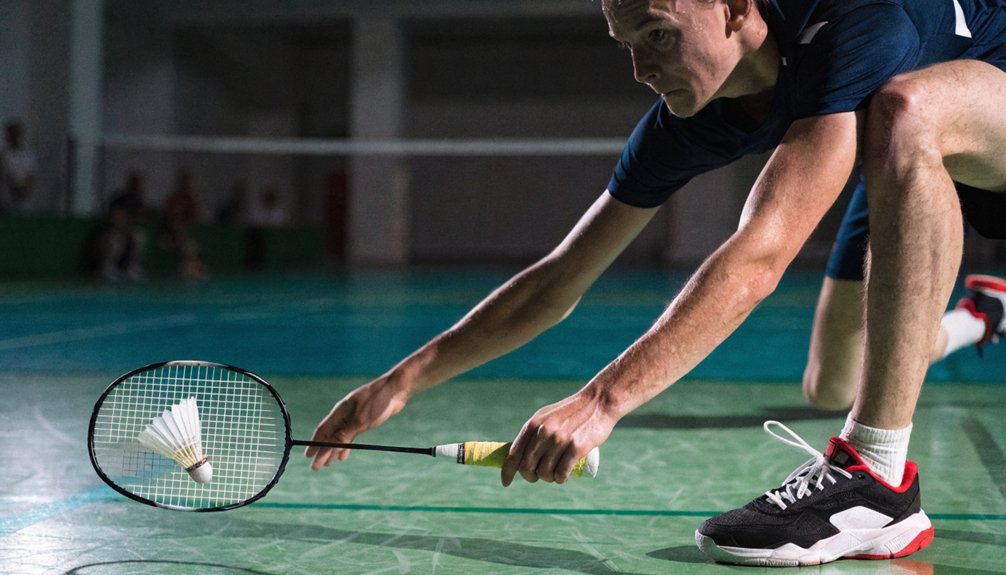
When your lift keeps landing short under pressure, it’s usually not bad luck – it’s a mix of rushed decisions, poor contact, and messy footwork. You probably tighten your grip, hit from too low, and lift from off-balance positions that invite an easy kill. The good news is that you can systematically fix this. Start by understanding exactly why your lifts break down in defense, attack, and neutral rallies…
Key Takeaways
- Prepare early with a split-step and fast first step so you’re stable and contacting the shuttle as high and in front as possible.
- Keep a relaxed, neutral grip and accelerate through the shuttle with a full throwing action instead of steering with only the wrist.
- Under pressure, prioritize deep, high resets to the backcourt, accepting occasional long outs over weak mid-court lifts.
- Use target-zone lift drills and multi-feed under load to ingrain consistent depth and a reliable contact point when tired or rushed.
- Between points, reset with a short routine, refocus on lift height and depth goals, and commit fully to each lift regardless of the score.
Why Your Badminton Lifts Go Short Under Pressure
When the score tightens, your lifts don’t just get shorter by accident—they’re the product of specific technical and tactical breakdowns under stress. Under pressure, you tend to rush the shot, abbreviate your preparation, and hit from a compromised base. Your brain shifts from “build the rally” to “just survive,” so you lift reactively instead of choosing height, length, and target. You also misjudge risk. Afraid of lifting out, you reduce racket acceleration and cut the follow-through, sacrificing depth. Positionally, you’re often a step late, loading from a narrow stance or leaning backward, so you trade length for simply getting the shuttle over. Psychologically, you stop committing fully: you guide the shuttle instead of striking it decisively with a clear tactical intention. Under pressure, opponents may also use deliberate mind games—like shouting or slowing play—to increase your stress and make these technical and tactical breakdowns even more likely.
Technical Lift Mistakes That Make You Hit Short
When your lift keeps landing short under pressure, it usually comes down to an incorrect contact point and weak wrist preparation. If you’re reaching too low or too far behind your body, you lose leverage and are forced into a defensive, floaty lift. Add in a relaxed or late-set wrist, and you strip your stroke of both length and height, giving your opponent an easy chance to attack. Adjusting your preparation and contact point can be easier when your racket’s weight distribution suits your skill level and style of play.
Incorrect Contact Point
Although you might feel your lift technique is sound, a flawed contact point quietly robs you of both length and height, causing the shuttle to land short under pressure. You’re probably striking the shuttle too low, too close to your body line, or slightly behind your hip. Each of these shortens the effective swing path, forcing you to “push” instead of driving cleanly through the shuttle.
To correct this, prioritize meeting the shuttle earlier and farther in front of your body, with the racket head already traveling on an upward trajectory. Aim to contact just above shoulder level on forehand lifts and slightly in front of your lead hip on backhand lifts. Under pressure, consciously move your feet earlier so your body doesn’t drift behind the shuttle.
Weak Wrist Preparation
Even with a good contact point, a lazy wrist sets your lift up to fall short. Under pressure, you often let the wrist sit neutral and “dead” as the shuttle comes, so there’s no elastic preload. Without that slight cocking back and forearm rotation, you’re forced to push the shuttle instead of whipping it, bleeding power and length.
You need a compact but active wrist preparation: racket head slightly below the shuttle, wrist extended back, grip relaxed, forearm ready to pronate or supinate. Hold this shape early, then accelerate through the shuttle in one crisp motion. If your racket only starts moving at impact, you’re late. Prepare the wrist first, then let the body and swing follow.
Grip And Contact Fixes For Deeper Lifts
Instead of just swinging harder and hoping the shuttle travels deeper, you need to refine how you hold the racket and where you meet the shuttle on lifts. Under pressure, your grip often tightens and the contact point drifts too low or too close to your body, killing length even with a big swing. Using a relaxed, neutral version of the forehand grip helps reduce wrist strain and keep a higher, more controlled contact point under pressure.


- Relax your fingers so the racket can accelerate at impact. Use a neutral, slightly bevelled grip; avoid turning too panhandle or backhand, which flattens the trajectory.
- Meet the shuttle slightly in front of your hip and as high as possible. If you let it drop, you’ll only be able to scoop, not drive it deep.
- Focus on clean string contact: central, slightly brushing upward, not slicing across.
Footwork And Timing To Add Lift Power
Clean grip work and contact won’t add length if your feet leave you stretching, late, or off‑balance. Under pressure, your first step is usually the problem. You hesitate, then rush, so you arrive jammed. Train an automatic split‑step timed to your opponent’s hit, not to when you “see” the shuttle. From that split, push explosively off both feet toward the shuttle, then brake early so you’re stable before contact. On defense, you often sit too upright. Lower your base, widen your stance, and load your outside leg so you can lunge without collapsing. Think: “early preparation, slow arrival, fast last push.” If you’re still hitting while drifting, you’re leaking power. Land, plant, then lift. To really convert better footwork into longer lifts, aim to contact the shuttle in your racket’s sweet spot, since that’s where you’ll transfer the most power and keep control under pressure.
Adjusting Defensive, Attacking, And Rear-Court Lifts
When you’re under pressure, your defensive lift height control is often too binary—either floated too high and passive, or driven too low and attackable. You need to calibrate the shuttle’s peak height and length so your lift both buys recovery time and limits your opponent’s overhead options. From there, you can refine your attacking lift trajectory to stay flat, fast, and tight enough to force weak replies without gifting easy kills. Using a lightweight, even-balance racket can enhance maneuverability and timing, helping you execute these defensive and attacking lift adjustments more consistently under pressure.
Defensive Lift Height Control
Although most players treat defensive lifts as simple “get out of trouble” shots, controlling their height is a deliberate tactical choice that shapes the next three to five strokes. You probably float them too high when panicked and too flat when you’re late, giving opponents easy smashes or mid‑court kills. Instead, decide the height based on your balance, reach, and their preparation.
- High, deep reset – When you’re stretched or off‑balance, lift higher and right onto the rear tramlines to buy recovery time and neutralize angles.
- Medium, guided lift – From a stable base, use a slightly lower lift to reduce their steep angles while still reaching the rear court.
- Emergency containment – Under extreme pressure, prioritize length first; even a higher lift beats a short, attackable one.
Attacking Lift Trajectory
You’re too passive if your trajectory is loopy. Aim for a rising or very shallow arc that peaks just behind their contact point, landing deep and close to the singles sidelines or between doubles players. Use a compact, late swing with a slightly closed racket face to drive the shuttle up and past them. Under pressure, trust a committed, fast lift; half-hearted “safety” lifts sit up and get punished.
Drills To Groove Consistently Deep Badminton Lifts
A metronome is the right mental model for grooving consistently deep lifts: repeatable, calm, and ruthlessly accurate. Your drills must strip away randomness and expose any lazy contact, footwork, or follow-through that causes short lifts. Consistently deep lifts also protect you when serving and receiving under pressure by helping you understand rally dynamics and how each shot influences the next one.
1. Baseline Shadow-Lift Drill
Without a shuttle, shadow split-step, move to “rear court,” and mime a lift. Fix a consistent contact point above waist level and finish your racket high, pointing deep.
2. Target-Zone Lift Drill
Place towels one racket length from both back lines. In pairs, feed 10 shuttles; you must land 8/10 inside the target zone or repeat. Track percentages.
3. Under-Load Multi-Feed
Coach feeds rapid shuttles slightly short. You must retreat explosively, load on the outside leg, and still lift to the target zone—no defensive floaters allowed.
Match-Pressure Mindset For Calm, Deep Lifts
You need a scoring-neutral mindset: 15–15 or 20–20, your lift objective stays identical—high, deep, slowable trajectory to the back tramlines. Judge each lift only by depth and height, not rally outcome. When you feel tight, don’t “guide” the shuttle; commit to full preparation, clean contact, and a complete follow-through. Under pressure, keep your grip adjustments relaxed and consistent so the racket angle still sends the shuttle deep to the back.
Finally, accept that a deep out is better than a timid mid-court sitter. Strategic risk beats scared accuracy.
Between-Point Routines To Stop Rushing Lifts
Although the rally’s over, the next lift actually starts in the few seconds before serve or return, and that’s where a tight, rushed mindset quietly builds. You can’t just “relax more”; you need a repeatable between-point routine that slows your brain, resets your tactics, and prepares your feet and grip for a solid, deep lift. Using a consistent grip material and size—such as a towel or synthetic grip matched to your hand—can improve racket handling under pressure so your lifts stay controlled and deep even when you’re rushed.
- Reset your body – Turn away, exhale fully, roll your shoulders loose, then take one deliberate inhale as you face back to court.
- Refocus your plan – Ask: “If they attack my body/forehand/backhand, what lift depth and height do I want?” Decide before you receive.
- Rehearse the lift – Briefly shadow the preparation: split step, racket up, correct grip, full follow-through, then step into position.
Common Lift Errors In Games And Fast Fixes
Between-point routines buy you the mental space to lift well, but once the shuttle’s in play, specific execution errors still cost length and invite easy smashes. Under pressure, you often contact the shuttle too low and in front of your body, forcing a flat, mid‑court lift. Fix it by turning earlier, squaring your shoulders, and taking the shuttle higher and more to the side. You may also shorten your swing, relying on wrist only. That kills height and depth. Keep a relaxed forearm and use a full, smooth throwing action. Finally, panic makes you “steer” the lift. Commit instead: decide deep cross or straight, then accelerate through the shuttle, finishing your follow‑through toward the rear tramlines. Using a head-light racket can also improve your ability to react under pressure and adjust your lift technique quickly during fast rallies.