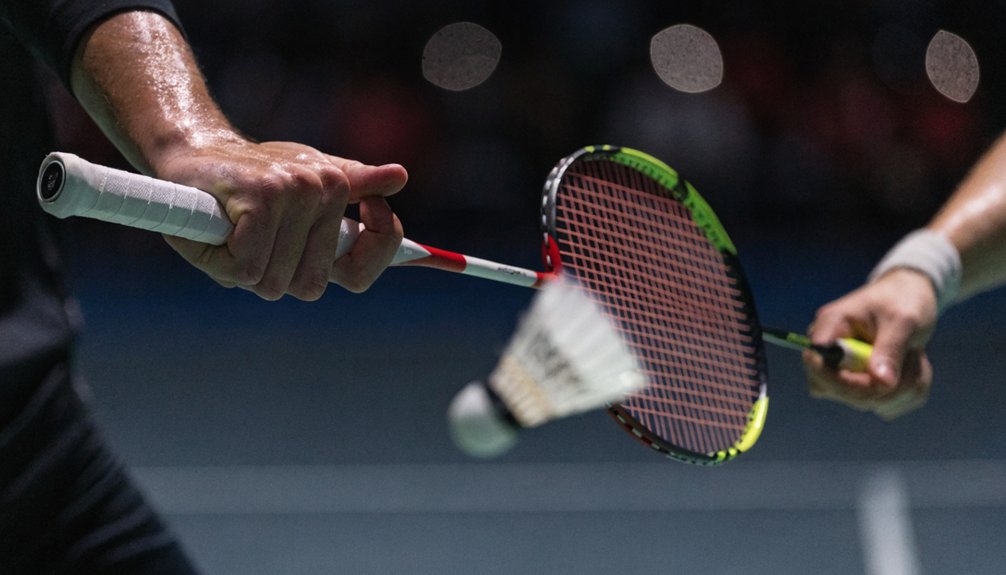
If you struggle to switch grips fast enough in chaotic rallies, you’re probably fighting your own technique more than your opponent. The key isn’t just “being quicker”; it’s setting a neutral base grip, assigning clear roles to each finger, and training specific switch patterns until they’re automatic at full speed. Once you understand which core grips matter, how loose you should stay, and which drills hard-wire the change, everything else starts to open up…
Key Takeaways
- Hold a neutral, finger-based grip between shots so you can quickly rotate to forehand or backhand without big hand adjustments.
- Keep grip tension light (around 3–4/10) and only tighten briefly on impact to avoid stiffness that slows grip changes.
- Practice isolated grip-change drills—rapid forehand/backhand switches without swinging, then with late adjustments after your partner starts their stroke.
- Use clean footwork to stay slightly behind the shuttle, keeping strokes in front of your body and grip options open.
- Do reaction drills where a partner calls or feeds randomly to force instant grip changes at increasing speeds, tracking and reducing mishandled grips.
How to Change Badminton Grips Faster (Step by Step)
Two small adjustments in how you move your fingers and relax your forearm can dramatically speed up your grip changes. First, set a neutral base grip: racket held mainly by your fingers, thumb and index forming a loose “V”, wrist relaxed. This lets you pivot, not squeeze. Mastery of grips also helps you adapt quickly to different shuttle positions during fast rallies, boosting both control and power.
Next, isolate finger roles. Use your thumb to “push” the grip for backhand, your index and middle fingers to “pull” it for forehand. Keep your ring and little finger light so the handle can rotate.
Drill 1: In ready position, alternate forehand–backhand grip 20–30 times without swinging, focusing on minimal handle rotation.
Drill 2: Add shuttle feeds; change grip only after the feeder starts the stroke, training late, efficient adjustments.
Common Grip Mistakes That Slow You Down (and How to Fix Them)
Now that you’ve got the basic grip change sequence, you need to eliminate three errors that sabotage your speed: overgripping and excess tension, poor thumb/finger placement, and switching late under pressure. Each one blocks clean racket rotation, delays stroke preparation, and leaks time in fast rallies. Let’s break these down and pair them with targeted drills so you can hardwire faster, more reliable grip changes. Paying attention to how your thumb and index sit on specific bevels in both the forehand and backhand grip will make your grip changes more precise and consistent.
Overgripping And Tension
Although a firm grip feels powerful, overgripping and excess tension actually slow your grip changes and reduce racket head speed. When you squeeze continuously, your forearm flexors stay contracted, making it harder to release, rotate, and re‑set the racket between shots.
Train a “relax–tighten–relax” sequence. In shadow swings, hold the handle loosely, then tighten only at the instant of “impact,” immediately releasing back to neutral. Use 20–30‑second bursts, focusing on smooth forearm rotation with minimal effort.


On court, play multishuttle drills where a feeder alternates clears, drives, and drops. Your task: maintain a light baseline grip pressure (about 3/10), briefly increasing to 6–7/10 only when striking. If your forearm burns or your shoulder lifts, you’re overgripping—reset, loosen, and rebuild the pattern.
Thumb And Finger Placement
Once your grip pressure is under control, the next limiter is how your thumb and fingers actually sit on the handle. If your thumb lies flat or wraps around, you lose leverage and can’t pivot quickly between grips. Place the thumb slightly diagonal on the bevel, with a small gap between the base of the thumb and index finger to keep the “V” shape.
Avoid letting your fingers collapse together. Instead, spread them slightly, with the index and middle finger leading the control. Practise “rocking” the racket using only thumb and index finger: alternate gentle push (thumb) and pull (index) without arm movement. Then add the other fingers as light stabilizers. This builds a compact, mobile hold that reorients instantly between forehand and backhand.
Switching Late Under Pressure
When rallies speed up, many players don’t miss because their grip is wrong, but because they switch grips half a beat too late under pressure. You hesitate, lock your fingers, and try to “finish” the previous stroke instead of already preparing the next.
Your fix is to rehearse grip switches as pre‑movement, not reaction. Micro‑relax your fingers right after contact and let the racket pivot, instead of squeezing through recovery. Use targeted drills:
| Problem under pressure | Drill solution |
|---|---|
| Late forehand–backhand switch | Multishuttle drives, coach randomizes forehand/backhand |
| Frozen fingers after smash | Smash–block–lift pattern, focus on instant relax |
| Panicking on body shots | Fast body drives, shuttle aimed at racket shoulder |
| Over-rotating handle | Shadow swings, small neutral-to-forehand shifts only |
| Predictable net grip changes | Feeder random net kill/tumble, grip changes on call |
The Core Forehand and Backhand Grips You Must Switch Between Fast
Before you can change grips quickly, you need a clear mental model of the two core positions you’ll be rotating between on almost every rally: the basic forehand grip and the basic backhand grip. Think of them as “home base” positions, not static holds. Your forehand grip aligns the racket face slightly closed, ready for overheads, drives, and pushes on your racket side. Your backhand grip rotates your hand around the handle, bringing the thumb behind the wider bevel for support on the non‑racket side. Over time, pairing fast grip switches with regular practice builds both consistency and the confidence to handle higher‑speed rallies.
Train the shift, not just the grips. Shadow-rally: alternate forehand and backhand drives across an imaginary net, calling “F” and “B” with each change. Aim for silent, minimal rotation while maintaining clear racket-face orientation.
How to Hold the Racket (and Stay Relaxed) for Instant Grip Changes
Think of your hand as a loose, articulated clamp that can slide and rotate around the handle, not a fist locked in place. Let the thumb and index finger form a “V” that steers the racket, while the last three fingers supply snap only at impact. Between shots, you’re at about 3–4/10 tension, never squeezing continuously. Using a light, maneuverable racket with an even balance makes it easier to stay relaxed in the hand while still generating quick grip changes and controlled power.
| Focus | Drill |
|---|---|
| Baseline Relax | Hold racket, pulse from 3/10 to 7/10 tension every second for 30 seconds. |
| Finger Control | Shadow swing, releasing then re‑closing last three fingers after each stroke. |
| Rotation Only | From neutral grip, rotate to basic forehand/backhand without swinging, 20 reps. |
| Pressure Check | After each rally, consciously loosen fingers before receiving the next shuttle. |
Footwork and Positioning for Faster Grip Changes
Although grip changes happen in your hand, they’re dictated by your feet and where your body is in relation to the shuttle. If you’re late or off-balance, you’ll lock into one grip and lose options. Clean footwork keeps your torso stable, your elbow in front of your body, and the racket in a neutral zone, so changing grip becomes almost automatic. Using stable, balanced movement patterns also helps you take full advantage of aerodynamic rackets that increase shot speed and make quick grip changes more effective.
Here’s how to position yourself for faster grip switches:
- Stay slightly behind the shuttle so you can hit in front of your body, not beside or behind you.
- Use small adjustment steps to align your hitting shoulder with the shuttle’s path.
- Lower your center of gravity so your wrist stays loose, not braced.
- Recover to base with racket in neutral grip, ready to adapt.
Solo and Partner Drills for High-Speed Grip Changes
Build grip speed the same way you build footwork—through targeted, repeatable drills that overload the skill. Start with “shadow switches”: stand in base, alternate forehand/backhand grips every half-second for 30–45 seconds, focusing on relaxed fingers and zero arm movement. Add “reaction switches”: partner calls “F” or “B” randomly; you change grip instantly without swinging.
For partner feeding, use three shuttles. Your partner hits flat drives to forehand, then backhand, then random. Your job’s to prepare the correct grip before shuttle crossing midcourt. Rotate in 15–20–rep bursts. As your grip changes improve, you can experiment with different shaft flexibility and head balances to see how equipment feel interacts with your control at high speed.
Finish with pressure drills: multi-shuttle drive exchanges where you must maintain correct grip orientation while increasing pace every 5 shots. Track mishandled grips as errors and aim to reduce them each set.