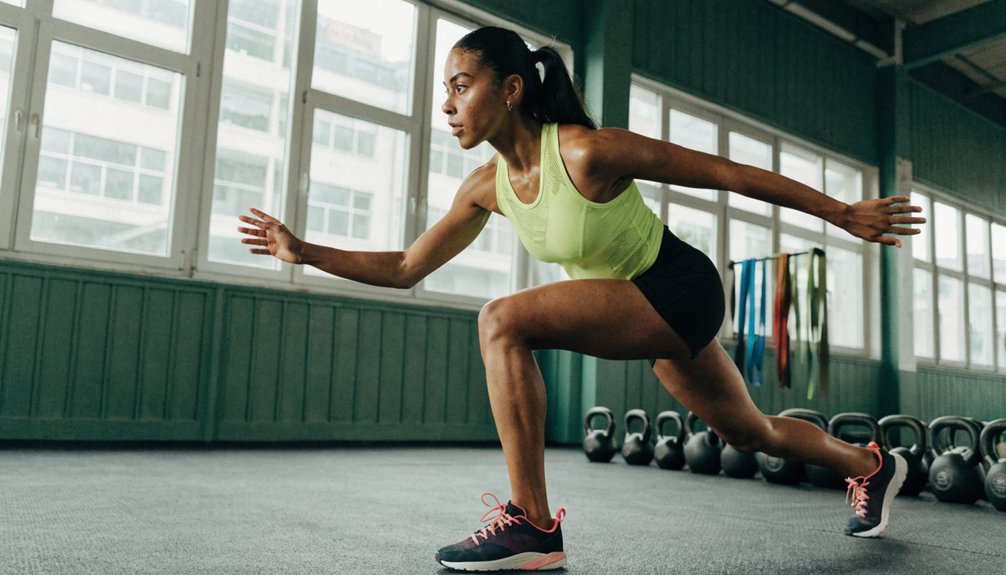
If you wobble or feel drained after lunges, you’re not weak—you’re likely missing a few key details in form, stability, and recovery. How you place your feet, stack your joints, and brace your core will determine whether each rep builds strength or just burns energy. Pair that with targeted mobility and smart post-set habits, and you’ll stabilize faster and bounce back sooner. The difference comes down to a few specific adjustments you probably haven’t tried yet.
Key Takeaways
- Use a controlled descent and keep your torso stacked over your hips, ensuring the front knee tracks over the second toe to maintain balance.
- Create a stable “tripod foot” by pressing big toe, little toe, and heel evenly into the ground, avoiding gripping with your toes.
- Lightly brace your core and exhale as you rise from the lunge to improve trunk stability and reduce wobbling.
- Before lunges, perform ankle, hip, and thoracic mobility drills (5–8 reps each) to improve range of motion and reduce compensations.
- After lunges, walk for 2–3 minutes, then use dynamic and gentle static stretching, monitoring for sharp pain or swelling as signs to rest.
Why You Wobble After Lunges (And What’s Normal)
Instability is a built-in feature of lunges, not a flaw, and some wobbling is a normal response to a challenging movement. When you lunge, you’re narrowing your base of support and loading one leg, so your center of mass shifts and your stabilizers have to react quickly. That reactive “shake” is your nervous system fine-tuning joint position.
You’ll wobble more if you’ve recently increased load, volume, or lunge variations, because your neuromuscular system hasn’t fully adapted. Fatigue also plays a role: when the glutes, quads, and calves are tired, smaller stabilizers work harder, so balance feels less reliable. Mild, controllable sway that you can correct without stepping out is normal; repeated loss of balance or knee collapse isn’t.
Fix Your Lunge Form for Better Balance
That normal wobble you feel after lunges isn’t a problem on its own, but your technique can either keep it manageable or push you into “nearly tipping over” territory. Start with your stance: step far enough that, at the bottom, both knees are around 90 degrees and your front shin is roughly vertical. A too-narrow or too-short stance magnifies side-to-side sway.
Keep your torso stacked over your hips instead of drifting forward or arching hard. Think “ribs over pelvis” as you lower straight down rather than lunging forward. Control the descent; a faster drop increases instability and braking demands.
Track the front knee in line with your second toe. Valgus collapse (knee caving in) not only harms balance but also wastes force production.
Use Simple Foot and Core Cues to Stay Steady
Two key anchors keep you upright after lunges: your feet and your core. Think “tripod foot”: press the big toe, little toe, and heel evenly into the floor. This widens your base, improves force transfer, and reduces wobble shown in balance studies. Avoid gripping with your toes; instead, feel the whole sole connect.
Next, lock in your midsection before and after each rep. Lightly brace—as if preparing for a cough—so your ribs stack over your pelvis. This creates stiffness through the trunk, giving your legs a stable platform.


Add a simple cue: exhale gently as you rise, maintaining that brace. If you feel shaky, reset: tripod the foot, stack the ribs, and re-brace before moving again.
What To Do Right After Each Lunge Set
Right after each lunge set, take 15–30 seconds to “audit” your body instead of just racking the weight and walking away. Stand tall, feet hip‑width, breathing through your nose. Scan from the ground up: Are your feet gripping evenly, or is more pressure on the toes or outer edge? Is one hip rotated forward?
Check your knees: do they feel irritated, or like they were collapsing inward? Note which leg felt less stable or weaker; that’s your priority side next set. Place a hand on your lower ribs—are they flared or stacked over your pelvis? If your breathing’s still shallow or rushed, extend rest until you can inhale quietly for 3–4 seconds and exhale for 4–6. Then start the next set.
Mobility Drills for More Controlled Lunges
Once you’ve audited each set, the next lever for better balance is improving how your joints move before you lunge. Limited ankle, hip, or thoracic mobility forces you to compensate, making wobbling and trunk sway more likely.
Prioritize ankles first: perform half-kneeling dorsiflexion rocks, driving your front knee over toes without the heel lifting. This improves forward knee travel so you don’t tip or lean.
Next, target hips with dynamic hip flexor rocks and 90/90 rotations, keeping your spine tall and ribs stacked. You’ll access deeper, more stable lunge positions instead of collapsing.
Finish with thoracic spine openers, like quadruped thread-the-needle, to maintain an upright torso. Cycle through these drills for 5–8 controlled reps each before your first working set.
Strength Moves for Better Post-Lunge Balance
Now it’s time to build the strength that actually keeps you from wobbling after each rep, starting with targeted core stability work. When your deep core can brace effectively and your ankles and hips can generate and control force, your center of mass stays stacked over your base of support. You’ll focus on precise, strength-based drills that improve trunk stiffness, ankle stiffness, and hip strength so your post-lunge balance becomes automatic rather than a struggle.
Core Stability Enhancers
Although lunges are a lower-body exercise, your core is the anchor that keeps you upright, stable, and efficient as you move in and out of each rep. Research links better lunge balance to stronger anti-rotation and anti-extension core strength, not endless crunches. You’re training your torso to resist motion so your front knee and torso don’t wobble.
Use these targeted moves:
| Exercise | Key Cue | Why It Helps Post-Lunge Balance |
|---|---|---|
| Front plank | Ribcage down, glutes tight | Prevents torso collapse and over-arching |
| Side plank | Hips stacked, don’t sag | Controls side-to-side knee drift |
| Dead bug | Low back “cemented” to floor | Trains limb movement with trunk stability |
| Pallof press hold | Resist cable rotation | Builds anti-rotation strength for control |
Do 2–3 sets, 20–40 seconds each, 3x weekly.
Ankle And Hip Strength
Even with a rock-solid core, you’ll struggle to stick the landing after lunges if your ankles and hips are weak or stiff. Strong, mobile ankles let you “read” the floor and correct micro-wobbles fast, while powerful hips control knee alignment and push-off.
Prioritize single-leg strength. Do rear-foot elevated split squats, driving through your front heel, tracking the knee over the middle toes, and keeping your pelvis level. Add tempo (3–4 seconds down) to build control.
For ankles, perform single-leg calf raises on a step, using a slow eccentric and full stretch; progress by adding weight and doing them barefoot when possible.
Finally, include lateral band walks and single-leg Romanian deadlifts to build frontal-plane hip stability that directly translates to steadier post-lunge recovery.
Post-Lunge Recovery Habits and When to Back Off
After your lunges, smart cooldown habits—like targeted stretching, light mobility work, and controlled breathing—help your nervous system reset so you maintain balance gains instead of “locking in” poor patterns. You’ll also want to watch for specific warning signs—sharp joint pain, lingering instability, or asymmetrical soreness—that signal it’s time to back off rather than push through. By pairing intentional recovery with clear red flags, you protect your mechanics, speed adaptation, and reduce your risk of balance-related setbacks.
Smart Post-Lunge Cooldowns
Once your last rep is done, what you do in the next 5–10 minutes can determine whether your lunges build strength and stability or leave you stiff and off-balance. Start with 2–3 minutes of easy walking to normalize heart rate and clear metabolites from your legs.
Then move into targeted mobility. Use dynamic stretches first: controlled leg swings, walking hip openers, and ankle circles to reset joint range without over-lengthening tissues. Follow with 20–30 seconds of static stretches for hip flexors, glutes, and calves, holding neutral spine and square hips.
Finish with low-level balance work while muscles are warm: single-leg stands or a short tandem walk, focusing on even weight through the foot and steady breathing to reinforce postural control.
Warning Signs To Rest
Although lunges are a staple for building strength and stability, specific post-workout signals tell you it’s time to back off rather than push through. Sharp or pinpoint knee pain—especially around the patellar tendon—or joint locking suggests technique breakdown or overload, not “good soreness.” Stop if you feel sudden low-back pain, radiating tingling, or numbness in the legs; these can indicate nerve irritation or poor trunk control.
If your balance worsens set to set, or your front knee keeps caving inward despite cues, fatigue is compromising form. Excessive swelling, warmth, or visible asymmetry around a knee, ankle, or hip demands rest and possibly medical assessment. Respecting these warning signs lets you adjust volume, refine mechanics, and return stronger.