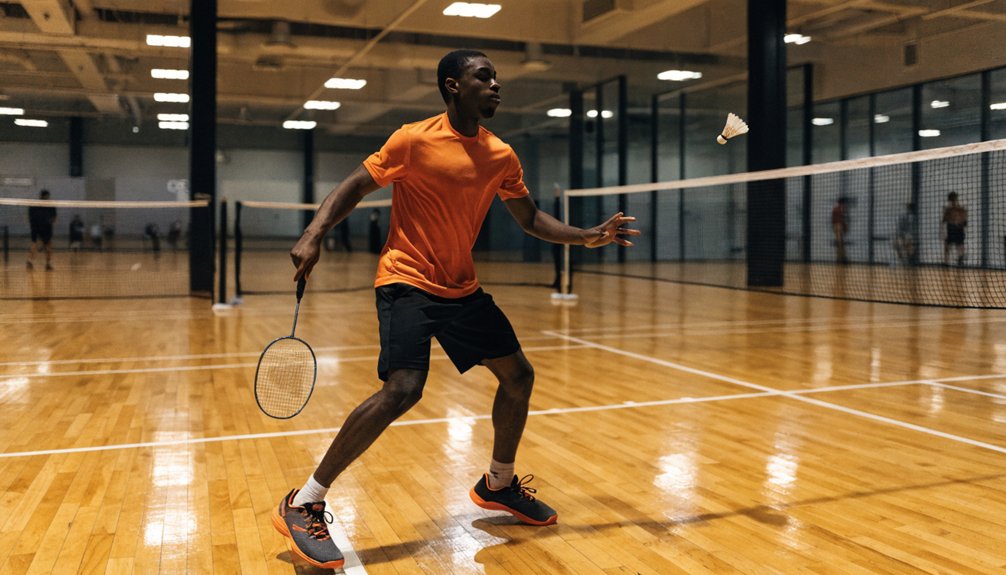
In a club match, you might notice a player who reaches every shuttle early yet hardly breaks a sweat, while you’re exhausted by the second game. The difference isn’t fitness alone; it’s how efficiently you move. Your stance, split-step timing, and choice of footwork pattern decide how much energy each rally costs you. If you want to cover the court faster while using less effort, you’ll need to fix a few specific habits first.
Key Takeaways
- Use a low, balanced ready position with knees flexed and weight on the balls of your feet to move efficiently in any direction.
- Time your split step to land exactly as your opponent hits, so your first step is explosive instead of wasting energy reacting late.
- Follow clear court patterns (front lunge, rear chasse/cross, quick recovery to base) rather than random chasing, to save steps and stamina.
- Take short, compact adjustment steps and avoid oversized lunges or excessive bouncing, which quickly fatigue your legs without improving reach.
- Build off-court endurance and leg strength with interval runs, skipping, and lunges so efficient footwork feels easier and less tiring in matches.
Fix Your Badminton Stance and Footwork Ready Position
Your ready position is the foundation of efficient badminton footwork, so you must standardize it before refining movement patterns. Stand with feet slightly wider than shoulder‑width, dominant foot half a step back, weight on the balls of your feet. Keep knees flexed about 20–30 degrees and hips hinged slightly so your center of gravity stays low and balanced. To fully capitalize on this stance, combine it with a comfortable, neutral basic grip that you can quickly adjust for both forehand and backhand shots. Align your torso square to the net, shoulders relaxed but active. Hold the racket in front of your body at chest height, elbow away from the torso, with the non‑racket hand slightly forward for balance. Distribute weight evenly, avoiding heel contact and locked knees. Maintain a neutral spine and keep your head level, eyes forward, so you can track the shuttle early.
Master Your Split Step Timing for Faster Starts
To master split step timing, you’ll need to read your opponent’s racket and body cues so your jump isn’t random but directly linked to their stroke preparation. You must synchronize the upward phase of your split step with their hitting motion so that you land exactly as they contact the shuttle, giving you explosive first-step acceleration. From there, you’ll reset to your ready position instantly after each movement, maintaining a continuous rhythm of split step, push-off, and recovery. Sharpening this timing also helps you stay composed under mind games and psychological tactics, so you can keep your focus on reading the shot instead of reacting to your opponent’s behavior.
Reading Opponent’s Cues
Although split stepping is often taught as a fixed habit, its real effectiveness depends on how accurately you read your opponent’s cues and sync your landing with their shot. To do this, you must track three things: racket preparation, shoulder rotation, and approach path to the shuttle.
First, watch the racket face: open face suggests a lift or net shot; a closed face suggests a drive or smash. Second, read the hitting shoulder: a relaxed, low shoulder often precedes a soft shot; a loaded, externally rotated shoulder signals power.
Third, use the opponent’s footwork: a wide lunge or deep step under the shuttle usually indicates a defensive stroke; a balanced, upright base near the rear court often precedes an attacking shot.
Synchronizing Jump And Landing
Once you can read those cues, split step timing becomes a matter of synchronizing your jump so that both feet land exactly as your opponent strikes the shuttle. You’re converting vertical loading into horizontal acceleration, so the contact moment is critical. If you land early, you’ll lose stored elastic energy; if you land late, you’ll react after the shuttle’s gone.
Use this progression: first, shadow without a shuttle, clapping your hands to simulate impact and landing exactly on the clap. Next, have a feeder perform slow, exaggerated strokes; initiate your jump just as their hitting arm starts forward, so you land when racket meets shuttle. Keep the jump small, hips low, and ankles “springy” to minimize fatigue while maximizing push-off speed.


Resetting To Ready Position
Every high‑level rally hinges on how quickly you reset to a neutral, balanced stance after each shot, because your next split step is only as good as the position you recover into. Immediately after hitting, reverse your momentum with small, controlled adjustment steps, not long strides. Aim to re-center on the baseline-intercept line relative to the shuttle, not the geometric court center.
Keep feet just wider than shoulder-width, toes slightly open, heels light. Maintain a low hip level, knees flexed, chest inclined forward, and racket held in front of your body. Your weight should stay on the balls of your feet, evenly distributed but ready to bias forward.
Drill this by shadowing: hit, recover three small steps, lock into ready, then perform a timed split step.
Use Simple, Efficient Badminton Footwork Patterns
When you build your movement around simple, efficient footwork patterns, you reduce wasted motion and reach the shuttle earlier with less effort. You’re aiming for predictable, repeatable routes from your base to each corner, not improvised running.
Map the court into six zones: front left/right, mid left/right, rear left/right. For each, drill a fixed pattern from your base: pivot, initial push-off, directional steps, plant, then recovery. For rear corners, use a pivot plus chasse or cross-step; for front corners, use a forward lunge pattern from your base. Incorporating footwork drills alongside these patterns helps enhance agility and movement efficiency so you can cover the court with less fatigue.
Always move out and recover along the same lines to make your patterns automatic. Repetition creates “default paths,” so under pressure you’ll still move economically instead of sprinting inefficiently.
Use Small, Balanced Steps to Save Energy
Those fixed patterns only work efficiently if your individual steps are compact and controlled. You want each step to be short enough that your center of gravity stays between your feet, so you’re always ready to push off in any direction. Keep your base slightly wider than shoulder-width, with knees flexed and heels light.
Use quick, micro-adjustment steps—sometimes called “chasse” or side shuffles—rather than big lunges whenever possible. This distributes muscular load across more, smaller contractions instead of a few exhausting ones. Emphasize smooth weight transfer: push from the rear foot, land softly on the front foot, then immediately re-center. Incorporating focused footwork drills into your routine builds the speed and agility to maintain these compact steps without getting tired.
In practice, shadow-move to specific corners using three to five small steps, then recover, maintaining the same compact stride length.
Avoid Badminton Footwork Mistakes That Make You Tired
When your footwork is inefficient, you waste energy through common habits like overstriding, crossing your feet, and stopping with heavy brakes. To stay fresh deeper into rallies, you’ll need correct alignment of your hips, knees, and feet so force transfers cleanly through your body. You’ll also refine your recovery steps so you return to base quickly with minimal extra movement. Just like choosing a racket based on your style of play, refining footwork should be tailored to how you move and play on court so you conserve the most energy.
Common Energy-Wasting Habits
Although you might feel that you’re simply “not fit enough,” fatigue in badminton often comes from inefficient footwork patterns that waste energy on every rally. You typically lose stamina through unnecessary steps, inconsistent base recovery, and poorly timed movements.
First, you might “chase” the shuttle with many small, random steps instead of using a planned split step and 2–3 efficient lunges or chasse steps. Second, you may stay too close to the front or back court after each shot, forcing long, exhausting sprints to the opposite corner.
Third, you might jump when it’s not required: excessive bouncing between shots raises heart rate without improving reach. Finally, delayed initiation—reacting late instead of moving on opponent contact—creates frantic, energy-heavy footwork.
Correct Footwork Body Alignment
Even with efficient patterns, poor body alignment in your footwork makes you work harder for every shot and drains stamina quickly. Keep your hips, shoulders, and knees facing roughly the same direction as your movement line; don’t twist the torso against the direction of travel. This reduces shearing forces on joints and stops you from muscling through steps.
Maintain a slight forward lean from the ankles, not the waist, so your center of mass stays over the balls of your feet. Your knees should be flexed, never locked, to absorb impact and enable rapid directional change. Land with the foot pointing where you’re going, avoiding inward collapse of the knee. This neutral alignment minimizes friction, wasted muscular effort, and cumulative fatigue.
Efficient Recovery Steps
Instead of admiring a single explosive lunge, you should prioritize how quickly and efficiently you return to your base position after each shot. Recovery steps determine whether you’re prepared for the next shuttle or chasing it in fatigue. After contact, initiate a small push-off from your front leg, transferring force through the hips so your center of gravity travels directly back toward your base, not sideways.
Focus on:
- Short, economical steps: Avoid big, bounding strides; use quick shuffles that keep your feet close to the floor.
- Neutral base width: Recover to a stance slightly wider than shoulder-width to maintain balance and multi-directional readiness.
- Continuous split-step timing: As you reach base, perform a light split-step synchronized with your opponent’s hit to reset explosively.
Do Off-Court Training to Boost Badminton Footwork Endurance
When you step away from the court, targeted conditioning work becomes the most efficient way to build the stamina your footwork demands. You should prioritize interval running, skipping, and strength work that mimics badminton’s short, explosive rallies with brief recoveries. Structure sessions 2–3 times weekly, focusing on lower-body power and aerobic capacity. Incorporating racket-specific drills that emphasize lightweight racket maneuverability can further align your off-court conditioning with the quick reactions and precise footwork demanded in intense rallies.
| Focus Area | Example Off-Court Drill |
|---|---|
| Aerobic base | 20–30 min steady run at conversational pace |
| Anaerobic bursts | 10 × 30 s hill sprints, 60–90 s walk recovery |
| Elastic rebound | Skipping rope: 5 × 2 min, 1 min rest |
| Multi-directional | Cone shuttles with planned change-of-direction |
| Strength-endurance | Walking lunges + calf raises, 3 × 15 each leg |
Always maintain strict form and track times, distances, and sets to guarantee progressive overload without overtraining.