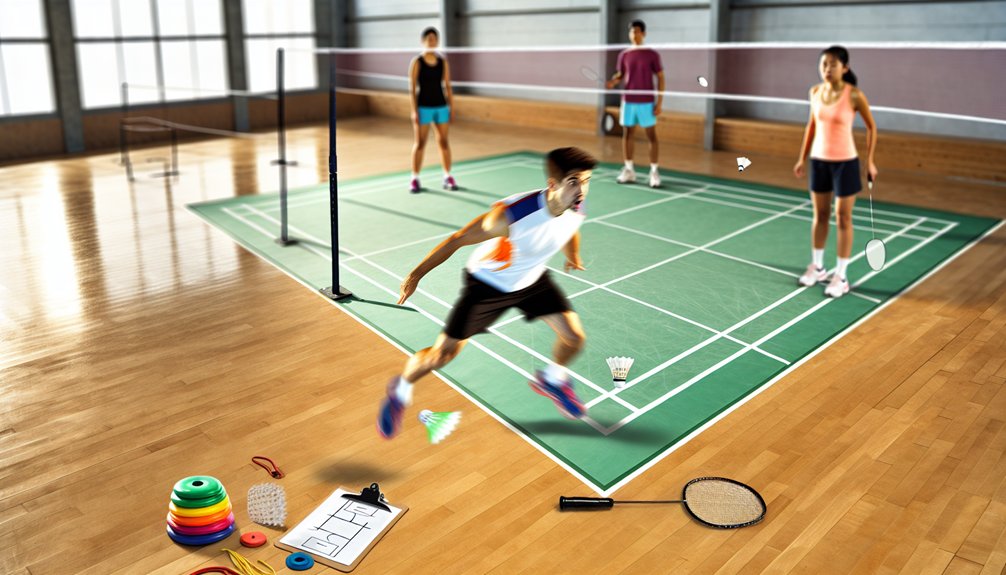
If you want steady badminton progress through 2026, you can’t rely on random drills or occasional matches—you need a weekly structure that ties every session to a clear performance outcome. By mapping your current level, setting measurable goals, and organizing technical, tactical, and physical work with built‑in recovery, you give yourself a system that compounds. The key is knowing what to do on which day, in what order, and how to adjust when performance stalls.
Key Takeaways
- Structure 5–6 weekly sessions balancing technical drills, tactical games, conditioning, and recovery, with at least one lighter day for adaptation.
- Assign each session a primary focus (e.g., overheads, net play, defense, footwork) and progress from isolated drills to game-like pressure.
- Track measurable metrics weekly: clear depth, unforced errors, rally length, court-sprint times, and work rate under fatigue for objective progress.
- Integrate dedicated footwork blocks (shadow, multi-shuttle, direction-change drills) 2–3 times weekly to improve acceleration, coverage, and recovery.
- Schedule one structured match-play session weekly with specific tactical goals and post-match review to adjust future training blocks.
Understanding Your Current Level and Goals
Before you design any badminton training plan, you need a clear picture of your current level and specific performance goals. Assess your technical skills objectively: consistency of clears, drops, smashes, net shots, lifts, serves, and basic footwork patterns. Note which strokes break down under pressure or fatigue.
Next, evaluate physical capacities: acceleration, change of direction, recovery between rallies, and ability to sustain high‑intensity movement across games. Track match outcomes and point patterns to see where you actually lose points: weak rear‑court coverage, poor net control, limited shot variety, or decision‑making errors.
Define measurable targets with timelines, such as improving rear‑court clear depth, reducing unforced errors per game, or increasing rally tolerance, so every future training block has a clear performance purpose.
Core Principles of an Effective Weekly Badminton Plan
Once you understand your level and targets, an effective weekly badminton plan aligns every session with a specific performance outcome instead of just “getting court time.” Your week should balance technical work (stroke mechanics and consistency), tactical training (patterns, decision‑making, shot selection), physical conditioning (speed, strength, endurance), and recovery. Integrate regular equipment checks—such as reviewing string tension and racket technology features—to ensure your gear supports the speed, power, and control demands of each training block. Every element must serve measurable progress: tighter shot quality, smarter rally construction, higher work rate, and stable execution under fatigue. You’ll prioritize session quality over volume, using clear objectives and simple metrics (rally length targets, unforced‑error limits, heart‑rate zones). Plan progressive overload across weeks, not random intensity spikes. Protect at least one lighter day to consolidate adaptations and prevent overuse. Finally, repeatedly test match‑relevant benchmarks so your weekly structure stays aligned with long‑term performance goals.
Structuring Technical Skill Sessions Across the Week
With clear weekly principles in place, the next step is to schedule technical work so it builds reliably from session to session instead of repeating the same drills on autopilot. Start by assigning each day a primary technical focus: one day for overhead strokes (clear, drop, smash), one for net skills (tumbles, tight net shots, lifts), one for serves and returns, and one for defensive strokes and blocks. Because your technique interacts directly with your equipment, make sure you’re using an appropriate badminton racket for your skill level and style so you can feel the effect of improvements in timing, grip, and swing mechanics more clearly. Within each session, progress from isolated technique to controlled application: shadow swings or feeding → predictable multishuttle → semi-random feeding → game-like constraints. Keep a small “always present” block (5–10 minutes) for your biggest technical weakness so it’s addressed several times per week. Track specific cues (e.g., racket preparation, contact point, grip changes) and repeat them consistently across sessions.
Footwork and Movement Patterns for Court Coverage
Treat footwork as your engine: if it’s inefficient, your strokes never reach full potential. Build movement patterns systematically: split step, first step, travel phase, braking, and recovery. Early in the week, isolate patterns: front-court lunge, rear-court chasse, side-step, cross-step, and pivot, always starting from a neutral base.
Structure sessions with short, precise intervals: 15–25 seconds of multi-directional shadow movement, 20–30 seconds rest, repeated for 6–10 sets. Emphasize low center of gravity, quiet landings, and controlled deceleration at each contact point.


Progress from simple, pre-planned patterns (front–back, side–side) to random, call-based directions. Finally, integrate footwork with shot timing—arrive before impact, stabilize, then recover to base quickly, ready for the next exchange.
Strength, Power, and Conditioning for Badminton Players
Although badminton looks light and elastic from the outside, your game depends on hard, quantifiable strength, power, and conditioning beneath the finesse. You’re building a body that can lunge explosively, jump repeatedly, and recover fast between rallies without technical drop‑off.
Across the week, you’ll target lower-body force, rotational power, upper-body speed, and energy-system conditioning. Think regarding sets, intensities, and clear progress metrics, not random “fitness.”
- Heavy split squats and deadlifts to raise force output for deeper, faster lunges
- Plyometric hops, bounds, and jump lunges for vertical and horizontal explosiveness
- Medicine-ball rotational throws to sharpen hip–torso–shoulder power transfer
- Push presses and band work for rapid overhead and forearm acceleration
- Intervals: 15–40 second high-intensity bouts with short rests to match rally demands
Integrating Match Play and Game-Like Drills
To convert your physical preparation into on-court results, you’ll structure weekly match sessions that target specific tactical and psychological objectives rather than just “playing games.” You’ll also design game-like drills that replicate real scoring pressure, shot patterns, and movement demands with controlled constraints. Together, these elements create a progression where every rally in training directly builds competitive performance.
Structuring Weekly Match Sessions
When you structure weekly match sessions around both full games and targeted game-like drills, you convert “just playing” into a controlled, progressive testing environment. You’re not chasing random wins; you’re tracking whether specific skills hold under pressure, fatigue, and score stress. Anchor each week with clear tactical themes and measurable constraints.
Use a consistent match-session template so your progress is comparable week to week:
- Warm-up sets to groove timing and footwork.
- Short games to 11 with focused tactical objectives.
- Full games to 21 emphasizing consistency and decision quality.
- Situational scoring (e.g., start 15–18 down) to pressure-test closing skills.
- Post-session review: key stats, patterns, and one adjustment for the next week.
This structure keeps match play intentional, repeatable, and performance-driven.
Designing Game-Like Drills
Structured match sessions give you the test environment; game-like drills build the specific weapons you’re testing. Design your drills to mirror real rally patterns: serve + third shot, lift–smash–net, or push–drive–counter. Fix scoring constraints (race to 7, only backhand receives, etc.) so every rally targets a tactical goal.
Start with low-variability versions: predictable feeds, defined zones, controlled tempo. Then increase chaos: varied feeds, full court, live scoring. Use role-based drills—“attacker vs defender,” “front-court controller vs lifter”—so you’re rehearsing decision chains, not isolated strokes.
Tie each drill to a weekly match theme: e.g., “dominate mid-court,” “finish at the net.” Track outcomes (conversion %, error rate, shuttle quality) to verify that drills actually transfer to match play.
Recovery, Mobility, and Injury Prevention Habits
Although it’s tempting to focus only on hitting harder and moving faster, your long‑term progress in badminton depends just as much on how well you recover, maintain mobility, and prevent injuries. You’re building a body that can tolerate repeated high‑speed decelerations, lunges, and jumps without breaking down.
Think regarding daily, low‑friction habits:
- 5–10 minutes of dynamic mobility for ankles, hips, and thoracic spine before every session
- Light post‑training static stretching emphasizing calves, hip flexors, glutes, forearms, and shoulders
- Simple strength “armor” work: Nordic curls, single‑leg RDLs, calf raises, external shoulder rotations
- Scheduled easy days with only light movement and soft‑tissue work (foam rolling, massage ball)
- Objective monitoring: RPE, soreness, and sleep duration to guide when to push or back off
Sample Weekly Training Schedules for Different Levels
Now you’ll translate principles into practice with concrete weekly structures, starting with a beginner weekly training example and progressing to an intermediate weekly training plan. You’ll see how to organize on-court sessions, physical conditioning, and recovery blocks so that each week builds specific technical, tactical, and physical capacities. Use these models as blueprints you can scale up or down based on your current level and match calendar. Integrate focused work on key techniques like grips, basic strokes, and footwork into these weekly structures so your tactical and physical development is always grounded in sound badminton fundamentals.
Beginner Weekly Training Example
A simple, well-planned beginner week gives you enough volume to improve without overloading your body or reinforcing poor technique. Aim for 3–4 on-court sessions plus 1–2 short off-court blocks, keeping total weekly training around 4–5 hours. Prioritize consistency, footwork quality, and basic stroke mechanics over intensity.
- Day 1 – Technical base: 45–60 min: grip drills, forehand/backhand drives, net shots, slow shadow footwork.
- Day 2 – Movement skills: 40–50 min: split-step practice, 2–3 point shadow patterns, light multi-shuttle.
- Day 3 – Recovery / mobility: 20–30 min: dynamic mobility, light band work, core stability.
- Day 4 – Integrated play: 45–60 min: serve routines, simple patterns, controlled half-court games.
- Day 5 – Optional conditioning: 20–30 min: low-impact cardio, basic strength (squats, lunges, rows).
Intermediate Weekly Training Plan
As your skills stabilize beyond the basics, an intermediate weekly plan should deliberately increase intensity, complexity, and volume while protecting your joints and refining efficiency. You’re now targeting sharper footwork patterns, higher rally tolerance, and more precise shot production under pressure.
Train 5–6 days per week, alternating stress and recovery. Use 2–3 on-court technical/tactical days, 2–3 physical days, and 1 active recovery day. Keep each session focused and measurable.
| Day | Focus Type | Key Emphasis |
|---|---|---|
| Mon | On-court | Multi-shuttle, front–back/base recovery patterns |
| Wed | Physical | Strength, elastic power, core stability |
| Sat | Match / Review | Conditioned games, video or notes analysis |
Progress by tightening work–rest ratios, expanding multi-shuttle sets, and raising movement speed while keeping strokes technically clean.
Tracking Progress and Adjusting Your Weekly Workload
Use simple, objective metrics and review them every 1–2 weeks:
- Track session RPE (1–10) and total minutes to monitor training load trends.
- Time standardized court sprints and shadow-footwork patterns for speed changes.
- Record rally length and unforced errors in practice games to gauge match readiness.
- Log technical focuses (e.g., backhand clear consistency) with made/attempted counts.
- Note sleep, soreness, and niggles to catch overload early.
When performance plateaus or fatigue climbs, reduce volume 20–30% for a week, then rebuild gradually. Incorporate periodic checks of your racket’s sweet spot contact consistency during drills to ensure your technique and equipment are supporting your progress.
Staying Motivated and Consistent Through 2026
Once your progress metrics are in place, you need systems that keep you training hard and smart for the long haul. Anchor motivation with clear outcome goals (rank, tournament level) and process goals (weekly footwork volume, quality rallies, strength loads). Translate them into a visible calendar so you can’t ignore skipped sessions.
Use “if–then” plans: “If I finish work late, then I do a 25‑minute condensed session.” This prevents all‑or‑nothing thinking.
Protect consistency with fixed training slots, pre‑packed gear, and defined session templates. Track “motivation‑independent” habits: warm‑up, sleep window, hydration, and cooldown. Drawing inspiration from programmes like Shuttle Time initiative, you can build a routine that emphasises structured, inclusive practice to keep you engaged over time.
Review video monthly to see technical gains; review match stats quarterly to confirm competitive progress. Continuous evidence of improvement sustains intrinsic drive through 2026.