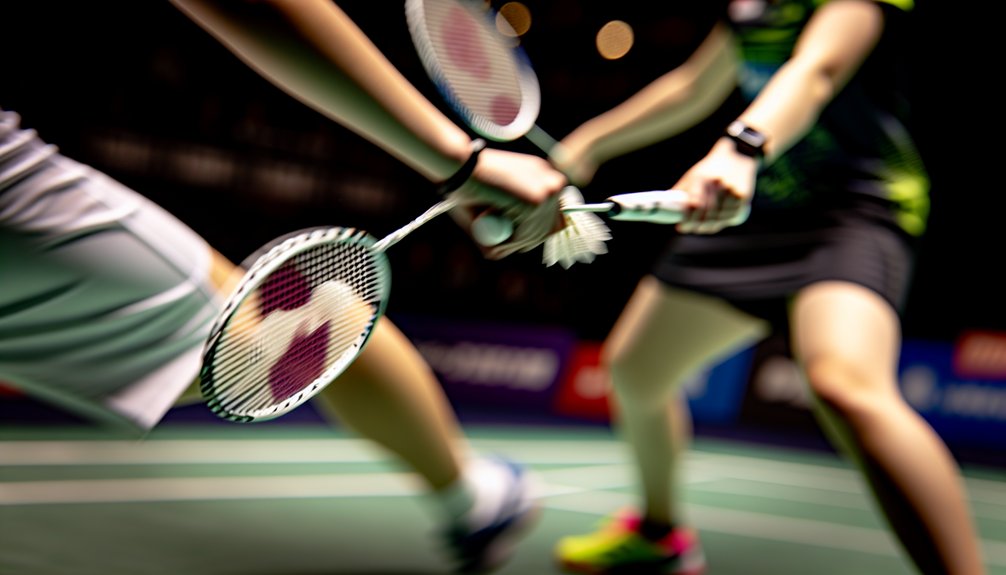
You notice the Victor Auraspeed Fantôme F 2026 feels faster through the air before you even complete your first drive. With its compact head, aero frame profile, and moderately head-light balance, it’s built for quick preparation and explosive acceleration in fast doubles exchanges. If you like taking the shuttle early, punishing loose lifts, and turning defense into instant counter-attack, you’ll want to understand how this frame really behaves under pressure.
Key Takeaways
- Offense-tuned, compact aero frame and slightly stiff shaft give a crisp, fast feel ideal for front-court doubles pressure and quick interceptions.
- Moderately head-light balance and light overall weight enhance maneuverability, enabling rapid racket repositioning during drives and flat exchanges.
- High frame stability and reinforced T-joint reduce twisting, improving line control in rapid rallies and aggressive counter-attacks.
- Best suited for attacking doubles players who take the shuttle early, value anticipation, and like controlling tempo at the net and mid-court.
- Pair with 0.66–0.68 mm at 24–26 lbs for explosive, fast-control drives, or 0.69–0.70 mm at 23–25 lbs for more touch and stability.
Key Specs and Design Overview
Although it borrows the Auraspeed family name, the Victor Auraspeed Fantôme F 2026 is a distinct, offense‑tuned frame built for fast, front‑court dominant play. You’re getting a compact, aero-profiled head with a slightly stiff shaft that favors quick, decisive hits over lazy swing mechanics. The design features prioritize reduced air resistance, a reinforced T‑joint, and a stable lower hoop to keep the head from twisting on fast interceptions. Drawing on modern aerodynamic rackets principles, its frame shaping is optimized to cut through the air and increase shot power and speed during rapid exchanges.
In terms of key specs, you’re looking at a doubles‑oriented weight class, a moderately head‑light bias, and a mid‑slim shaft diameter that translates into responsive repulsion. Performance metrics skew toward explosive shuttle release on drives and flat pushes, efficient energy transfer on sharp stick smashes, and reliable frame stability under pressure.
Handling, Balance, and Swing Speed
Because the Fantôme F 2026 pairs a moderately head‑light balance with a compact, aero head, its handling feels immediately biased toward fast preparation and recovery rather than heavy follow‑through power. You’ll notice it most in flat exchanges and rapid drive battles, where the reduced swing weight lets you reset your racket position a fraction earlier than your opponents. The frame stability is high for such a maneuverable profile, so the head doesn’t twist when you’re intercepting smashes or taking shuttles late at the tape. That stability, combined with clean aerodynamics, keeps your swing path efficient under pressure. Grip comfort supports relaxed fingers, encouraging quick grip shifts for forehand–backhand shifts and late, deceptive changes of direction. This combination of light overall weight and an even‑feeling balance across the frame supports enhanced maneuverability and control in the kind of fast doubles exchanges where quick reactions decide the rally.
Shaft Stiffness, Feedback, and Feel
While the Fantôme F 2026 isn’t brutally stiff, its shaft sits firmly on the upper‑medium side, tuned for efficient energy return without feeling board‑like. You get clean shaft responsiveness that rewards compact, technically sound strokes without punishing you on late contacts. It’s engineered to load predictably and unload on‑axis, so you feel exactly what your mechanics are doing. This pairs naturally with modern graphite rackets that emphasize stability, vibration dampening, and precise feedback to the hitting hand.
You’ll notice:
- Crisp impact definition – mishits, sweet‑spot strikes, and frame contacts all feel distinct, sharpening player feedback.
- Controlled flex window – the shaft bends just enough to stabilize timing without over‑whipping.
- Low torsional blur – reduced twist keeps the shuttle’s exit line readable in your hand.
- Transparent touch – net kills, blocks, and quick holds feel immediate, not muted.
Performance in Drives and Flat Exchanges
In fast drives and flat exchanges, the Fantôme F 2026 behaves like a stability‑biased speed frame, prioritizing line control and repeatability over reckless punch. You’ll feel the head react quickly yet stay composed, so the frame doesn’t twist when you’re taking the shuttle early or redirecting pace off the body.
The slightly head‑light balance and responsive shaft work together to keep your stroke compact, which directly boosts drive consistency under pressure. You don’t need a big shoulder swing; a short, forearm‑led action produces a penetrating, flat trajectory. When opponents lift the pace, the racket lets you absorb and reapply speed without over‑hitting. It’s particularly effective for holding straight lines, then snapping sharp angles once you’ve established control in flat exchanges.


This kind of stability‑oriented speed performance is similar to how Li‑Ning’s Aeronaut technology minimizes air resistance to enhance control during rapid, flat exchanges.
Net Play, Interceptions, and Front-Court Control
With the Auraspeed Fantôme F 2026 in your hand, net play becomes a platform for aggressive interceptions rather than passive blocks. You’re able to step in early, cut the shuttle in front of your body, and convert half-chances into outright winners through sharp, controlled racket acceleration. Its fast frame works best when paired with quick reflexes and proactive positioning at the tape, allowing you and your partner to dominate doubles exchanges at the front court.
Aggressive Net Interceptions
Few skills showcase the Auraspeed Fantôme F’s speed advantage more clearly than aggressive net interceptions, where you convert half-chances into immediate pressure or outright winners. With its ultra-fast frame recovery, you can commit to aggressive tactics at the tape, trusting the racket to stabilize even on late or off-center contacts. Your goal is to turn neutral shuttles into forced lifts or direct kills through sharp, early contact.
Use these net strategies to maximize the Fantôme F:
- Step diagonally forward, not straight, to cut tighter angles.
- Hold your racket head high, slightly in front of your body line.
- Use compact finger power for jabs, blocks, and brush interceptions.
- Read patterns: prioritize intercepting flat drives and loose pushes.
Dominating Front-Court Pressure
Although the Auraspeed Fantôme F is fast enough to shine from anywhere, it’s at the front court where its acceleration and stability translate most directly into points. You can stand a half-step tighter to the tape, using the compact head to win micro-races on net kills, brushes, and tight spins.
Build your front court tactics around early shuttle contact: hold your racquet high, elbows in, and drive through the cork with short, flat punches. Rotate the grip slightly for forehand and backhand interceptions so you’re never resetting between exchanges.
Your pressure strategies hinge on continuous downward or flat replies—no lifts unless forced. Cut angles to the sidelines, then pounce on the weak block, maintaining an unbroken chain of front-court initiatives.
Rear-Court Power, Smashes, and Clears
When you shift to the rear court with the Auraspeed Fantôme F 2026, your goal is to translate its fast frame and stiff profile into explosive yet repeatable power. You’ll need to optimize smash mechanics, contact point, and pronation to produce steep, penetrating lines without sacrificing recovery speed. At the same time, your clears must be structurally efficient—using the racket’s repulsion to hit deep, high trajectories on command while maintaining tight directional control. Heavier rackets can offer more stability in shots, helping advanced players maintain aggressive rear-court play and precise smashes and clears.
Maximizing Rear-Court Power
Because the Auraspeed Fantôme F 2026 is tuned for fast acceleration rather than sheer head-heaviness, maximizing rear‑court power means extracting every bit of whip, timing, and angle from the frame instead of just swinging harder. Your rear court strategies should prioritize efficient power generation from the ground up, not arm effort.
- Load from the legs: sink slightly, rotate hips and torso, then let the racket follow that chain.
- Use a compact preparation: keep the racket head up, elbow relaxed, and shorten the backswing to match the frame’s quick rebound.
- Contact in front: strike at full reach, slightly ahead of your body line to exploit shaft recoil.
- Accelerate late: keep the swing smooth, then snap wrist and fingers only in the final micro‑second.
Smash and Clear Precision
Even with the Fantôme F’s speed bias, you can still produce penetrating smashes and length‑perfect clears if your precision comes from disciplined mechanics rather than brute force. You’ll need compact, efficient smash technique: a relaxed grip that tightens only on impact, a pronounced shoulder‑to‑forearm whipping motion, and a steep racket face that exploits the frame’s quick acceleration for sharp angles rather than flat hits.
For clears, prioritize clear accuracy over raw height. Use a longer, smoother swing path with early preparation and a slightly more open racket face, letting the head‑light balance accelerate through contact. Aim to strike the shuttle slightly in front of your body line, maintaining a consistent contact point to standardize depth and trajectory.
Defense, Blocks, and Counter-Attacking Strengths
Although it’s marketed as an attacking frame, the Victor Auraspeed Fantôme F 2026 is deceptively strong in defense, offering fast head recovery, a compact swing path, and excellent stability on impact. You can execute tight defensive strategies under pressure because the frame stays steady even when you’re late, letting you redirect pace rather than just absorb it. This makes it a great option for players progressing from lighter frames toward slightly heavier rackets as their strength and defensive timing improve.
Use it to refine:
- Micro-blocks on the forehand, punching flat into space to regain the attack.
- Backhand drive blocks, using minimal backswing for instant counter attacking techniques.
- Soft blocks crosscourt, exploiting the frame’s touch to move opponents off balance.
- Body-defense interceptions, stepping in and “catching” smashes early for sudden counters.
The Fantôme F turns desperate retrievals into structured, proactive defense.
Ideal Player Types and Playing Styles
Built for modern, high-velocity rallies, the Victor Auraspeed Fantôme F 2026 best suits attacking players who value speed, early racket preparation, and sharp positional play over brute power. If you thrive on front–court pressure, rapid drive exchanges, and fast rotation with your partner, this frame matches your instincts.
Among ideal player profiles, you’re likely a doubles specialist who likes to intercept early, take shuttles in front of your body, and convert half-chances with quick angles rather than sheer smash volume. It also suits balanced playmakers who shift instantly from defense to attack, using punch clears, flat pushes, and fast blocks.
If your playing preferences lean toward touch, anticipation, and continuous tempo control, you’ll extract maximum performance from this racket. Players with this style also benefit from understanding smart doubles tactics and warm-up routines that support the fast, explosive movement patterns demanded by the Auraspeed Fantôme F 2026.
Recommended Strings, Tensions, and Setups
To release the Auraspeed Fantôme F 2026’s full speed-and-control profile, you need a string and tension setup that sharpens its front‑court precision without choking the sweet spot. Focus your string types and tension recommendations on maximizing repulsion for drives while preserving touch for net kills and pushes.
- Fast-control setup – 0.66–0.68 mm multifilament at 24–26 lbs for explosive drives and quick counters. This pairs well with the racket’s carbon fiber frame, whose aerodynamic design supports rapid racket head acceleration and quick directional changes.
- Touch-dominant setup – Slightly thicker 0.69–0.70 mm at 23–25 lbs to stabilize blocks and lifts under pressure.
- Rear-court bias – 0.65–0.66 mm at 26–28 lbs if you’re the primary smasher but still rotate forward.
- Mixed-doubles stability – Hybrid or textured string at 25–27 lbs for firmer net interceptions and tighter serves.
Comparison With Other Popular Doubles Rackets
When you compare the Fantôme F to Yonex Astrox models, you’re really weighing rotational head-heavy power against the Auraspeed’s ultra-fast, front-court oriented acceleration. Set against Li-Ning’s Aeronaut series, you’ll notice how the Fantôme F trades some shuttle stability in turbulence for a crisper, quicker repulsion that rewards early racket preparation. And within Victor’s own lineup, contrasting Auraspeed with the Drive series helps you decide whether you prioritize instantaneous counter-drive speed or a more stable, punchy mid-court base. This kind of comparison highlights how weight distribution and overall balance often matter more than brand names or price tags when choosing a doubles racket.
Versus Yonex Astrox Models
Although both lines target aggressive play, the Victor Auraspeed Fantôme F diverges sharply from Yonex’s Astrox series in how it generates attack, especially in fast doubles. With the Victor Auraspeed, you’re exploiting frame speed and sharp repulsion; with a Yonex Astrox, you’re leaning more on head-heaviness and steep-angle power.
- Swing profile – Fantôme F is faster through the air; typical Yonex Astrox models feel heavier in the head, better for back-court bombing.
- Defensive recovery – Auraspeed lets you reset faster after blocks and drives.
- Mid-court dominance – Fantôme F excels in flat exchanges; Astrox prefers half-smash patterns.
- User profile – Choose Auraspeed if you’re a front-court or drive-based aggressor; pick Astrox if you prioritize raw rear-court punch.
Compared to Li-Ning Aeronaut
Shifting from Yonex’s head-heavy Astrox line to Li-Ning’s Aeronaut series, the contrast with the Victor Auraspeed Fantôme F becomes more about feel and shuttle stability than raw power bias. In Victor vs. Li Ning terms, Aeronaut frames give you a slightly softer, more cushioned response with excellent shuttle hold, ideal if you rely on tight net spins and deceptive pushes.
The Auraspeed Fantôme F, by comparison, feels crisper and quicker through the air, with a more instantaneous shuttle release. For pure Racket Performance in fast men’s or mixed doubles, you’ll notice the Fantôme F recovers fractionally faster in flat drives and mid-court interceptions, while Aeronaut rewards you more in defensive lifts, block control, and precision when absorbing heavy smashes.
Auraspeed Vs Victor Drive
Even within Victor’s own catalog, the Auraspeed Fantôme F and the more accessible Victor Drive series sit on very different ends of the doubles spectrum with respect to speed, stability, and power access. In an aura speed comparison, you’re choosing between a precision tuned, aerodynamic hammer and a more forgiving, all‑round mallet.
- Frame speed – Fantôme F cuts faster in flat exchanges, ideal when you’re hunting early shuttle contact.
- Stability – Auraspeed’s torsional rigidity keeps blocks and drives truer under pressure.
- Power access – Drive performance favors relaxed, mid‑court hitting; Fantôme F rewards full kinetic chain engagement.
- Player profile – Pick Auraspeed if you dictate pace in front‑court and mid‑court; choose Drive if you value ease over peak ceiling.