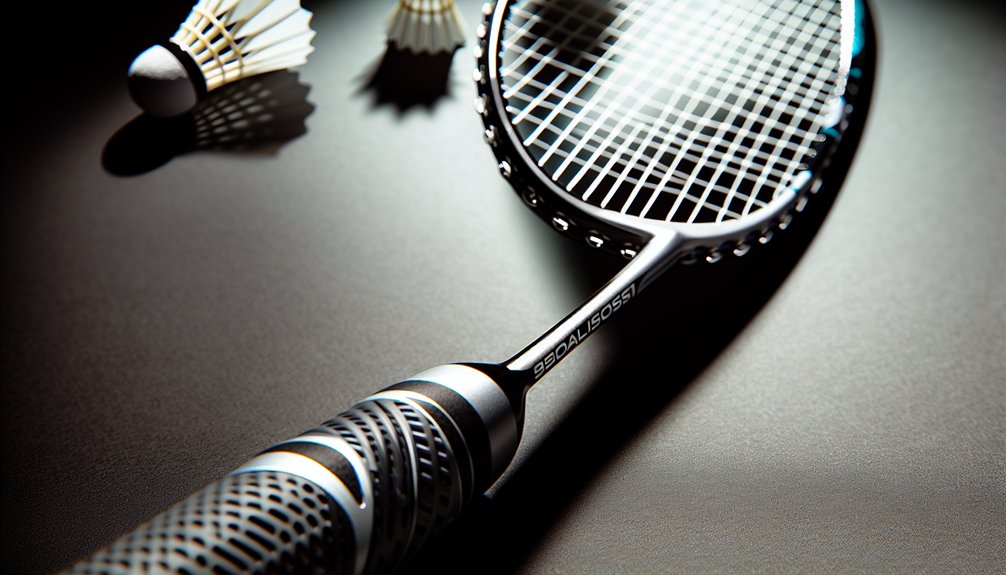
When you’re looking at the Victor DX-12WT25 2026 Guide World Tour Finals Edition, the key is how its mildly head-heavy balance and mid-stiff shaft translate into controllable power and precise flight. You’ll want to pay attention to weight distribution, frame stiffness, and grip customization, because small tweaks in string tension and profile dramatically change its response. To get the most out of this tournament-tuned setup, you’ll need to understand exactly how it’s built—and why.
Key Takeaways
- World Tour Finals Edition DX-12WT25 is a mildly head-heavy, mid‑stiff to stiff, high‑modulus graphite racket optimized for controlled power and quick handling.
- Enhanced layup, stiffer mid‑throat, and concentrated head mass deliver higher terminal shuttle speed and better stability on high‑torque swings.
- Compact aero‑box frame and torsional stiffness support accurate, stable shots at high string tensions with reduced drag and vibration.
- Choose grip profile (cylindrical, tapered, or micro‑concave) to tune torque feel, power transfer, and grip changes to your play style.
- For setup, select strings and tension to match timing, then document final tension, balance point, and maintenance intervals in a log for consistent performance.
Overview of the Victor DX-12WT25 2026 World Tour Finals Edition
Although it’s branded for the 2026 World Tour Finals, the Victor DX-12WT25 is fundamentally a performance-tuned racket engineered around controlled power, quick handling, and tight shuttle feedback. You’re getting a frame that’s optimized for advanced timing rather than just cosmetics, so the visual package simply labels a tour-level configuration.
You’ll notice how the frame profile, shaft behavior, and head geometry integrate as design innovations aimed at stable acceleration with minimal torsion. The aerodynamic contouring and material layup are configured to keep movement swings compact and repeatable. Victor clearly prioritized iterative refinement from user feedback, so the WT edition feels like a dialed-in evolution, not a repaint. Treat it as a calibrated platform ready for your preferred string, tension, and grip setup. Just as with Yonex’s focus on Rotational Generator System weight tuning in its Astrox series, the DX-12WT25’s construction emphasizes efficient energy transfer and maneuverability to support high-intensity, tour-level play.
Key Specifications and Technical Breakdown
Three core parameters define how the Victor DX-12WT25 actually plays: weight class and balance, shaft stiffness, and frame profile. You’re looking at a 3U/4U chassis with a slightly head-heavy lean, tuned for a fast but stable swing. The mid-stiff to stiff shaft uses high-modulus graphite and nano-resins, translating racket technology into efficient energy return on full-length strokes. The compact aero-box frame blends pressure stability with low drag, so it doesn’t twist under high-tension stringing or steep, late contact. Modern graphite layups also boost vibration dampening, cutting down arm shock and helping maintain comfort over long matches.
- Weight–balance pairing governs swing timing, recovery, and defensive readiness.
- Shaft stiffness dictates how much you must load the racket for maximum performance enhancements.
- Frame profile controls shuttle hold, directional accuracy, and behavior at your preferred string tension.
What Sets the World Tour Finals Edition Apart
Beyond the core DX-12WT25 spec sheet, the World Tour Finals Edition adds a tournament-tuned package of materials, layup, and finish that subtly shifts how those numbers feel on court. You’re getting exclusive features calibrated around pro-level tempo: a marginally stiffer mid-throat region to stabilize high-torque swings, a touch more head concentration for terminal pace, and a micro-adjusted balance that keeps defense reactive.
Design enhancements focus on functional feedback. The Finals graphics aren’t cosmetic only; contrasting visual cues along the frame help you track face angle during rapid grip changes. A slightly altered surface finish optimizes aerodynamics for repeated full-length rallies, while tailored weight tolerances tighten swing variance between frames, so your backup setup mirrors your primary gamer almost perfectly. In line with its pro-centric tuning, the frame integrates principles similar to Dual Optimum system stability and maneuverability to keep both forehand and backhand transitions sharp under pressure.
Materials, Construction, and Durability
When you’re evaluating the DX-12WT25, you’ll want to start with its premium shaft and frame materials, since these dictate stiffness, torsional stability, and overall response. From there, you should match its specific weight class and balance point to your preferred feel during fast exchanges and controlled nets shots. Finally, you need to take into account how its layup, resin system, and reinforcement zones handle repeated high-tension stringing and intense play without compromising structural integrity. Built-in protection at critical contact points, such as grommets and butt caps, also helps preserve string tension and frame integrity over long-term, high-intensity use.
Premium Shaft and Frame
Engineering precision defines the Victor DX-12WT25’s premium shaft and frame, combining high‑modulus graphite with carefully tuned resin systems to balance stiffness, torsional stability, and impact resilience. You’re working with premium materials designed to maintain structural integrity under World Tour string tensions and repeated high‑load impacts. The shaft wall thickness is micro‑tapered to control flex distribution, while the frame technology uses multi‑directional carbon layups around key stress points.


When you’re configuring this racket, you should think regarding load paths through the shaft–frame junction and how they’ll behave under your typical stroke mechanics.
- Optimize grommet patterns to preserve frame geometry over time
- Match string gauge to shaft recovery characteristics
- Inspect bonding zones regularly for micro‑cracks under harsh conditions
Weight, Balance, and Feel
Weight and balance on the Victor DX-12WT25 aren’t just spec sheet numbers; they’re the foundation for how efficiently you convert swing effort into shuttle speed and control. You’re working with a tuned weight distribution that pushes a touch of mass into the head while keeping the overall profile maneuverable for late defensive takes.
| Spec Focus | Setup Notes |
|---|---|
| Overall Weight Class | Optimized around 4U/3U thresholds for mixed play styles |
| Balance Point | Slightly head-heavy to stabilize clears and smashes |
| Swing Weight | Calibrated to keep recovery smooth after full-power strokes |
| Handle Mass | Subtle counterweighting to fine-tune feel preference |
In practice, you’ll notice quicker acceleration without losing stability on off‑center contacts, especially when you match grip thickness to your feel preference.
Durability Under Intense Play
Although the DX-12WT25 is tuned for speed and responsiveness, its frame is built around a high‑modulus graphite layup with localized reinforcement at high‑stress zones (3/9 o’clock and T‑joint) to withstand repeated high‑tension stringing and full‑power impacts. You can safely run 30–32 lb tensions without premature warping, provided your stringer supports the frame correctly. Victor’s internal durability testing cycles clash and drive impacts to simulate season‑long intense gameplay, so structural fatigue is minimized.
For practical setup, you’ll want to monitor grommet wear every restring, especially at shared holes and top‑cross entries.
- Rotate strings every 2–3 sessions to reduce notching.
- Replace high‑stress grommets every 3–4 restrings.
- Log breaks and frame scuffs to track long‑term durability trends.
Balance, Weight Distribution, and Flight Dynamics
With the Victor DX-12WT25, you’ll want to start by matching its overall balance point and static weight to your swing speed and preferred contact zone. You’re configuring how mass is distributed between the head, shaft, and handle, which directly governs racket head acceleration and stability at impact. That setup then dictates shuttle flight behavior, including launch angle, trajectory consistency, and how precisely you can control lift on clears, drops, and smashes. This balance and mass distribution also interact with the racket’s sweet spot size to influence how consistently you can produce powerful, accurate shots under match pressure.
Overall Racket Balance
Even before you look at the shaft specs, the DX-12WT25’s balance profile tells you how it’s meant to move through the air: a mildly head-heavy configuration with mass biased toward the upper third of the frame, supported by a moderate overall weight in the 4U/3U range (spec-dependent). You’re working with a balance point that typically sits just past 295 mm, tuned for racket stability without feeling sluggish on recovery.
The engineered weight distribution favors a compact, rotational swing, letting you load the head quickly on short preparation. You can fine-tune this behavior by adjusting grip build and string type/tension.
- Short grip + overgrip: shifts balance further head-heavy
- Full replacement grip: recenters toward neutral
- Hybrid string setups: subtly affect perceived head load
Shuttle Flight Behavior
That same mildly head-heavy bias and 4U/3U mass now show up clearly in how the DX-12WT25 drives the shuttle through its flight path. You’ll feel a slightly longer contact window, which lets you modulate spin and trajectory without destabilizing shuttle aerodynamics. The frame’s torsional stiffness keeps the face square at impact, so flight stability remains high even when you’re late.
On flat drives, the weight distribution helps the shuttle sit lower over the tape, minimizing lift wobble. In rear-court clears, the extra polar weight loads the shuttle early, producing a cleaner, more linear arc. If you string toward the upper tension range, you’ll tighten the launch angle but still retain enough dwell to avoid skidding or erratic cork behavior.
Grip Profiles and Barrel Design Options
Two core design variables—grip profile and barrel geometry—determine how the Victor DX-12WT25 interfaces with your hand and transfers force through the stroke. You get three stock grip profiles: straight cylindrical (Ø26 mm), tapered rear-loaded (24–27 mm), and micro-concave (25–26 mm). Each can be paired with one of two barrel design options: uniform-wall titanium alloy or progressive-thickened carbon-titanium hybrid. Drawing from general grip principles, choosing the correct profile and thickness directly influences shot accuracy, power transfer, and your ability to make fast grip adjustments in rallies.
The cylindrical grip keeps torque distribution neutral, while the tapered variant biases load toward the palm for firmer acceleration. Micro-concave machining adds tactile indexing without over-building circumference.
- Match circumference to your measured palm breadth plus 2–3 mm overgrip buildup.
- Align barrel wall thickness with preferred stiffness and feedback.
- Use sanded or matte finishes to stabilize micro-adjustments under sweat conditions.
Ideal Player Types and Throwing Styles
When you match the DX-12WT25 to the right player profile, you’re looking at release speed, wrist torque, and consistency of arm slot rather than just general “feel.” You’ll want to assess whether your natural motion favors a high-spin, late-release mechanic or a smoother, earlier-release path, because the barrel weighting and grip geometry respond differently to each. From there, you can tune your stance, reach-back, and follow-through so the disc’s stability profile works with your throwing style instead of against it.
Best-Suited Player Profiles
Many players overlook how specifically the DX-12WT25’s geometry and weight distribution target certain release mechanics and arm paths. You’ll benefit most from this mold if your player styles already lean toward controlled, high-spin throws with repeatable timing. The 12° wing taper and 25% forward-biased mass favor athletes who can consistently hit a flat-to-slight-hyzer launch window and don’t rely on exaggerated wrist roll.
You should evaluate your fit through measurable performance metrics: spin rate stability, entry angle variance, and dispersion across 20–30 test throws. If your misses cluster narrowly left–right while distance bands stay tight, the DX-12WT25 is likely aligned with your profile.
- High-spin, moderate-power control throwers
- Data-driven players tracking throws with sensors
- Technicians prioritizing repeatable, low-variance lines
Optimal Throwing Mechanics
Although the DX-12WT25 is forgiving within its design window, it performs best when your throwing mechanics align with its forward-biased mass and 12° wing taper. You’ll get peak flight if your throwing technique emphasizes a flat, linear pull and late acceleration, allowing the head’s CG to track directly through the target line.
Keep your release angle slightly closed (3–5°) on flat trajectories; add 6–8° for controlled arc shots. Match grip pressure to shaft stiffness so the head doesn’t over-rotate at impact.
| Spec / Variable | Recommended Mechanical Focus |
|---|---|
| Release angle | 3–5° closed, neutral wrist |
| Swing plane | Shoulder-high, minimal vertical deviation |
| Tempo | 3:1 backswing-to-forward ratio |
| Wrist action | Delayed hinge, abrupt unload at impact |
| Follow-through path | Low, down-line, no early deceleration |
Step-by-Step Setup and Configuration Guide
Before you power on the Victor DX-12WT25, you’ll need to perform a precise sequence of hardware and firmware checks: verify the input voltage matches the unit’s rated AC range, connect the primary and auxiliary power leads to the designated terminals, attach any required I/O modules to the expansion ports, and confirm the DIP switch or jumper block positions correspond to your target operating mode, network topology, and default communication parameters (baud rate, parity, and addressing) as specified in the datasheet. Build a written setup checklist so you don’t skip safety interlocks, ground bonding, or thermal sensor leads. Then access the configuration menu via USB or RS-485 and apply your configuration tips to align latency, sampling rate, and error-handling behavior with venue requirements.
- Validate each step against factory defaults
- Log firmware versions and parameter sets
- Document final wiring and addressing schema
Fine-Tuning Grip, Stance, and Release Mechanics
Once the Victor DX-12WT25 is electrically validated and its firmware parameters are stable, you’ll fine‑tune “grip, stance, and release” as three tightly coupled mechanical domains: fixture clamping force (grip), chassis and mounting orientation relative to the target axis (stance), and actuator or output timing tolerances (release). You’ll begin grip adjustments by setting clamping torque to the spec’d Nm range, verifying even pressure across contact pads with feeler gauges or shim stock, and confirming no micro‑slip under peak load.
Next, set stance by aligning the base rails to the reference datum within ±0.15° yaw/pitch and ≤0.3 mm lateral offset.
Finally, calibrate release timing: log actuation latency, compensate in firmware offsets, then iterate until jitter stays within the specified millisecond window.
Maintenance, Storage, and Long-Term Performance Tips
When the Victor DX-12WT25 is in regular service, maintaining long-term performance depends on disciplined cleaning intervals, environmental control, and traceable inspection of wear components. You’ll anchor Performance maintenance with Routine inspections after every 2–3 sessions: log frame scuffs, grommet wear, and tension drift. Apply non-abrasive Cleaning techniques to the frame and shaft, avoiding solvent contact with decals and resin joints. String replacement should follow tension-loss thresholds (≈8–10%) or visible notching rather than breakage events. For Proper storage, keep the DX-12WT25 in a thermo-lined cover, using Humidity control (40–60%) and stable temperatures. As part of each inspection cycle, confirm that your current string tension and string type still match your skill level and playing style, adjusting gradually rather than waiting for a breakage or a drastic loss in feel. Seasonal checks validate balance, stiffness, and handle integrity to support Long term care:
- Audit tension, balance point, and shaft flex
- Verify grommet deformation and cap seating
- Document adjustments in a maintenance log