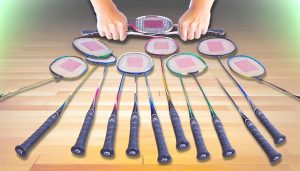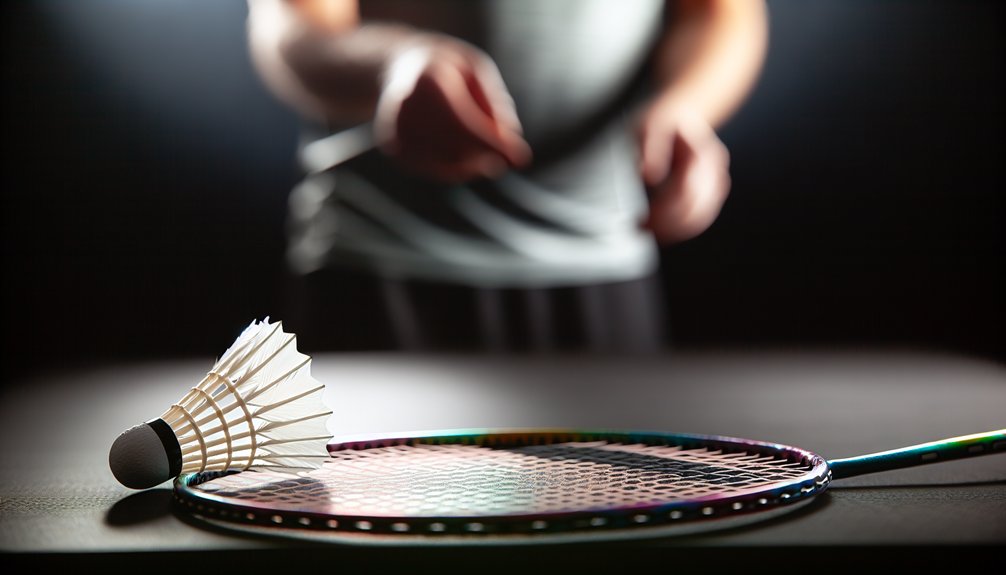
If you’re using the Victor Auraspeed LYC 2026 Liu Yu Chen Edition for fast doubles, you can’t treat it like a generic speed frame. Its compact head and stiff shaft demand precise pairing of string gauge, tension, grip thickness, and balance to release controlled acceleration instead of unstable rebound. When you tune these elements for plastic shuttles at 26–28 lbs, you start gaining repeatable drive timing—yet that’s only the first layer of optimizing this setup.
Key Takeaways
- Use a high-modulus multifilament string in 0.66–0.68 mm gauge to balance fast repulsion with enough dwell time for control.
- String at 26–28 lbs for plastics or 28–31 lbs for feathers, tweaking by 0.5–1 lb to fine‑tune drive precision vs. forgiveness.
- Keep a thin base grip plus one uniform overgrip to maintain quick handling while preserving direct feedback from the stiff shaft.
- Add 1–2 g of tape under the butt cap to make the balance slightly more handle‑heavy, stabilizing drives and interceptions.
- Practice flat-drive and interception drills emphasizing short, compact swings to exploit the racket’s aerodynamic head and optimized sweet spot for speed control.
Understanding the Auraspeed LYC 2026 for Speed-Oriented Doubles Play
When you approach the Auraspeed LYC 2026 from a speed-oriented doubles perspective, you’re dealing with a frame engineered for rapid exchanges, flat drives, and aggressive interceptions rather than pure back-court power. You should first understand how its speed dynamics influence stroke timing. The compact head and stiff shaft reduce lag, so you can commit later to interceptions and still win the shuttle’s peak contact point. In fast front-court and mid-court patterns, the aerodynamic profile lets you recover your racquet position quickly after each drive. That’s essential for layered doubles strategies: rotating after an attack, reloading for the next flat rally, or countering body smashes. The LYC 2026 rewards short, efficient swings, continual split steps, and assertive racket preparation in front of your body. With its focus on rapid exchanges, pairing this frame with an optimized sweet spot through appropriate string tension and technique drills further enhances control in flat, defensive, and counter-attacking scenarios.
Optimizing String Type and Gauge for Explosive Acceleration
Two primary variables define how explosively the Auraspeed LYC 2026 accelerates the shuttle off your strings: construction (string type) and diameter (gauge). You’re optimizing how fast the string bed deforms and rebounds. With string materials, high-modulus multifilament nylon gives you the best blend of repulsion and control, while vectran or Vectran-blend models feel crisper but slightly harsher.
For pure acceleration, prioritize thin gauges (0.61–0.65 mm). They bite the shuttle faster, deform less mass, and recover sooner, translating swing speed directly into shuttle speed. In gauge comparison, mid-gauges (0.66–0.68 mm) trade a bit of “pop” for durability but still suit fast doubles. Heavier gauges (≥0.69 mm) damp responsiveness and slow the racquet’s perceived snap.
Dialing in String Tension for Precision Drives and Blocks
String tension is your primary tool for converting the Auraspeed LYC 2026’s raw speed into tight, error‑free drives and compact blocks at the tape. You’re not chasing a number; you’re targeting a response profile. Start by anchoring tension around 26–28 lbs for plastics, 28–31 lbs for feathers, then make small tension adjustments of 0.5–1 lb. Higher tension shrinks dwell time, improving drive consistency and directional accuracy, but punishes off‑center contact. Lower tension increases shuttle hold, giving you more lift on defensive blocks but slightly fuzzier drive lines. Because string tension impacts your game as much as racket type and grip, experiment within these ranges to find the balance between control, power, and arm comfort that you can repeat under pressure. Test under match‑pace multi‑shuttle: measure how often your straight drives stay within a one‑meter lane and how cleanly your blocks die below tape height. Adjust until both metrics stabilize.
Grip Setup and Balance Adjustments for Tighter Control
Although the Auraspeed LYC 2026 is inherently fast and stable, your grip build and balance tweaks determine how much of that speed you can actually control under pressure. You’re engineering two things: how securely the frame sits in your hand, and how its balance weight interacts with your forearm during micro-adjustments at the net and midcourt. Developing comfort with multiple basic grips here not only improves adaptability but also makes your control-oriented setup feel natural across all strokes.
- Visualize a thin base grip with a dry grip texture, letting your fingers “lock” on the bevels for crisp forehand–backhand shifts.
- Picture one overgrip only, wrapped with uniform tension so diameter increases without dulling tactile feedback.
- Imagine 1–2 grams of tape under the cap, shifting balance slightly handle-heavy for steadier drives.
- See symmetrical side taping, correcting any rotational bias without slowing your swing.
Match-Ready Configurations and Drills to Maximize the LYC 2026
Once your grip build and balance are locked in, you can start thinking in complete on-court systems: specific match-ready setups for the LYC 2026 paired with drills that stress-test its speed and stability under realistic rally patterns. First define your match strategies: front–back aggression, flat-drive pressure, or counter-control. Then tune string tension and overgrip thickness so your reaction window matches your chosen tempo. This is also the stage to decide whether a slightly head-light balance better suits your doubles maneuverability needs or if extra rear-court power is worth a shift toward neutral or head-heavy.
Use structured drills that hard-link player positioning with racket response:


| Drill Focus | LYC 2026 Setup | Key Outcome |
|---|---|---|
| Flat drive chains | Mid tension, neutral balance | Faster shift on body drives |
| Front-court traps | Slight head-light, tacky thin grip | Tighter net kill angles |
| Rear-court defense | Slight head-heavy, medium grip build | Deeper, later-contact lifts |
Rotate configurations weekly and track lift depth, block length, and drive error rate.