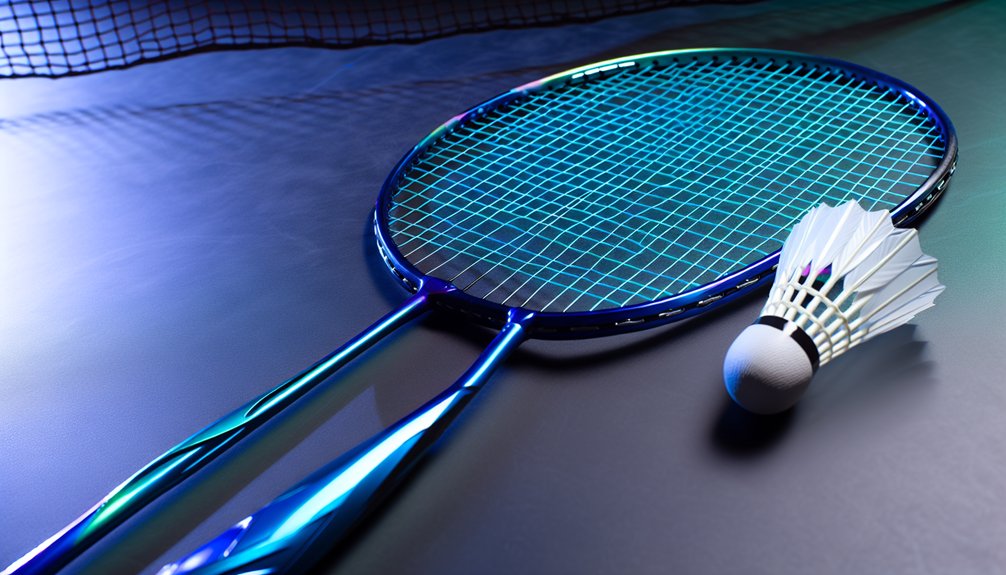
You probably don’t know that the Thruster Ryuga Muse Azure Blue subtly shifts the Ryuga line toward a more balanced attacking profile without fully abandoning its head-heavy DNA. You’re getting a softer shaft profile, tweaked weight distribution, and crisper feedback that separate it from the original Ryuga and the Dragon. But those changes don’t help every playing style equally, and some types of players may actually lose out with this version…
Key Takeaways
- New Muse Azure Blue refines the Thruster Ryuga line with a softer, more elastic shaft and less extreme head heaviness for broader playability.
- Frame aerodynamics are updated for better stability and control, trading some raw sledgehammer power for more efficient, repeatable shot production.
- Suits rear-court attackers wanting accessible, heavy smashes without harsh kick or excessive strain on the arm and shoulder.
- Works very well for fast doubles players and all-rounders who intercept at the net and need quick head return in flat exchanges.
- Less suitable for grindy retrievers preferring very flexible, forgiving frames; best when strung around 26–28 lbs for advanced users.
Design, Specs, and Key Technologies
A study in contrasts, the Thruster Ryuga Muse Azure Blue pairs a traditionally head-heavy Thruster frame with a slimmer, speed-oriented profile that sits somewhere between the stiff, brute-force Ryuga II and the more maneuverable Auraspeed series. You’re looking at a compact head, moderate shaft stiffness, and a balance point that still favors rear-court power, yet doesn’t feel brick-like on rapid exchanges. Technically, you get a boxier frame cross-section blended with aerodynamic beveling, so drives and midcourt interceptions feel quicker than most power-oriented Thrusters. The shaft’s torsional rigidity is solid but not elite, so you’ll notice slight twist on off-center hits. Material quality is high, though not obviously premium versus its price bracket, and the Azure Blue colorway prioritizes aesthetic appeal over on-court visibility. Thanks to its relatively light overall feel and evenly distributed weight, the Muse helps reduce arm fatigue while maintaining both power and precision over longer sessions.
How It Differs From Previous Thruster Ryuga Models
Viewed against the rest of the Ryuga line, the Muse Azure Blue feels less like a simple repaint and more like a recalibration of the series’ core identity. You’re not just getting fresh cosmetics; VICTOR’s pushed the frame and shaft architecture in subtler, more structural ways.
Compared with the original Ryuga and Ryuga II, the Muse Azure Blue alters four core parameters:
- A marginally softer, more elastic shaft profile, shifting the feel from brutally stiff to more progressive loading.
- Tweaked head weight distribution, moderating the extreme tip bias of earlier Thrusters.
- Refined frame aerodynamics that prioritize stability over raw punch.
- Updated innovation features marketed as performance upgrades, but you’ll notice they’re more about efficiency and accessibility than outright spec escalation.
For players cross-shopping other premium lines, it sits conceptually closer to Yonex’s Rotational Generator and isometric-style control philosophies than to the ultra-head-heavy, one-dimensional power frames of past generations.
On-Court Performance: Power, Control, and Speed
Once you get the Muse Azure Blue on court, its personality diverges more clearly from the earlier Ryugas than the spec sheet suggests. You’ll still feel a rear‑biased power profile, but the power dynamics are smoother: the shaft unloads more progressively, so full swings produce heavy smashes without the “all‑or‑nothing” kick of the first Ryuga. On control, the slightly faster head and crisper face help you execute tighter control techniques at the net and in hold‑and‑flick situations. It’s easier to vary trajectory on half‑smashes and pushes, though it’s less brutally punishing than the OG on straight‑line bombs. In flat exchanges, the reduced swing weight gives you quicker head return, but it’s not as whippy as many speed‑oriented frames. Compared with many aerodynamic rackets, its slightly higher drag trades a touch of raw swing speed for extra shuttle stability and more solid feedback on contact.
Best Player Types and Playing Styles for the Muse Azure Blue
From the way it hits on court, the Muse Azure Blue clearly favors attacking players who want a power‑leaning frame without the brutality of the OG Ryuga. You’ll notice it best suits you if you like to pressure from the rear court but still rely on counter‑drives and blocks rather than pure sledgehammer smashes. Similar to Li‑Ning’s head‑heavy Aeronaut series that blends speed and control, it offers accessible power without feeling unwieldy in fast exchanges.
- Rear‑court aggressive attackers – You get easier access to steep angles than with the OG, but slightly less terminal weight on outright bombs.
- Fast‑paced doubles front players – If you intercept a lot, the quicker head lets you punch‑block and kill at the tape more cleanly.
- Balanced all‑rounders – You’ll gain extra bite in evolution, though touch players may find feedback a bit hot.
- Calculated defensive strategists – You can turn defense into attack quickly, but grindy retrievers may prefer something softer and more flexible.
Stringing, Customization, and Buying Considerations
Although the Muse Azure Blue is more forgiving than the OG Ryuga, it’s still sensitive to string and setup choices, so you can easily ruin or refine its power‑control balance depending on how you tune it. You’ll want to treat string tension more conservatively than on the OG: 26–28 lbs suits most advanced players, whereas 29–30+ only makes sense if you’ve got impeccable timing and strong forearms. With its high‑resilience graphite construction and strong vibration dampening, it rewards precise setups that match your preferred balance of power and control.


| Focus | Recommended Direction |
|---|---|
| Power-bias | 26–27 lbs, repulsive string |
| Control-bias | 27–28 lbs, textured string |
| Durability | 25–26 lbs, thicker gauge |
Compared with the OG, customization options (lead at 12 o’clock, slightly thicker replacement grip) react faster because of the livelier shaft. If you’re buying blind, choose 4U, a medium-high tension request, and minimal added weight first, then iterate.