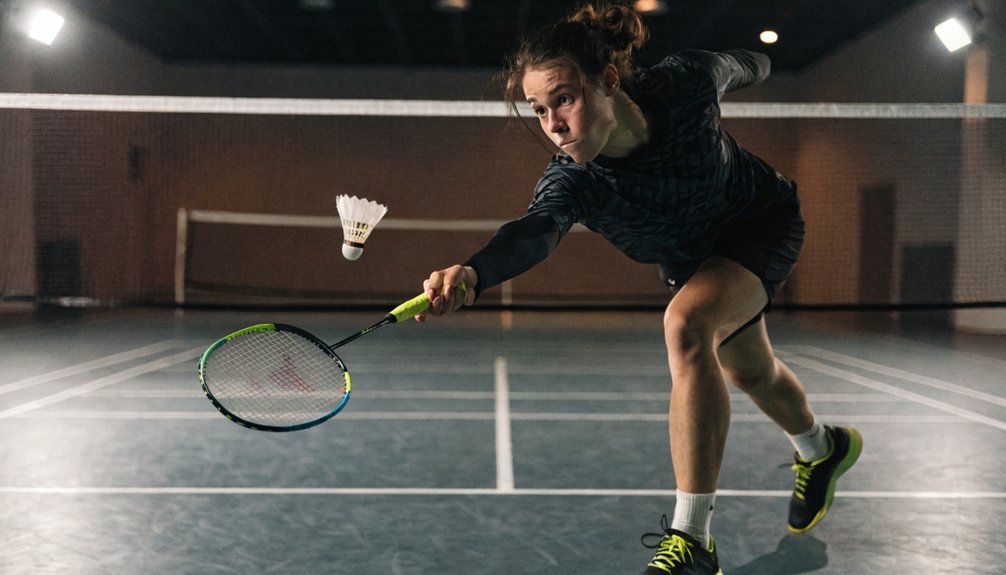
Like a chess opening that dictates the whole game, your badminton serve quietly controls what happens next. If you can tighten your low serve, add a deceptive flick, and mix in smart variations, you’ll force weaker returns instead of scrambling on defense. It starts with a legal, repeatable motion, the right grip and stance, and an understanding of when to change height, pace, and direction—because once your serve improves, everything after it can change.
Key Takeaways
- Use one identical stance, grip, and shuttle position for all serves, then change only wrist and finger acceleration to disguise low, flick, and other variations.
- For a tight low serve, strike the shuttle below knee height with a relaxed, compact pendulum motion so it just clears the tape and lands near the T.
- Add flick serves when receivers crowd the line, using a late, sharp wrist snap while keeping your preparation identical to the low serve.
- Vary placement and trajectory—tape-skimming lows, body lows, wide angles, straight and flat flicks—to prevent opponents from predicting and attacking your serve.
- Practice specific serve drills (e.g., 10-spot accuracy, alternating low and flick) while tracking faults to build reliability and deception under pressure.
What Makes a Badminton Serve Legal?
Although a serve may look simple, badminton rules define strict criteria that determine whether it’s legal or faulted. You must hit the base of the shuttle first, in one continuous forward motion, with no feints once the racket moves toward the shuttle. At the moment of impact, the entire shuttle has to be below 1.15 m from the court surface, and your racket head must be clearly below your racket hand. Your feet need contact with the court and must stay stationary until you strike the shuttle; no lifting, sliding, or jumping early. You also have to stand within your correct service court, serving diagonally into your opponent’s. Mastering these details lets you push the legal limits for tighter, more deceptive serves. Complying with these general service regulations is crucial for maintaining fairness and consistency in competitive play.
Set Up Your Grip, Stance, And Relaxation
Once you understand what makes a serve legal, the next step is setting up your body so you can hit it with accuracy and disguise. Use a relaxed forehand grip with the handle more in your fingers than your palm, so you can make tiny angle changes for both low and flick serves. Using a light “handshake‑style” hold that aligns your thumb and index finger along the racquet bevels helps you stay relaxed while still controlling the face of the racket. Keep the grip gentle—just enough to control the racket.
Stand side‑on to the net, racket foot slightly forward, weight balanced over the balls of your feet. Position yourself close to the T, but not crowding the line. Soften your knees, keep your shoulders loose, and let your non‑racket arm hang naturally. Scan your opponent, exhale slowly, and feel your forearm, wrist, and fingers stay relaxed—tension ruins touch and deception.
Technique For A Consistent Low Badminton Serve
Think of your low serve as a flat, controlled lift that just clears the tape and dies in the front service box. Place the shuttle in front of your body, slightly toward your racket leg, with the cork pointing slightly downward. Let your racket start behind the shuttle, head below your hand, facing slightly upward. Keep the swing compact: a smooth, pendulum motion from the shoulder with relaxed fingers, no jerky acceleration. Contact the cork cleanly, in front of your body, at knee height or lower. Aim for a shallow, rising trajectory that peaks just as it crosses the net. For consistency, lock in a repeatable routine: same starting position, shuttle release point, swing path, and follow-through that finishes naturally toward your target. To maximise control and disguise on your serve, make sure you’re using a comfortable, basic forehand grip that you can quickly adjust for flicks and variations.
Common Low Serve Mistakes And Fixes
Now that you’ve built a basic low serve, you need to eliminate the habits that quietly sabotage it: an inconsistent contact point, predictable serve patterns, and illegal serve mechanics. You’ll see how a drifting strike height, repetitive placement, or a borderline racket angle not only cost you cheap points but also invite opponents to attack. Let’s break down each mistake so you can correct it systematically and turn your low serve into a reliable tactical weapon.
Inconsistent Contact Point
Although it’s easy to blame “bad timing,” many low-serve errors actually come from an inconsistent contact point. If the shuttle meets your strings even a few centimeters higher, lower, or farther from your body than usual, the trajectory and spin change, making the serve sit up or fall short. That inconsistency gives receivers easy lifts or outright kills.
To fix it, lock in a repeatable setup. Keep the shuttle at the same height, directly in line with your front knee, and strike it beside your leading leg, not underneath your body. Use a compact, minimal backswing so your racket travels through a narrow corridor. In practice, freeze after impact and check: shuttle height, distance from body, and racket-face angle.


Predictable Serve Patterns
To fix this, you need controlled variation, not random change. Alternate serve targets: T, body, and wide, while keeping identical preparation. Mix in occasional flicks that use the same stance, rhythm, and grip pressure as your best low serve. Track opponents’ habits: who attacks wide, who crowds the T, who hesitates. Then sequence serves deliberately, so each one exploits the anticipation created by the last.
Illegal Serve Technique
Several of the most “innocent‑looking” low serves are actually illegal, and they’ll quietly sabotage your development even if umpires don’t call them. You must respect three critical areas: shuttle position, racket position, and striking motion.
Common faults include holding the shuttle too high, having the racket head above your grip hand, or slicing upward with a clear “hit” instead of a continuous underhand motion. These habits distort timing and disguise, so your legal serve feels weak by comparison.
To fix them, audit your technique:
- Freeze at contact: shuttle below 1.15 m, racket head clearly below your hand.
- Use a smooth, single‑action forehand or backhand, no double‑action flick.
- Practice in front of a mirror or wall mark to standardize legal contact height.
When To Use The Flick Serve
When exactly should you deploy the flick serve instead of your standard short serve? You use it when the receiver crowds the service line, leans heavily forward, or commits their racket high above the tape to kill your low serve. In these cases, their base of support is narrow and weight is too far in front, so a well‑placed flick exploits their poor rear‑court coverage. You should also flick when you’ve established a reliable tight low serve and conditioned the opponent to expect it. That’s when their split step becomes smaller and later, making their first push backwards slower. Use the flick sparingly—perhaps one in every 6–10 serves—so it remains unpredictable, and select it more in doubles or mixed, where aggressive front‑court receiving is common. At higher levels, mixing in the flick serve also doubles as a subtle mind game that can disrupt an over‑aggressive receiver’s rhythm and confidence.
Technique For A Fast, Deceptive Flick Serve
To build a fast, deceptive flick serve, you’ll rely on a late, explosive wrist snap combined with precise shuttle contact timing. You must keep your preparation identical to your regular short serve—same stance, grip, racket position, and rhythm—so your opponent reads “short” until the last instant. By only changing the serve at the final fraction of a second with a sharp wrist acceleration, you create both speed and disguise that pressure even advanced receivers.
Wrist Snap And Timing
One essential ingredient of a fast, deceptive flick serve is the precise coordination between your wrist snap and the instant of shuttle contact. You’re not just hitting harder; you’re sequencing forearm rotation and finger power so the shuttle leaves your strings fast, flat, and late. The key is a compact, relaxed preparation, then an explosive, razor-short acceleration right at impact.
- Keep the grip loose, then tighten with the fingers at the last moment to “crack” the shuttle without a big arm swing.
- Time your wrist snap so maximum speed happens exactly as the racket face meets the shuttle, not before or after.
- Vary the heightand *depth* of your flick by micro-adjusting snap intensity, not your overall motion.
Disguising Serve Preparation
Mastering wrist snap and timing gives you power; disguising your preparation decides whether that power actually wins you the point. You want every serve to start from an identical “template”: same stance, grip, shuttle position, and pre-serve rhythm. That way, your opponent can’t read whether you’ll play a tight low serve or a fast flick.
Hold the shuttle slightly in front of your body, racket head relaxed, with your elbow close to your hip. Keep your backswing minimal and consistent. The only difference between low and flick serves is a late, sharp acceleration from your fingers and wrist.
Practice sequences where you call “low” or “flick” only after initiating your motion. This trains true late decision-making and visual disguise.
Badminton Serve Variations To Keep Rivals Guessing
Although a consistent basic serve is essential, you’ll win more points by layering in precise variations that disrupt your opponent’s rhythm and positioning. You’re not just changing height or speed; you’re manipulating contact point, trajectory, and spin to force indecision and weaker replies. Smart use of serve variation pairs especially well with choosing a racket whose weight distribution and stiffness match your style, so your control and deception hold up under pressure.
Mix three core families of serves, all from the same disguise:
- Low serve variants: Tight tape-skimmers, slightly deeper “body” lows, and marginally wider angles that threaten the tramlines yet land safely inside.
- Flick variations: Straight flicks to the backhand hip, faster flat flicks at the shoulder, and higher, slower arcs that drop steeply near the rear lines.
- Occasional surprise serves: Rarely used crosscourt or punchy half-flicks aimed at the racket hip, injected only when your opponent’s base position drifts forward.
Badminton Serving Tactics In Singles Vs Doubles
When you compare singles and doubles, your serve placement priorities shift dramatically, and so should your decision-making. In singles, you’re managing court length and lateral width to control rallies, while in doubles you’re threading low, tight serves into small windows to prevent all-out attacks. Each type of serve choice carries a different risk–reward profile, and understanding that trade-off lets you be aggressive without gifting your opponents free points.
Serve Placement Priorities
A well-placed serve in badminton isn’t just about getting the shuttle in—it’s about dictating the next shot. Your first priority is to limit your opponent’s available angles. In singles, that usually means serving tight to the T on both short and flick serves, forcing straight replies and predictable patterns. In doubles, you aim tighter to the tape and closer to the receiver’s racket hip, cutting off their drive and push options.
Your placement priorities should follow a clear hierarchy:
- Target their weaker side (backhand or less stable wing).
- Aim where it’s hardest for them to generate angle or depth.
- Serve so your next shot is “pre-loaded” (e.g., ready to pounce on the straight return).
Risk And Reward
Serve placement sets the stage, but your real advantage comes from how much risk you’re willing to take for a stronger reply. In singles, you can serve slightly higher and longer because you’re protecting a larger court alone. A safer low serve reduces outright attack but invites neutral rallies; a riskier, tighter serve may force weak lifts yet punishes any inconsistency in your contact point.
In doubles, the trade‑off shifts. Your partner’s at the back, so you’re rewarded for ultra‑tight, aggressive low serves that force upward returns. However, the cost of error skyrockets: any loose serve is smashed. Your flick serve is higher value in doubles—used sparingly—to disrupt aggressive receivers and reclaim neutral or attacking formations.
Footwork And Third-Shot Patterns After Serving
Exploit your serve by linking it to sharp footwork and a clear third-shot plan. As soon as the shuttle leaves your strings, your racket leg should be ready to drive, split-step, and explode toward the opponent’s most dangerous reply options. Your base position shifts slightly depending on whether you’ve served low or flicked, and whether you expect straight or cross returns.
- After a tight low serve, recover with a compact split-step, biasing your weight slightly forward to pounce on net shots while still covering the body push.
- After a flick serve, open your hips early and move into a rear-court base, preparing for straight smashes and drops first.
- Pre-plan third-shot choices (net kill, lift, or drive) according to your opponent’s favorite returns and tempo.
Link these patterns to your racket’s sweet spot consistency so that your first interception after the serve maximizes both control and power in the rally’s early exchanges.
Simple Drills For Low And Flick Serves
When you’re ready to make your serves truly reliable under pressure, simple, structured drills give you the fastest gains. Start with a “10‑spot” low‑serve drill: place small markers just beyond the short service line, aim to land 10 consecutive serves inside the corridor, then shrink the target. Track faults and net clips. Since serve quality is only fully effective when the shuttle responds predictably off the strings, periodically checking your string tension and adjusting it for control can make these drills even more consistent and informative.
Next, add a “height control” drill. String a tape or rope across the net 5–8 cm above the tape and serve under it without hitting the net. This grooves a flat, tight trajectory.
For flick serves, alternate 1 low : 1 flick to the same receiver. Focus on identical preparation, relaxed finger power, and hitting just above the waist. Measure success by depth (last metre) and opponent’s late contact.