Over 60% of rallies at intermediate level break down after a weak forecourt lift, not a power smash. If your lift sits up or falls short, you’re handing your opponent control. To change that, you need sharper preparation, a cleaner grip, and more disciplined footwork, not more strength. Once you understand what a good forecourt lift really looks like—and the small errors that ruin it—you’ll start turning pressure into opportunities instead of cheap points.
Key Takeaways
- Move early with a split-step, then plant a stable front foot slightly behind the shuttle’s drop line to avoid cramped, rushed lifts.
- Use a relaxed neutral grip, tightening fingers only at impact, with the wrist aligned straight to generate clean, controlled power.
- Contact the shuttle in front of your leading hip around shoulder height, striking the back of the cork for height and depth.
- Aim your lift high, deep, and close to the rear tramlines, varying height and speed to disrupt your opponent’s timing.
- Rotate your torso and transfer weight forward smoothly through the shot, following through upwards to maintain lift length and consistency.
What a Good Forecourt Lift Looks Like
A good forecourt lift travels high, deep, and tight to the rear tramlines, forcing your opponent backwards and buying you time to recover. The shuttle should peak above your opponent’s contact point, then descend steeply, landing within 30–60 cm of the baseline. You’re aiming to give them a late, awkward overhead, not an easy intercept. Consistently producing this kind of lift depends on clean technique supported by factors like sweet spot control, appropriate string tension, and a racket that balances power and maneuverability.
From your perspective at the net, a quality lift comes from a stable base, compact preparation, and a clean, slicing contact under the shuttle. Your racket face stays controlled and relaxed, sending the shuttle in a smooth, continuous arc. The trajectory shouldn’t wobble or drift wide. Visually, you’ll see a high, controlled parabola that pushes your opponent to their rear-court “stretch” position.
Common Forecourt Lift Mistakes (And How to Fix Them)
To consistently reproduce a high-quality forecourt lift, you’ll need to eliminate three common errors: rushed preparation and footwork, an inconsistent contact point, and poor racket follow-through. Each of these faults disrupts shuttle control, lift height, and length, directly limiting your ability to reset under pressure. Using a relaxed but secure forehand grip on forecourt lifts helps reduce wrist and arm strain while maintaining the control needed for accurate height and length. In the next section, you’ll see exactly how to correct these issues with specific positional, timing, and racket-action adjustments.
Rushed Preparation And Footwork
When your preparation and footwork are rushed in the forecourt, your lift loses height, length, and control, giving opponents easy chances to attack. The problem usually starts with delayed movement: you react only after the shuttle crosses the tape, so you’re still arriving as you hit. That forces a cramped stance, unstable base, and arm‑dominant lift.
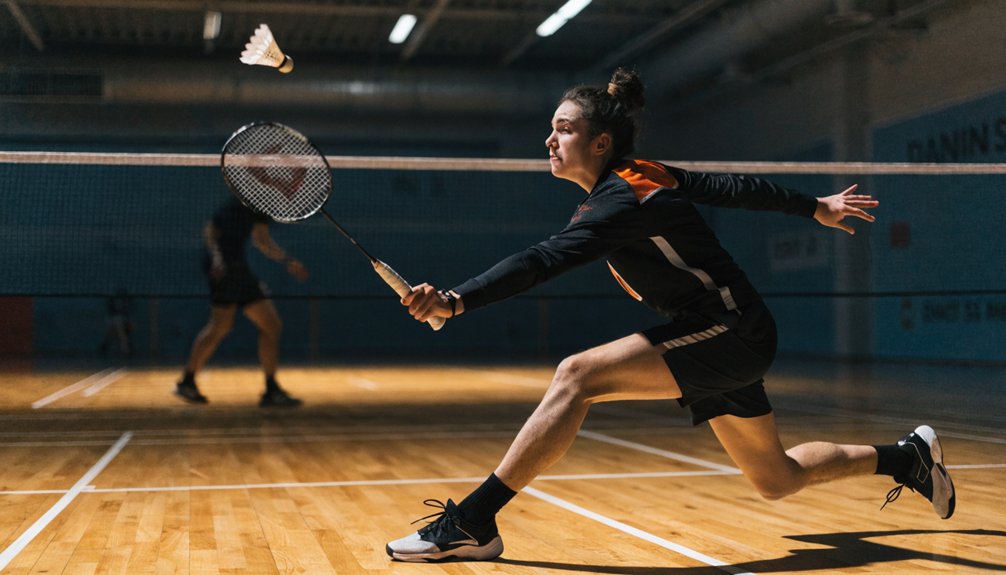
Instead, split-step as your opponent strikes, then drive explosively off your outside leg toward the shuttle. Aim to plant your front foot slightly behind and to the side of the shuttle’s drop line, knees flexed, torso balanced, racket already set under the shuttle. Prioritize early preparation over speed of swing. When your feet arrive first and stabilize, you can lift smoothly, using body and forearm, not panic.
Inconsistent Contact Point
Although your feet may get you to the shuttle on time, inconsistent contact height and position will still ruin lift quality. If you hit too low, you’re forced to lift with a weak, scooping motion. If you reach too far in front or behind, the shuttle slices off the strings, killing length and control.
Use these cues to standardize your contact point:


- Aim to contact the shuttle slightly in front of your body line, around knee-to-hip height.
- Keep your hitting arm relaxed, with a consistent elbow bend as the shuttle enters your striking zone.
- Align your racket face square to the shuttle’s trajectory at impact.
- Shadow-train: pause at the ideal contact point, then add a shuttle once the position feels automatic.
Poor Racket Follow-Through
Once your contact point’s consistent, the next limiter on lift quality is how you finish the stroke. Poor follow-through usually means you’re decelerating too early, steering the shuttle, or opening the racket face mid-swing, all of which kill length and height.
From the forecourt, your follow-through should be short, but not abrupt. After impact, let the racket travel naturally along the intended lift line, with the strings facing the shuttle’s flight path, not the ceiling. Keep your grip relaxed so the racket can accelerate through contact, then decelerate smoothly.
Drill it: shadow 10–15 lifts, freezing at the end position each time. The racket head should finish slightly above shoulder height, elbow away from the body, and balance stable.
Grip Technique for Strong, Safe Forecourt Lifts
To generate strong, safe forecourt lifts, you need a neutral grip that lets you switch seamlessly between forehand and backhand while keeping the racket head stable. You’ll then use controlled finger power, not a big arm swing, to accelerate the racket sharply at impact. Let’s break down how to set your neutral grip and train precise finger adjustment so your lifts are both powerful and secure under pressure. Mastering quick grip changes and small grip adjustments will help you adapt instantly to tight forecourt shuttles and improve the quality of your lifts.
Neutral Grip Fundamentals
Neutral grip is the foundation that lets your forecourt lifts be both powerful and safe under pressure. You’ll align the racket so the handle runs diagonally across your fingers, not straight into the palm. Keep the V between thumb and index finger resting on the top bevel, with the racket face naturally neutral, neither forehand nor backhand.
Key checkpoints:
- Relax your fingers so the handle can move slightly; don’t clamp or over-squeeze.
- Keep your wrist in a straight, neutral line with your forearm to avoid strain.
- Maintain a small gap between your index finger and the others for control.
- Confirm the strings face roughly forward when your arm is in a natural, handshake position.
Finger Power Adjustment
Think of finger power as the trigger that turns a neutral grip into a fast, explosive forecourt lift without overusing your arm or wrist. From your neutral base, keep the hand relaxed, then time your “squeeze” precisely at shuttle contact. The power should come from a sharp closing of the last three fingers, with the thumb providing firm counter‑pressure.
Don’t pull with your arm; let the racket pivot in your fingers. Start with small half‑swings, focusing on feeling the shaft accelerate only when you squeeze. If the racket feels heavy or slow, you’re gripping too early or too hard. Aim for a crisp, short contact, then instantly relax again so you’re ready to adjust grip and generate the next lift.
Timing and Footwork for Early, High Forecourt Lifts
- Track the shuttle early and decide: chasse, crossover, or lunge, based on distance and angle.
- Use a compact, low split-step, landing on the balls of both feet, then push off the outside leg.
- Prioritize small adjustment steps so your final stance isn’t stretched or off-balance.
- Recover with quick, efficient replacement steps, returning to base ready for the next shot.
- Staying balanced and early to the shuttle also helps you stay composed under mind games and psychological pressure from opponents.
Body Position and Shuttle Contact for Deeper Lifts
Although your feet create the platform for a solid lift, it’s your body position and exact contact point that determine how deep the shuttle travels. Keep your chest slightly forward, hips low, and non-racket arm counterbalancing so you’re stable yet explosive. Your spine should stay neutral, not collapsing toward the net, so force transfers efficiently from legs to racket. Players using lightweight rackets will especially notice how good posture and clean contact amplify maneuverability and shot accuracy.
Aim to strike the shuttle slightly in front of your leading hip, at or just above shoulder height when possible. Contact the shuttle on the “back” side of the cork, with a relaxed grip that tightens at impact.
| Focus Area | Key Cue | Performance Effect |
|---|---|---|
| Torso | Chest forward | Better weight transfer |
| Hips | Sit, not squat | Faster recovery |
| Contact | In front, high | Deeper, higher lifts |
Lifting Tactics: When, Where, and How High From the Forecourt
Use height to control time. A high, deep lift resets under pressure; a flatter, still‑deep lift attacks by rushing your opponent. Always aim near the singles rear tramlines, but vary corner, height, and speed. Choosing a lightweight racket with good maneuverability makes it easier to lift accurately under pressure and maintain consistent length from the forecourt.
- Lift cross when your opponent’s momentum moves the wrong way.
- Lift straight when you’re late or off‑balance.
- Lift higher against tall, fast jump‑smashers to push them back.
- Lift flatter when they’re slow starting or weak overhead.