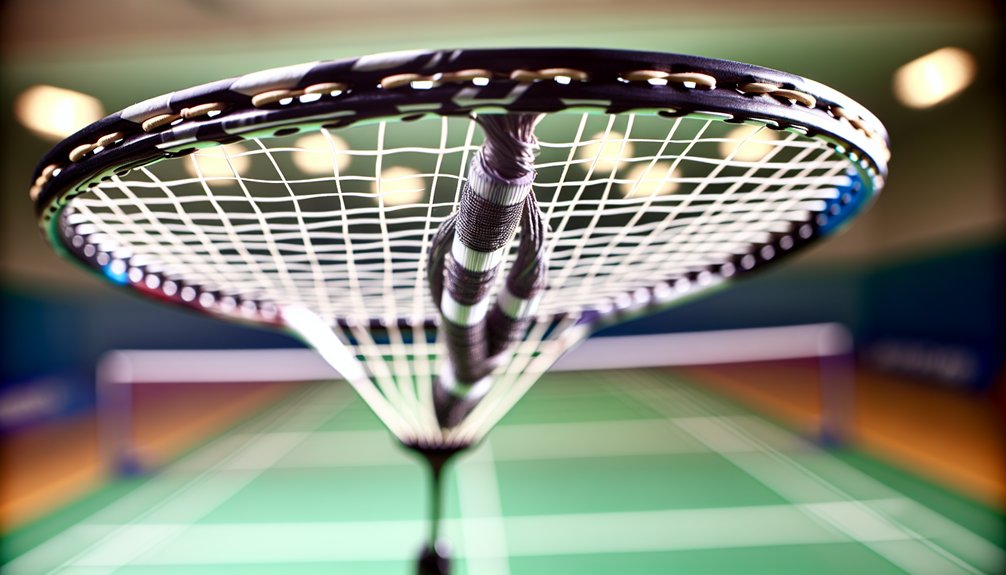
If you’re trying to tighten up your net game with Yonex Aerobite Boost in 2026, you’ll want to treat it as more than just a thicker main and thinner cross. The 0.72 mm mains give you stability on tight net kills, while the 0.61 mm crosses restore speed and bite on lifts and pushes. How you balance tension, pattern, and racket choice with this hybrid will decide whether it actually sharpens your front-court control or not.
Key Takeaways
- Use Aerobite Boost’s 0.72 mm mains and 0.61 mm crosses to combine net bite, control, and repulsion, especially for front-court dominant play.
- String mains 1–2 lbs lower than crosses (e.g., 24/25–26 lbs) to enhance shuttle grip and keep net shots low and spinny.
- For developing players, stay around 22–24 lbs; advanced net aggressors can move to 25–27 lbs for crisper net feel and tighter trajectory.
- Pair head-heavy, stiff rackets with slightly lower overall tension, and flexible or even-balance frames with tighter setups to sharpen net precision.
- Emphasize brushing and slicing motions with a relaxed wrist to exploit the textured mains’ grip for tighter spinning net shots and tighter net cords.
Understanding the Aerobite Boost Hybrid Concept
Although it’s marketed as a power-oriented string, Aerobite Boost is fundamentally a hybrid system: a textured, thicker main string (0.72 mm) paired with a thinner, more repulsive cross string (0.61 mm). You’re not just installing a string; you’re configuring a system with distinct roles for mains and crosses.
To grasp the aerobite boost benefits, think regarding task allocation. The mains stabilize the shuttle on impact, giving you net control and bite for spinning tumbles. The crosses return stored energy faster, helping you finish rallies when you attack. Hybrid string advantages here include being able to tune feel and response by adjusting tension balance, pattern, and pre-stretch, so you can deliberately bias your racket toward control, power, or a specific net-dominant style.
String Materials, Gauge, and Performance Characteristics
When you choose Aerobite Boost, you’re committing to a specific hybrid string material composition that directly controls bite on the shuttle, repulsion, and long-term tension stability. You’ll need to understand how the braided Vectran-infused mains and high-polymer cross strings interact, because their different surface textures and stiffness levels shape your control and power window. From there, you should match gauge selections to your swing speed and mishit tolerance, since even a 0.01–0.02 mm change in diameter alters feel, durability, and shuttle exit speed in a very noticeable way. This hybrid’s Vectran-infused multifilament construction leverages advanced materials to enhance durability while maintaining a plush, controlled feel.
Hybrid String Material Composition
Hybrid string construction is where the Aerobite Boost really differentiates itself, combining two distinct materials and gauges to tune power, control, and feel. When you do a string composition analysis, you’ll notice the mains use a textured, high-friction nylon multifilament for bite and braking at the shuttle, while the crosses rely on a smoother, denser nylon core designed to stabilize impact and preserve tension.
You should evaluate material durability first. The rougher mains will notch faster but give you superior net hold and spin-like cut; the smoother crosses resist wear and maintain a consistent response. In practice, you’re trading a bit of lifespan in the mains for sharper control feedback, so plan restring intervals around your training volume and match schedule.
Gauge Impact on Playability
Beyond the material pairing, gauge is what really locks in how Aerobite Boost feels on court, because each string’s thickness directly changes power, bite, and stability. When you do a gauge comparison, treat mains and crosses separately: the thicker Boost mains provide directional control and durability; the thinner net-control crosses tune spin and touch.
Thicker gauges (0.69–0.70 mm) deform less, raising control and tension stability but muting shuttle feel. Thinner gauges (0.61–0.66 mm) increase dwell time, improving bite on net kills and lifts, while reducing durability. Key playability factors you’ll notice: shuttle hold on slices, launch angle on blocks, and forgiveness on mishits. If you’re an aggressive front-court player, prioritize a slightly thinner cross to amplify precision.


How Aerobite Boost Enhances Net Control and Spin
With Aerobite Boost, you’re using textured mains to “bite” the shuttle, giving you cleaner net brush shots and more predictable spin. You’ll pair that with a hybrid tension setup that lets you fine‑tune touch: slightly higher on the mains for control, slightly lower on the crosses for feel and shuttle hold. As you adjust these two variables, you can systematically shape how aggressively the shuttle spins and how tightly you can control it at the tape. This kind of precise net control pairs especially well with smart doubles tactics, where tight spinning net shots can create lift opportunities for your partner to finish.
Textured Mains for Bite
Although Aerobite Boost is a hybrid system, its defining on‑court feel starts with the textured mains that “grab” the shuttle on contact. Those textured strings increase friction at impact, giving you earlier shuttle rotation and more predictable spin response on net shots and cut drops.
You’ll feel this bite enhancement most when you brush rather than hit through the shuttle. On tight net tumbles, the mains “lock” onto the skirt, letting you control the roll duration instead of guessing how far it’ll travel. When you slice from mid‑court, the mains help the shuttle dip faster, tightening your margin inside the tramlines.
To maximize this effect, keep your brushing angle shallow and finish compact, letting the mains do the work.
Hybrid Tension for Touch
Once the mains are set up to bite, Aerobite Boost’s real advantage comes from how the hybrid tensions balance feel and control at the net. You’re using the thicker mains to stabilize the shuttle on impact, while the thinner crosses fine‑tune touch. Start with mains 1–2 lbs higher than crosses; this keeps your net blocks firm but lets you bleed off pace on tight spinning tumblers.
Use small tension variations to dial in net precision. If pushes float long, raise cross tension slightly. If your spinning net shots feel dead, lower the crosses 1 lb for more dwell and feedback.
| Setup Focus | Practical Adjustment |
|---|---|
| Baseline control | Mains +2 lbs over crosses |
| Softer net touch | Reduce crosses by 1–2 lbs |
| Crisper deflection | Increase mains by 1 lb, test touch |
Ideal Tension Ranges for Different Player Types
Because tension directly dictates how the Yonex Aerobite Boost behaves on impact, you need to align it with your playing level, swing speed, and preferred style. Treat string tension as a tuning dial that translates your technique and player preferences into predictable shuttle responses. Since rackets and strings work as one system, your ideal tension should also complement your racket’s weight distribution so that power, control, and maneuverability stay in balance.
If you’re a developing or control‑oriented player with moderate swing speed, stay around 22–24 lbs for a forgiving sweet spot and easier length. For advanced, fast‑swing attackers seeking crisper net control and flatter drives, move into the 25–27 lbs window. Elite or physically strong players who consistently hit the sweet spot can explore 27–29 lbs for maximum feedback and stability, accepting reduced margin for error. Always adjust in 1 lb steps and test under match pace before settling.
Recommended Mains/Crosses Patterns and Setups
For aggressive net control, prioritize denser mains patterns in the central hitting zone; ask your stringer to maintain consistent spacing from the 3rd to 9th main on each side. Pair this with slightly more open crosses setups in the upper third of the bed to increase bite on net kills and spinning pushes. Since higher tensions can increase injury risk, be sure your hybrid layout still respects the racket’s recommended tension range to balance control, durability, and arm safety.
On isometric heads, keep the top three crosses 0.5–1 lb looser than the mains to preserve shuttle hold, while keeping mid‑bed crosses equal or +1 lb for directional precision.
Matching Aerobite Boost to Your Playing Style and Racket
Your pattern choices only pay off when Aerobite Boost is matched to how you hit and what you swing. Start by mapping your game style: if you’re a front-court aggressor, prioritize higher cross tension for net bite and quick shuttle hold; back-court punchers should keep mains firmer for length and steeper angles. Check racket compatibility next. Head-heavy, stiff frames usually pair better with slightly lower overall tension to maintain shuttle dwell, while even-balance or flexible frames tolerate tighter setups for sharper control. Align this with your string preferences: if you like crisp feedback, run a smaller tension gap between mains and crosses; if you prefer a softer, more forgiving response, widen that gap and drop overall tension by 1–2 lbs. For example, pairing a head-heavy frame like a Li-Ning Aeronaut series racket with a slightly lower overall tension can complement its built-in power and airstream technology for a more stable, controlled response.
Durability, Feel, and Maintenance Considerations
While Aerobite Boost is known for its bite and control, you still need to manage its durability, feel, and upkeep if you want consistent performance rather than short bursts of brilliance. The textured mains notch faster, so monitor fraying and tension loss weekly; once net shots start launching higher or sounding dull, string longevity has dropped below its ideal window. Because Aerobite Boost responds strongly to tension, pairing it with an appropriate string tension range for your level and play style maximizes both control and durability. For a consistent feel, log restring dates, tensions, and conditions (hall temperature, shuttle speed). Correlate this with your own player feedback after each session: note shuttle response on tight nets, lifts, and stick smashes. Wipe strings dry after play, avoid leaving the racket in a hot car, and use a soft cover. These small habits delay creep, preserve feel, and stabilize performance.
Expert Tips for Getting the Most From Aerobite Boost
Once you’ve got durability and basic maintenance under control, the real gains with Aerobite Boost come from how you install it and how you play with it. First, separate your goals: higher string tension for maximum shot precision and net control, slightly lower for hold and lift security. Typically, keep mains 1–2 lbs softer than crosses to let the textured mains bite. During installation, insist on a consistent, slow pull on every string and meticulous knot tying; uneven tension kills the hybrid’s feedback. On court, exaggerate a short, compact preparation on net kills and pushes, letting the string’s grip do the work. For slices and tumbling nets, focus on brushing, not hitting, and keep your wrist relaxed to feel micro-adjustments. Matching your Aerobite Boost setup with the right racket flexibility and grip size helps convert that extra bite into controllable power and long-term arm comfort.