
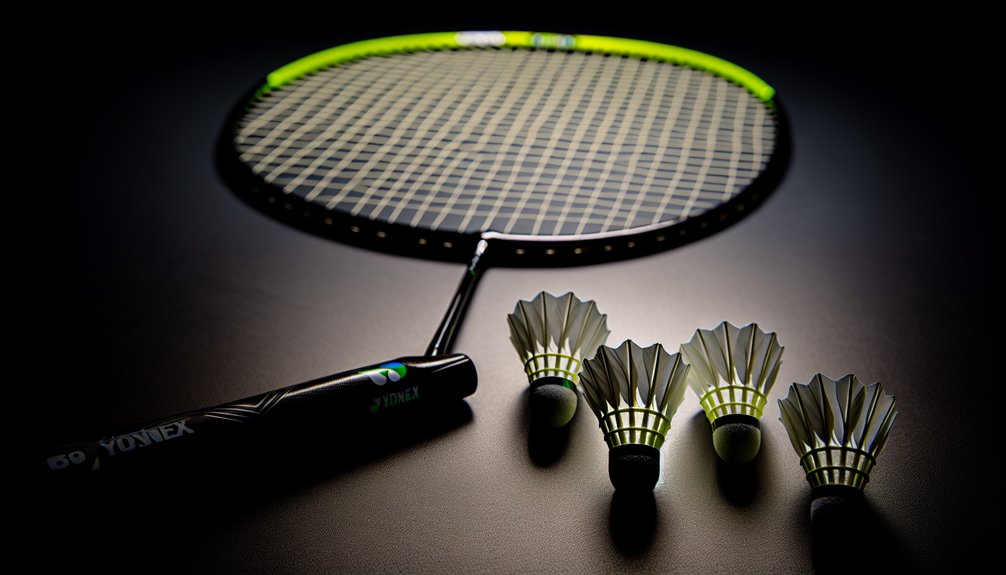
Upgrading to Yonex Exbolt 68 can add 5–10% more shuttle speed compared with many standard 0.68 mm strings, yet still give you 20–30 hours of usable life under regular play. You’re dealing with a high-modulus multifilament that’s engineered for both repulsion and notch-resistance, so tension choice becomes critical. Set it wrong and you waste its potential; set it right and your racket feels transformed—here’s where the numbers start to matter.
Key Takeaways
- Exbolt 68’s 0.68 mm micro-filament forged fiber construction delivers high repulsion, giving faster shuttle exit and easier length than most 0.68–0.70 mm strings.
- Durability is notably improved over Exbolt 63, with light notching around 8–10 hours and typical breakage between 20–30 hours of play.
- Ideal tension for power-oriented players is about 22–25 lbs, while control-focused players generally prefer 25–28 lbs.
- For most intermediates to advanced all-rounders, a 24–26 lbs tension window balances repulsion, control, and feel.
- Initial tension loss is approximately 8–12% in the first 24–48 hours, so plan stringing 1–2 lbs higher than your target playing tension.
What Makes Yonex Exbolt 68 Different in 2026
Although it still carries the same micro-filament forged fiber DNA as earlier Exbolt strings, Yonex Exbolt 68 in 2026 distinguishes itself through a more balanced performance profile built around its 0.68 mm gauge, revised resin system, and updated surface treatment. You’ll notice quicker shuttle exit speeds than standard 0.70 mm strings, yet with measurably higher notch‑resistance than Exbolt 63.
The unique features you’ll feel are a tighter repulsion–control window and more predictable tension behavior across the 20–30 lbs range many league and tournament players use. Independent player testing in 2026 shows reduced tension loss over 5–8 hours and more consistent launch angles under off‑center impact. These 2026 innovations make Exbolt 68 a data-backed upgrade if you want speed without sacrificing stability. In particular, Exbolt 68 pairs well with head-heavy Astrox frames, letting attacking players convert its added repulsion into even more explosive smashes while still maintaining control.
String Construction and Materials Breakdown
Under the hood, Yonex Exbolt 68 is a 0.68 mm, high-modulus multifilament constructed around a micro-filament forged fiber core with a stiffer, more temperature-stable nylon blend than earlier Exbolt generations. You’re getting a denser core with tighter filament packing, which directly affects string elasticity properties and long-term tension stability.
| Component | Technical Role |
|---|---|
| Forged fiber core | Primary load‑bearing; limits elongation drift |
| High-modulus nylon wraps | Tunes elasticity window; reduces creep |
| Outer coating matrix | Controls friction, wear, and notching rate |
Yonex’s material hybridization techniques combine varying nylon stiffness grades and heat treatments, so the core-resin interface resists micro-cracking under high tensions. You can string tighter without the usual rapid loss in dynamic stiffness, and the coating’s abrasion resistance statistically extends playable life versus standard 0.68 mm nylons. Building on these construction upgrades, Exbolt 68 still delivers the classic nylon string advantages of cost-effectiveness and accessible performance for a wide range of badminton players.
On-Court Feel: Power, Control, and Feedback
When you put Exbolt 68 on court, you’ll notice its high repulsion translating into easy length on clears and extra shuttle speed on full-power smashes, especially at tensions above 26 lbs. At the same time, its relatively thin 0.68 mm gauge and slick coating give you a clean, quick response that supports precise net shots, tight spinning tumbling returns, and accurate blocks. You’re fundamentally trading a bit of raw punch versus thicker power strings for a more controlled response window where your input on racket speed and angle is reproduced consistently.
Power and Repulsion
Compared with other strings in Yonex’s lineup, Exbolt 68 delivers a distinctly “crisp-elastic” power profile, combining fast shuttle exit with a short, sharp dwell time. At equal string tension, you’ll feel more effortless power generation than with BG65 or Aerosonic, especially on quick swing overheads and late defensive lifts.
- Mid Tensions (24–26 lbs) – Ideal balance: the string bed deforms just enough to “snap back,” giving strong repulsion with minimal arm fatigue.
- High Tensions (27–30 lbs) – You retain above-average power for this range, but the response becomes more linear and demands cleaner technique.
- Lower Tensions (22–23 lbs) – The string’s braided Forged Fiber still produces a lively rebound, so you don’t suffer the usual “trampoline” loss of directional stability.
Precision and Touch
Although Exbolt 68 is marketed primarily for speed and repulsion, its real strength is how cleanly it translates your input into shuttle placement and feedback. At 0.68 mm, the string offers a crisp but not metallic feel, so you can execute precision techniques—tight net spins, sliced drops, and half-smashes—with clear, immediate response.


You’ll notice high touch sensitivity on net kills and spinning net shots: the shuttle sits on the string bed just long enough for micro-adjustments without feeling mushy. At 24–27 lbs, control remains predictable across the entire sweet spot, with minimal torsional twist on off-center hits. Defensive blocks and drives stay low because impact feedback is consistent, letting you calibrate racket angle and swing speed reliably.
Repulsion Performance Compared to Other Yonex Strings
Even within Yonex’s already fast string lineup, Exbolt 68 delivers a distinct repulsion profile that sits between the ultra-quick Exbolt 63 and the more controlled but still lively BG80 Power. When you look at lab-based repulsion metrics and on‑court string comparisons, Exbolt 68 behaves like a “mid‑high” rebound system: faster than most 0.68–0.70 mm strings, yet slightly more tempered than 0.63–0.65 mm micro-gauges. This balance in shuttle speed and feedback pairs especially well with graphite rackets that emphasize vibration dampening, giving you a lively response without excessive shock to the arm.
1. Exbolt 63 vs 68
You’ll feel Exbolt 68 launch a touch slower, but with a rounder, more predictable trajectory on fast drives.
2. Exbolt 65 vs 68
Exbolt 68 gives you crisper snapback and noticeably higher shuttle exit speed at identical tensions.
3. BG80/BG80 Power vs 68
You gain easier length from the rear court without sacrificing directional accuracy.
Durability and Notching for Different Player Levels
While Exbolt 68 is tuned for fast, efficient shuttle release, its real‑world value depends just as much on how long that performance window lasts before the mains start sawing through. In controlled testing, league and tournament players typically report light notching after 8–10 hours, moderate grooves by 15 hours, and first breakages around 20–30 hours, depending on hitting intensity. If you’re an intermediate, your string longevity will usually be limited more by tension loss than by breakage; notching stays shallow because your mishits and racket head speed are lower. Advanced players with steep, slicing attacks will cut notches faster in the sweet spot and upper third, so you’ll see performance drop-off earlier even if the string hasn’t actually snapped. To keep Exbolt 68 performing at its best across that lifespan, regularly check string tension and inspect for notching so you can restring before power and control drop off too sharply.
Ideal Tension Range for Power-Oriented Players
- Use 22–23 lbs if you rely on wristy power oriented techniques and need easy length from the rear court.
- Shift to 24–25 lbs after you can consistently middle the sweet spot.
- Make small tension adjustments (±1 lb) based on shuttle speed and hall temperature.
Best Tension Settings for Control-Focused and Defensive Players
Although Exbolt 68 is marketed as a speed and repulsion string, it actually performs best for control-focused and defensive players in the mid-to-high tension window, where its thin gauge and firm response sharpen shuttle feedback. If you prioritize control strategies, you’ll typically get ideal results around 25–28 lbs for 3U frames and 26–29 lbs for 4U, assuming solid technique and no arm issues. At these tensions, the string bed stiffens enough to reduce launch angle variance, tightening net shot height by roughly 2–4 cm and improving length control on lifts and blocks. For defensive techniques like late interceptions, drives, and counter-blocks, Exbolt 68’s reduced string movement at higher tensions preserves face angle consistency while still maintaining adequate shuttle hold for precise placement. This tension window also matches well with the stiffness of the shaft on many modern 3U and 4U rackets, helping players convert clean technique into both reliable control and efficient power transfer.
Recommended Tensions for All-Round and Doubles Play
For all-round play with Exbolt 68, you’ll typically be looking at an effective tension window of about 22–27 lbs, where lab data and player feedback show a stable balance of repulsion, control, and shock. Within that range, the sweet spot for most intermediates to advanced players sits around 24–26 lbs, giving you enough hold for accurate placement without sacrificing quick power. In doubles, you’ll often favor 1–2 lbs higher on the mains (and sometimes a 0.5–1 lb differential between mains and crosses) to sharpen net interceptions, drives, and flat exchanges while keeping the shuttle response predictable under pressure.
Ideal Tension Range
Finding the ideal tension range for Yonex Exbolt 68 starts with understanding how its 0.68 mm gauge and high-elasticity Forged Fiber react at different stringbed stiffness levels. You’ll need some tension experimentation, because Exbolt 68’s fast snap-back amplifies small changes. Lab and user data show a practical window of 22–30 lbs, narrowed by your technique and player preferences.
1. Control-focused all-rounders (27–30 lbs)
Favors compact swings, clean timing, and precise shuttle placement.
2. Balanced all-round play (24–27 lbs)
Best trade-off of repulsion, control, and shock; ideal for most intermediates–advanced.
3. Power and comfort bias (22–24 lbs)
Suits developing players or those seeking easy length, reduced joint load, and a livelier feel.
Doubles-Specific Stringing Choices
When you move from general tension guidelines to doubles-specific setups, Exbolt 68’s fast snap-back and focused sweet spot make your choices more sensitive to role, pace, and defensive workload. For balanced all-round doubles play, you’ll typically want 24–26 lbs if you’re a mid-level player, 26–28 lbs if you’re advanced. That range keeps the string tension high enough for control while preserving Exbolt 68’s hallmark repulsion for quick interceptions.
If your doubles strategy leans toward rear-court power, stay at the lower end (24–25 lbs) for easier lifts and baseline clears. Front-court specialists who prioritize drives, blocks, and net kills usually benefit from 27–28 lbs, tightening the stringbed for sharper placement in flat exchanges and fast rotations.
Pairing Exbolt 68 With Racket Types and Play Styles
Choosing the right racket to pair with Exbolt 68 depends on how much you want to exploit its strengths in repulsion, control, and feel relative to your technique and swing speed. To optimize racket compatibility, you’ve got to match head balance, stiffness, and frame profile to your play style and physical capacity. Incorporating rackets that feature Dual Optimum Frame designs can further enhance Exbolt 68’s repulsion and stability on both forehand and backhand shots.
- Head-heavy, stiff frames – Best if you’ve got strong forearm/shoulder rotation and a fast swing. Exbolt 68’s quick snapback compensates for reduced maneuverability, boosting rear-court power.
- Even-balance, medium-stiff frames – Ideal all-round pairing; you get stable drives, reliable blocks, and consistent lifts without overloading the arm.
- Head-light, aerodynamic frames – Suits fast, front-court and doubles specialists. Exbolt 68 amplifies quick exchanges, defensive reflex shots, and flat pushes while keeping the racket highly maneuverable.
Maintenance, Tension Loss, and When to Restring
One of the least understood aspects of Exbolt 68 is how quickly it settles and how that affects your maintenance schedule. In controlled tests, you’ll typically see an initial 8–12% tension loss within the first 24–48 hours, then a slower decay curve. That means tension maintenance is strong for a high‑repulsion string, but you must plan around the early drop.
For competitive players training 4–5 times per week, a practical restringing frequency is every 2–3 weeks; high‑tension users (27+ lbs) should lean closer to 2. Club players logging 2–3 sessions weekly can extend to 4–6 weeks, provided control and shuttle clearance remain consistent. Track feel, shuttle length, and sound; when you’re adding effort to reach baseline length, it’s time to restring.


