Studies on racket sports show that even a 0.05-second delay in preparation can ruin shot quality, and you’re likely losing points the same way without realizing it. If your clears feel heavy, smashes mistime, or drives come off the frame, it’s rarely just “bad form”—it’s late preparation, poor spacing, and an inconsistent swing rhythm working together. Fixing that requires a systematic approach, and that’s where your training needs to change.
Key Takeaways
- Prepare the racket early, with the head up and ready, before the shuttle crosses the net to avoid rushed, mistimed contact.
- Sync your split-step with the opponent’s hit, then drive explosively to the shuttle so you reach your ideal striking distance calmly.
- Standardize a relaxed pre-swing pattern, accelerating only in the final third of the stroke for smoother rhythm and more consistent sweet-spot contact.
- Use video or partner feedback to spot late preparation, poor footwork, or unstable contact windows, then isolate and drill each flaw.
- On match days, use deep breathing and simple focus cues like “split–load–hit” to calm nerves and stabilize your timing in the first rallies.
Find the Real Causes of Your Bad Timing
Before you can fix your badminton timing, you need to isolate whether the problem comes from late racket preparation, incorrect footwork patterns, poor shuttle tracking, or inefficient stroke mechanics. First, film yourself from the side and behind in multi‑shuttle drills. Use slow motion to check if your racket’s fully prepared before the shuttle crosses the net or if you’re still backswinging as it drops. Since timing problems can also be triggered by psychological pressure, pay attention to whether your mechanics or footwork break down more when you imagine an opponent using mind games and psychological tactics against you.
Next, assess tracking. Do your eyes lock on the shuttle’s flight early, or do you “lose” it near impact? Note any flinching or late head adjustments.
Finally, evaluate stroke mechanics: check contact point consistency, swing path smoothness, and grip changes. Identify which variable fails most frequently, then prioritize correcting that single constraint in your next practice block.
Sync Your Footwork and Positioning for Better Timing
To fix timing issues, you need to sync your split-step with the shuttle’s contact on your opponent’s racket so your first step is always explosive and on time. You’ll also learn to recognize and hit within ideal striking distance zones, rather than reaching or letting the shuttle get too close to your body. From there, you’ll adjust your base position and footwork pattern for each corner so you arrive early enough to execute a relaxed, efficient stroke. As your timing improves, you’ll find it much easier to contact the shuttle in the racket’s sweet spot, making your shots feel cleaner and more powerful.
Align Split-Step With Shuttle
Although it looks simple, aligning your split-step with the shuttle’s movement is one of the most critical timing skills in badminton. You want your feet to land at the exact moment your opponent strikes the shuttle, not earlier, not later. This lets your muscles preload, so you explode in the correct direction the instant the shuttle leaves the stringbed.
Watch the opponent’s preparation, then initiate your hop just before their racket meets the shuttle. Land softly on the balls of your feet, knees flexed, hips low, weight balanced slightly forward. If you’re landing too early, delay your hop; if you’re always late, start it a fraction sooner. Train this by shadowing rallies, syncing your split-step to imagined contact.
Optimal Striking Distance Zones
When your feet and the shuttle’s position are out of sync, timing breaks down because you’re striking outside your ideal distance zone. You need a repeatable contact window where your arm is neither cramped nor overextended, and your body weight can drive cleanly through the shot.


Think of “distance zones” as fixed relationships between your hitting shoulder, contact point, and base position. Build a precise feel for them:
| Concept | Key Details |
|---|---|
| Forehand rear-zone | Contact slightly in front of shoulder line, elbow relaxed, body rotated. |
| Backhand rear-zone | Contact to side of body, stable core, compact swing. |
| Forecourt net-zone | Racket far in front, lunge knee over toes, minimal backswing. |
| Midcourt drive-zone | Racket in front hip line, neutral stance, short acceleration. |
Adjust Position For Corners
Because every late shot in the corners starts with a late first step, syncing your footwork with the shuttle’s trajectory is the fastest way to fix your timing there. As soon as your opponent hits, push explosively from your base, then split-step so you land just before their contact. That lets you “ride” the shuttle’s line instead of chasing it.
For rear corners, open your hips first, then chasse or cross behind so your body arrives under and slightly behind the shuttle. You’ll hit in front of your shoulder instead of beside your ear.
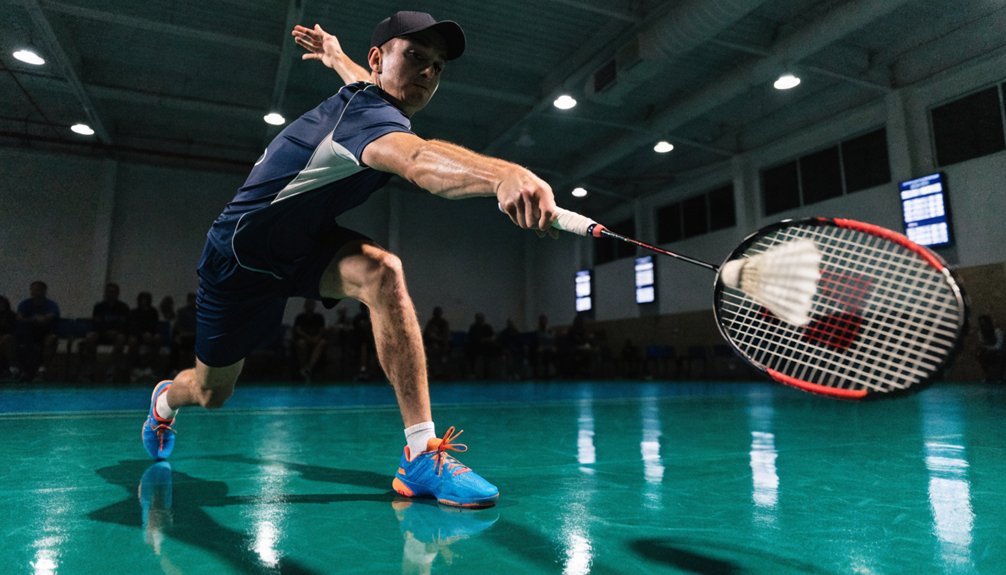
For front corners, keep your upper body tall, lunge with your knee tracking over toes, and place your racket foot slightly outside the shuttle’s line. That stabilizes your balance so contact feels clean, not rushed.
Find the Right Contact Point for Clean Shots
Use this reference table:
| Situation | Ideal Contact Point |
|---|---|
| Rear-court clear/smash | Just in front of your hitting shoulder, highest reach |
| Mid-court drive | Slightly in front of body, around chest height |
| Front-court net shot | In front of racket foot, as high as legal over the net |
Prioritize “early, high, in front” while maintaining full arm extension and stable grip pressure.
Clean timing is also easier to achieve when your racket’s weight distribution matches your swing speed and style of play.
Train Your Swing Rhythm for Smoother Badminton Timing
Although contact point is critical, your timing won’t truly stabilize until your swing rhythm is trained to be smooth and repeatable. Think of the whole action—unit turn, racket preparation, swing, and recovery—as one continuous tempo. You’re aiming for consistent sequencing, not rushed speed.
First, standardize your pre-swing pattern: split step, turn shoulders, non-racket hand pointing, racket head up and relaxed. Keep this identical for every stroke family so your brain recognizes the pattern.
Next, manage acceleration. Start the racket slowly, then accelerate only through the final third before impact. Avoid sudden, jerky bursts. As your rhythm improves, pairing it with a stable racket setup—like a frame using the Dual Optimum system to enhance stability and maneuverability—helps your swing feel cleaner and more repeatable.
Finally, match your breathing to your rhythm: inhale during preparation, short exhale as you accelerate. This stabilizes muscle tension and makes your timing more repeatable under pressure.
Drills to Fix Timing on Smashes, Drops, and Drives
To correct timing under pressure, you’ll now apply targeted drills for your smashes, drops, and drives. You’ll use smash timing shadow drills to sync your jump, shoulder rotation, and racket acceleration; net drops rhythm practice to coordinate your last step, racket touch, and shuttle height; and drive exchanges footwork coordination to align split-steps with flat, fast contacts. Each drill trains a specific contact window so your strokes land cleanly even at full speed. Using a racket with enhanced maneuverability can make these timing drills more effective by allowing quicker adjustments and cleaner contact at full speed.
Smash Timing Shadow Drills
Lock in your smash timing by stripping away shuttle contact and rehearsing the full stroke as a “shadow” movement. Stand on your rear court mark, split-step, chasse or cross-step back, load your hips, then whip the racket through an imaginary contact point slightly in front of your shoulder. Freeze your follow-through for one second to check balance and racket face.
Next, add rhythm. Count: “1–split, 2–push back, 3–rotate, 4–snap.” Keep the same tempo for every repetition. Use a mirror or video to verify that your elbow leads, your non-racket arm points up, and your contact “window” stays consistent.
Progress by adding a small jump, landing on both feet, and ensuring you’re still “hitting” at the same imaginary height and timing.
Net Drops Rhythm Practice
When your net drop rhythm is clean, your timing on smashes, drops, and drives becomes far easier to sync because your body learns a repeatable “hit on the beat” pattern close to the tape. Stand one big step from the net, coach or partner feeding shuttles slowly to your forehand, then backhand.
Use a strict three-count: 1) split step as the feeder hits, 2) glide in and set the lunge, 3) brush the shuttle at the tape. Say “split–step–hit” out loud to lock tempo.
Focus on: identical contact height, minimal swing, relaxed fingers, and finishing with racket slightly up, ready for the next feed. Progressively increase feed speed while maintaining the same three-count rhythm.
Drive Exchanges Footwork Coordination
Although net drops teach you fine control near the tape, it’s drive exchanges that hard‑wire your timing under pace and pressure and directly support cleaner smashes, drops, and drives. Stand mid‑court, neutral stance, racket up, and agree on a fast, flat rally with your partner. Your priority isn’t power; it’s contact precision and synchronized footwork.
Use small, split‑step recoveries on every stroke: land as your partner hits, then push off to adjust. Keep steps light, no crossing feet, hips square, and avoid drifting backward. Focus on meeting the shuttle slightly in front of your body line, with a compact swing and stable core.
Progress by adding directional drives, then sudden down‑the‑line smashes to test reaction timing.
Keep Your Timing Solid Under Match-Day Nerves
Even with perfect technique in practice, match-day nerves can disrupt your swing tempo, shuttle contact point, and footwork timing if you don’t manage them deliberately. Before each rally, take one deep diaphragmatic breath, exhale slowly, and lock onto a single cue: “split–load–hit.” This narrows attention and stabilizes rhythm. Since tension often ruins stroke rhythm at the moment of contact, consciously relax your fingers on the grip so you can still adjust for quick grip changes right before you hit. Use a between-point routine: towel, breathe, visualize one clean stroke you’ll use next rally. Keep heart rate controlled so your swing speed doesn’t spike and shorten your preparation.
When you feel rushed, lengthen your preparation phase: earlier chasse steps, earlier shoulder turn, racket already up before the shuttle crosses. Treat the first three rallies each game as “timing calibration” points—focus purely on clean contact and stable tempo, not winners.