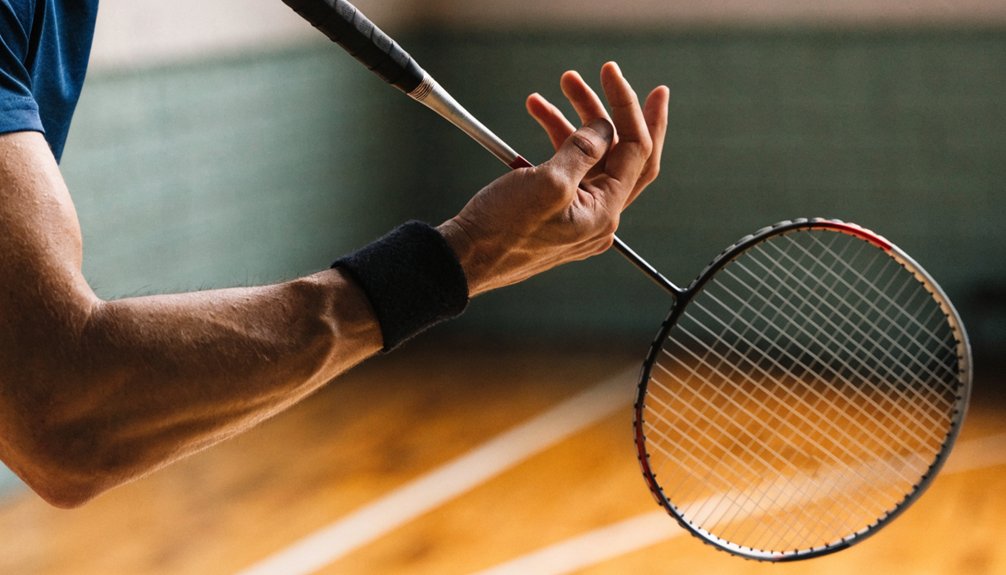
Your racket grip can make your hand feel either lightning-fast or hopelessly late. If you want quicker handling in badminton, you need a grip that stays relaxed, precise, and easy to adjust between shots. Small changes in finger pressure, thumb position, and grip timing can sharpen every shift from smash to net play. Get these details right, and your racket speed starts to change in ways most players miss.
Key Takeaways
- Hold a basic forehand grip like a handshake, with a relaxed V-shape between thumb and index finger for quick, controlled racket handling.
- Keep the racket in your fingers, not deep in the palm, to improve maneuverability and enable faster grip changes.
- Use brief finger pressure at contact, then relax immediately after, to increase racket-head speed and maintain readiness.
- Rotate smoothly between forehand and backhand grips during the backswing using thumb and index finger, without resetting your whole hand.
- Check thumb placement regularly: diagonal on forehand grips and higher on backhand grips for stability during fast exchanges.
Start With the Basic Badminton Grip
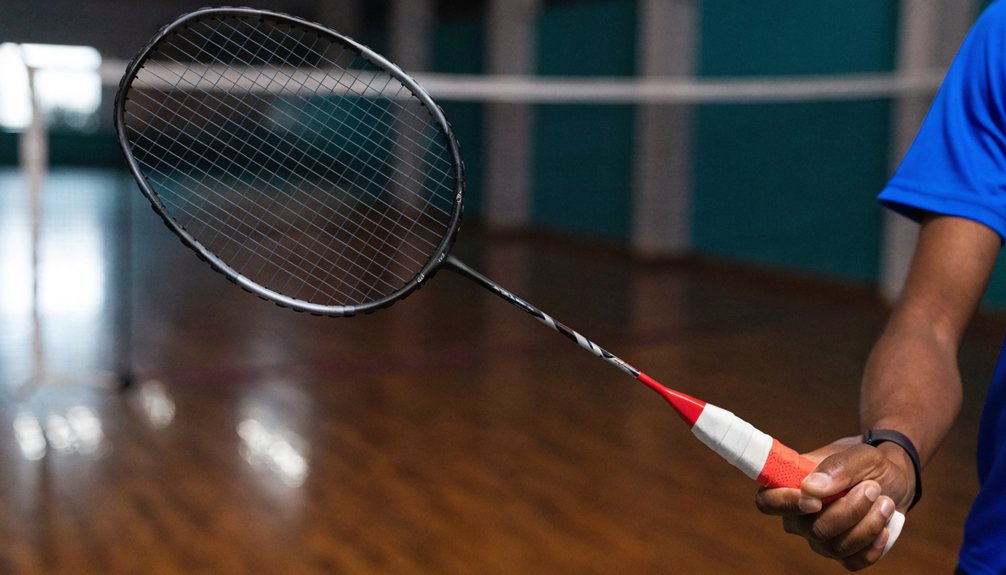
Start with the basic forehand grip, because it gives you the most efficient foundation for control, power, and quick racket adjustments. You should hold the handle as if you’re shaking hands with it, keeping the racket face naturally square. This alignment supports reliable shot direction and smoother shifts between strokes during rallies.
Focus on basic grip techniques by placing your thumb along the side bevel and wrapping your fingers comfortably, not tightly, around the handle. Your index finger should sit slightly separated to improve leverage and racket stability. Precise grip hand positioning lets you maintain relaxed forearm tension, which improves maneuverability without sacrificing accuracy. Check that the V-shape between your thumb and index finger rests on the top side bevel. Build this habit early, and your handling will become cleaner, quicker, and more consistent. Learning basic grips first also makes it easier to communicate clearly during coaching and shot instruction.
Use Finger Power for Faster Handling
Once your basic grip is set, finger power becomes the next step in improving racket speed and control. Instead of squeezing the handle constantly, you should apply brief, targeted pressure with your thumb, index, and middle fingers. This sharpens racket acceleration without tightening your wrist or forearm. Effective grip techniques rely on timing: relax between shots, then contract at contact to create a quicker, cleaner response.
To build finger strength, practice short squeezing drills and controlled tapping movements while holding the racket correctly. Focus on keeping your palm relaxed so your fingers do the adjustment work. A proper forehand hold starts from a light handshake position on the racquet’s octagonal handle, which helps your fingers stay active without excess tension. You’ll notice faster preparation, more precise touch, and better stability on quick interceptions. Small finger actions produce efficient handling, helping you react sooner while maintaining accuracy under pressure during fast exchanges.
Switch Faster Between Forehand and Backhand
Because rallies change direction in a split second, your grip must rotate smoothly between forehand and backhand without forcing a full hand reset. You shouldn’t squeeze continuously; instead, keep light finger contact so the handle can turn a few degrees inside your palm. That small adjustment links efficient forehand techniques with reliable backhand strategies under pressure. The versatile continental forehand grip supports quick transitions because it allows multiple shots without major hand repositioning.
- Let your thumb and index finger guide rotation, not your whole wrist.
- Return to a neutral bevel reference after each stroke preparation.
- Practice shadow switches until the movement feels automatic and compact.
If you overgrip, the racket face arrives late and your recovery slows. If you stay relaxed, you’ll recognize cues earlier, rotate faster, and keep the shuttle in front of your body for cleaner interception during quick exchanges under sustained pressure.
Adjust Your Grip for Smashes, Drives, and Net Shots
You’ll get better results when you fine-tune your grip to match the shot. For smashes, tighten your grip at contact; for drives, shift quickly to a neutral hold that supports fast exchanges. At the net, soften your fingers and adjust pressure precisely so you can control angle, touch, and shuttle speed. Choosing the right grip size can also improve maneuverability and reduce stress on your fingers, palm, and wrist.


Smash Grip Adjustment
When you switch from clears to attacking shots, a small grip adjustment gives you better racket-head speed and cleaner contact. For a stronger smash, rotate slightly toward a forehand bevel grip instead of squeezing the handle flat in your palm. That position preserves grip flexibility, so your fingers can tighten at impact and release tension just before acceleration.
- Keep your thumb relaxed along the side bevel, not pressing forward.
- Let your index finger guide the angle for steeper smash techniques.
- Tighten the last three fingers only at contact to sharpen power transfer.
You’ll feel the racket move faster when your wrist stays loose and your palm doesn’t over-clamp. Practice this adjustment slowly first, then increase swing speed while keeping the same contact point and face alignment under pressure consistently.
Drive Grip Transition
While drives demand less swing length than smashes, they require a faster adjustment to a neutral forehand grip so you can react early and keep the racket face stable through flat exchanges.
From your smash setup, relax your thumb and index finger, then rotate the handle slightly toward bevel one. This small adjustment sharpens drive grip mechanics by aligning your wrist behind the shuttle for compact, linear contact. You shouldn’t squeeze continuously; tighten only at impact to preserve speed and directional control. Practice switching between slight forehand and backhand-oriented drive grip variations without reopening your fingers or regripping in your palm. Keep the racket head up, elbow forward, and preparation minimal. When your grip adjustment becomes automatic, you’ll intercept sooner, recover faster, and maintain pressure during rapid midcourt rallies against aggressive opponents consistently.
Net Shot Control
At the net, even a two-millimeter grip change can decide whether the shuttle tumbles tight or sits up. You should ease from a neutral forehand toward a softer finger-led hold, reducing palm pressure so the racket head stays sensitive. That lighter contact improves precision feedback, letting you feel brush angle, cork contact, and rebound timing.
- Relax your thumb and index finger to fine-tune racket face stability.
- Shorten your preparation so opponents can’t read your net shot techniques.
- Squeeze only at contact for tighter spin and better height control.
If you choke the handle too firmly, touch disappears and the shuttle lifts. Keep your wrist quiet, guide with fingers, and recover instantly after contact. Master this micro-adjustment, and you’ll own tighter nets, safer replies, and more attacking opportunities consistently.
Relax Your Grip Between Shots
Although it’s tempting to hold the racket tightly after contact, relaxing your grip between shots improves both speed and control. You want minimal grip tension during recovery so your fingers and thumb can reset instantly for the next stroke. That lighter hold keeps the racket head mobile, reduces forearm fatigue, and helps maintain clean shot rhythm under pressure.
As the shuttle leaves your strings, let your hand soften without losing alignment. Keep the handle secure enough to guide preparation, then tighten briefly only at impact. This squeeze-release pattern shortens reaction time because your wrist and fingers stay available for quick directional changes. You’ll feel smoother shifts from defense to attack, especially in flat exchanges and midcourt interceptions. Train this consciously, and your racket handling will become noticeably faster and more efficient. Choosing the right grip thickness also supports faster handling, since overly thick grips can restrict movement while thin grips generally improve control.
Fix Badminton Grip Mistakes That Slow You Down
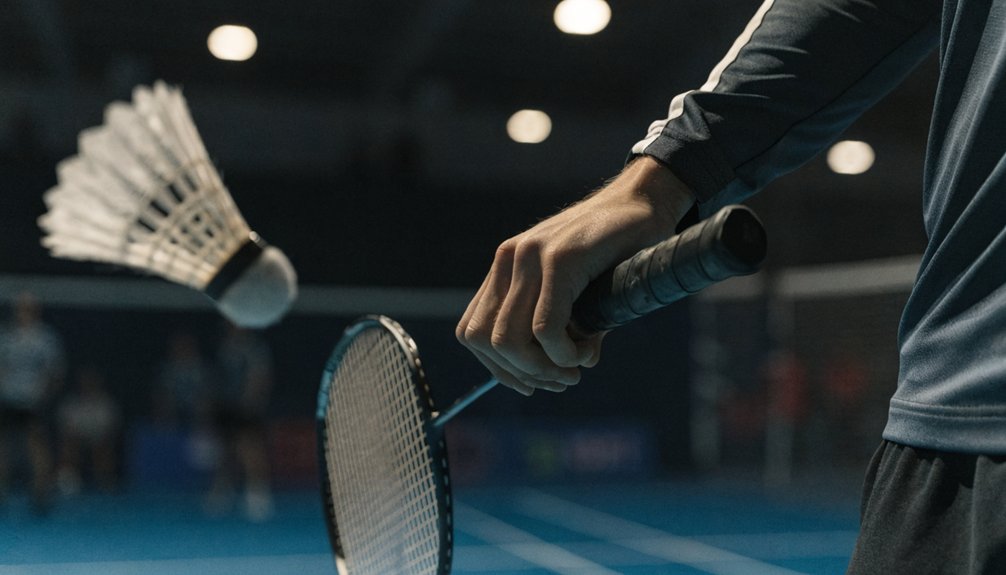
Small grip errors can reduce your racket speed and delay clean contact, so you’ll want to correct them early. Start by placing your thumb correctly, loosening any overtight hold, and making sure your grip changes stay aligned with each shot. When you tighten these fundamentals, you’ll move the racket more efficiently and respond faster under pressure. Using a racket with an isometric head can also support faster handling by giving you a larger sweet spot for more consistent contact.
Correct Thumb Placement
When your thumb sits too far around the handle or presses flat across a forehand grip, you lose leverage, tighten your wrist, and slow the racket head through contact. Correct thumb positioning keeps the bevels readable in your hand and improves grip stability during fast shifts.
- On forehand grips, rest your thumb diagonally along the side bevel, not spread across the back face.
- On backhand grips, move it higher so it supports a direct push without twisting the racket.
- During changes, let the thumb slide minimally between bevels so your fingers guide the angle precisely.
You’ll feel cleaner pronation, sharper interception, and better control at speed. Check your thumb before every rally; small placement errors multiply quickly once the shuttle pace rises under pressure in matches.
Loosen Overtight Grips
Relax your grip pressure before the shuttle arrives so the racket can accelerate instead of fighting your forearm. If you squeeze continuously, you restrict wrist mobility, slow pronation, and waste energy through unnecessary muscular co-contraction. Your goal is controlled relaxation: keep the handle secure with minimal baseline grip tension, then tighten briefly at impact. That sequence improves racket-head speed and makes recovery quicker for the next shot.
Check your hand positioning as well. The racket should sit in your fingers more than your palm, letting the thumb and index finger guide fine control without clamping. During practice, rate your squeeze from one to ten; most neutral phases should feel like three or four. If your forearm burns early, you’re probably overgripping and limiting both touch and speed badly.
Align Grip Changes
Because each shot demands a slightly different racket-face angle, your grip changes must align with the swing rather than happen late or independently of it. If your hand adjusts after the racket starts accelerating, you lose timing, stability, and deception. Coordinate grip rotation with your preparation so the face arrives set at contact.
- Initiate grip rotation during the backswing, not at the shuttle.
- Match grip pressure to impact: relaxed early, firmer through contact.
- Keep finger placement consistent, so changes stay small and fast.
This sequencing lets you switch from forehand to backhand without extra motion. You’ll feel cleaner contact, quicker recovery, and better control under pace. Train slowly first, then increase speed until the adjustment becomes automatic within every stroke pattern under match pressure consistently.
Practice Grip Changes Until They’re Automatic
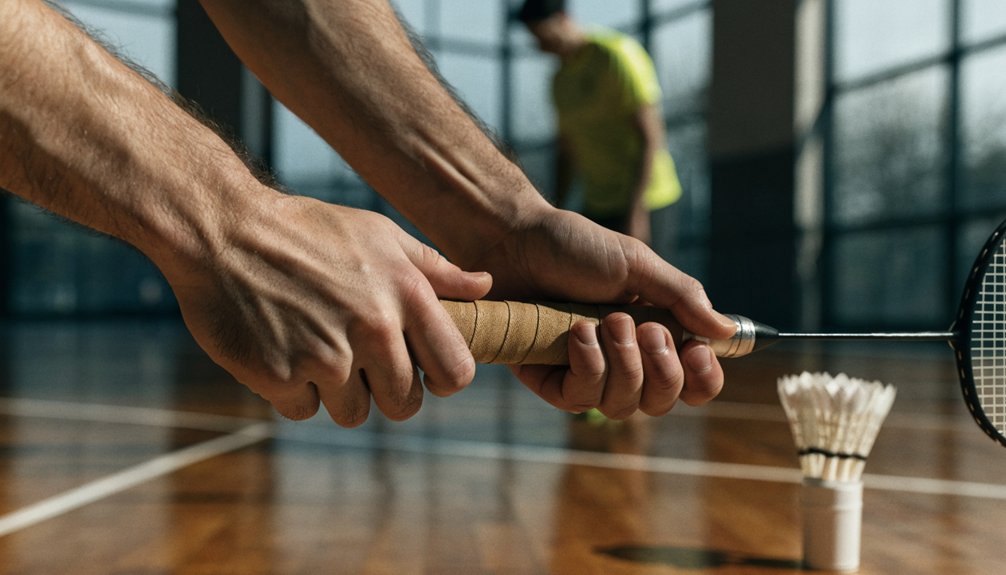
Train your hand to switch grips without conscious thought, since badminton gives you only fractions of a second between shots. Repetition builds automatic shifts, letting you move from forehand to backhand without delaying your swing path or contact timing. Start with shadow swings, changing grips after every simulated shot. Then add multishuttle drills so your fingers learn pressure changes under speed. Focus on grip consistency: the handle should settle into the same reference points each time, not drift during recovery.
You’ll improve faster by practicing short, frequent sets instead of long, sloppy sessions. Keep your wrist relaxed, use your fingers to rotate the handle, and return to neutral between strokes. When grip changes become automatic, your racket preparation gets earlier, your reactions sharpen, and your shot quality holds up under pressure. Choosing the right grip size also supports faster handling by improving comfort and control during repeated grip changes.
Frequently Asked Questions
What Grip Size Is Best for Beginners in Badminton?
You’ll usually do best with a smaller badminton grip, like G4 or G5, since it supports beginner techniques and easier grip adjustments. You can always build it up with overgrips as your control improves.
How Often Should Badminton Grips Be Replaced?
You should replace badminton grips every 20–30 hours of play; nearly 60% of players wait too long. Monitor grip durability through sweat, tack loss, and compression, and prioritize grip maintenance to preserve control and responsiveness.
Do Overgrips Affect Racket Handling Speed?
Yes, overgrips can affect your racket handling speed: thinner overgrip thickness and tacky grip material usually let you change grips faster, while thicker or cushioned options may slow adjustments. You’ll perform best by matching feel and control.
Can Sweaty Hands Reduce Grip Control During Matches?
Yes—when sweat slicks your palm, the racket can twist like a wet fish, reducing control during matches. You’ll regain precision using hand drying techniques and moisture absorbing grips, keeping your hold stable, responsive, and confident.
Should Juniors Use Different Grips Than Adults?
Yes, you should often use slightly different grips than adults, because junior adaptability and grip development matter. You’ll benefit from smaller handles, softer overgrips, and progressive adjustments that match hand size, strength, and technique maturation.