
In badminton, a split step timed even 0.1 seconds late can cost you the first attacking touch. If you want to move earlier without guessing, you need to match your landing to your opponent’s contact, not their swing. That requires sharper visual cues, better stance control, and cleaner recovery mechanics. Get those pieces aligned, and your court coverage starts to change in ways most players never train for.
Key Takeaways
- Land your split step exactly as your opponent contacts the shuttle, not before or after, to maximize elastic rebound and reaction speed.
- Watch the opponent’s racket head closely and use impact sound only as support for more accurate contact-based timing.
- Keep the hop compact and land in a balanced stance with flexed knees, loaded hips, and weight slightly forward.
- Avoid guessing early, because early landings stiffen the legs, while late landings delay your first push and recovery.
- Practice shadow and partner cue drills with varied tempo, deception, and video feedback to build consistent split step timing.
How Good Split Step Timing Feels
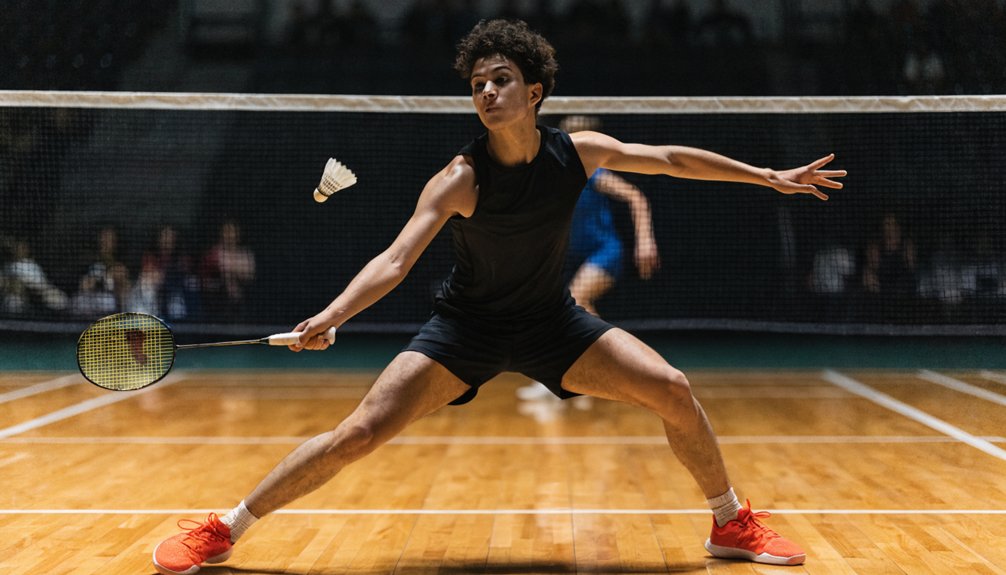
When your split step is timed well, it feels less like a jump and more like a brief, spring-loaded landing that matches your opponent’s hit. You sense your center of mass settle under control, with your hips loaded and your feet alive, not heavy. These split step sensations tell you your body is organized for immediate movement.
You’ll notice clear timing benefits in the next instant. Your first push feels cleaner, because your weight is balanced between both legs and your ankles stay reactive. Instead of guessing, you feel poised, quiet, and ready to accelerate in any direction. Good timing also reduces unnecessary muscular tension, so your legs respond faster without forcing effort. If it feels smooth, elastic, and connected, you’re probably close to the right rhythm now.
Land Your Split Step on Contact
That smooth, spring-loaded feeling comes from one key cue: your feet should complete the split step at the exact moment your opponent strikes the shuttle. If you land too early, the elastic response fades before you need it. If you land too late, your first movement gets delayed. Train contact awareness by watching the opponent’s racket head, not just the shuttle’s path. The sound of impact can help, but visual timing should lead.
Your goal is to descend as the swing unfolds, then touch down exactly on contact. Keep the action compact and repeatable so your timing holds under pressure. Precise foot placement matters because inconsistent spacing changes landing time and disrupts your push-off window. Footwork drills can sharpen this rhythm and improve movement speed for faster first steps. Dial in that contact-matched landing, and you’ll react faster, cleaner, and with less wasted effort overall.
Get Into a Balanced Split Step Stance
Once you’ve matched your landing to the opponent’s contact, your split step stance has to put you in position to move equally well in any direction. Keep your center of mass slightly forward, hips loaded, and knees flexed so you can push instantly without a reset. Your balanced posture should feel athletic, not low for the sake of being low.
Focus on precise foot placement. Set your feet just wider than shoulder width, with weight distributed through the balls of both feet and heels lightly connected to the floor. Angle your toes slightly outward so your hips stay free to rotate and your first step isn’t blocked. Keep your chest upright, racket leg and non-racket leg equally ready, and your arms relaxed for stability. From this stance, you’ll react cleaner, faster, and with better directional control.
Fix Common Split Step Timing Mistakes
Even with a solid stance, poor split step timing can cancel out your movement before the rally really develops. If you land too early, your legs stiffen and you lose elastic rebound. If you land too late, you react after the shuttle’s direction is already clear, costing distance and balance. Your goal is to contact the floor exactly as your opponent strikes.


Another common error is guessing instead of reading. You shouldn’t split because you expect a smash or drop; you should sync your hop to the opponent’s hitting action. Keep the hop compact, not exaggerated, so your center of mass stays controlled. Staying composed against mind games also helps you read the opponent’s contact more clearly instead of reacting to distractions. These corrections reinforce footwork fundamentals and sharpen reaction training. When your timing matches the opponent’s contact point, your first step becomes faster, cleaner, and far more efficient overall.
Use Drills to Improve Split Step Timing
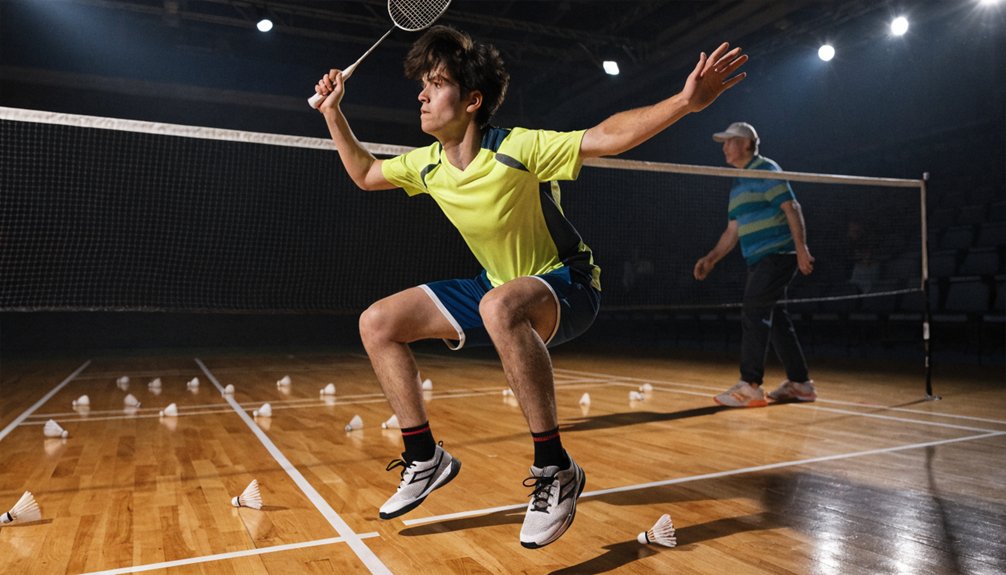
To make those timing corrections automatic, you need drills that train your split step against a real contact cue, not just a guessed rhythm. Start with shadow reps: split exactly as a feeder points or claps, then push off immediately. Next, use partner drills where your partner alternates clear, drop, and smash signals, forcing you to delay the hop until contact. Just as racket balance affects how quickly you can react and change direction, your drill setup should match your playing style and speed.
| Drill | Focus |
|---|---|
| Clap-feed shadow | Land on cue |
| Random partner feed | React, then push |
Add drill variations by changing feed tempo, deception, and recovery distance. Keep your center of mass low, heels light, and first step explosive. If you’re early, pause longer; if you’re late, shorten the hop and preload sooner. Film a few sets so you can verify whether your feet land precisely at shuttle contact consistently.
Adjust Split Step Timing for Singles and Doubles
Because singles and doubles place different demands on space, pace, and anticipation, your split step can’t follow one fixed rhythm. In singles, you usually have more time, so your landing should sync closely with your opponent’s contact while staying balanced for deeper court coverage. Effective singles strategies depend on reading stroke preparation early without committing too soon.
In doubles, exchanges are faster, flatter, and more reactive. You need a shorter, sharper split step that lands fractionally later, matching the reduced shuttle travel time. Good doubles coordination also matters: your timing must align with your partner’s positioning, especially in front-back and side-by-side formations. Because badminton uses rally point scoring, every exchange can immediately affect the score, making precise split step timing even more valuable in fast doubles rallies. If you practice both formats, train your split step under each tempo separately, so your body learns the correct trigger, height, and landing moment for every rally situation.
Recover Faster After the Split Step
Explode out of the landing, not up from it. After your split step, keep your hips loaded and your center of mass slightly forward so the first push drives horizontally. You shouldn’t pause on contact; absorb force through your ankles, knees, and hips, then redirect it immediately into the movement line. That short amortization phase is what sharpens reaction speed.
A racket with a Dual Optimum Frame can support faster forehand and backhand transitions by improving stability and shot effectiveness during quick recoveries. To recover faster, bring your non-racket leg under your body as soon as you plant, and keep your chest stable while your feet reset. Efficient footwork coordination comes from compact steps, not extra hops. Stay on the balls of your feet, let your racket arm balance your trunk, and finish each chase with a small recovery step. Train this rhythm consistently, and you’ll move sooner, stop cleaner, and cover more court.
Frequently Asked Questions
Can Split Step Timing Reduce Knee Strain During Badminton?
Yes—like a metronome, you’ll reduce knee strain by timing your split step correctly, because better knee mechanics improve force absorption and alignment. That supports injury prevention, helping you load, decelerate, and change direction more safely.
How Long Does It Take to Improve Split Step Timing?
You’ll usually improve split step timing within 2–6 weeks with consistent practice. If you’re training timing drills 3–4 times weekly, you’ll notice sharper reactions, better court balance, and clear split step benefits through measurable movement efficiency.
Should Beginners Learn Split Step Timing Before Advanced Footwork?
Yes—like building on bedrock, you should learn split step timing before advanced footwork. You’ll gain split step benefits sooner, and beginner techniques become cleaner, faster, and more reliable, giving you a precise foundation for later movement.
Does Shoe Type Affect Split Step Timing and Responsiveness?
Yes—your shoe type affects split step timing and responsiveness. You’ll react quicker with appropriate shoe traction matched to the court surface. Choose lightweight, stable shoes; they’ll improve grip, reduce slippage, and help you load efficiently.
Can Fatigue or Poor Fitness Ruin Split Step Timing?
Yes—reaction time can slow by 10% under fatigue, and you’ll feel every missed split step. The fatigue impact is real: poor fitness levels degrade leg stiffness, timing precision, and recovery, but you can rebuild them.