
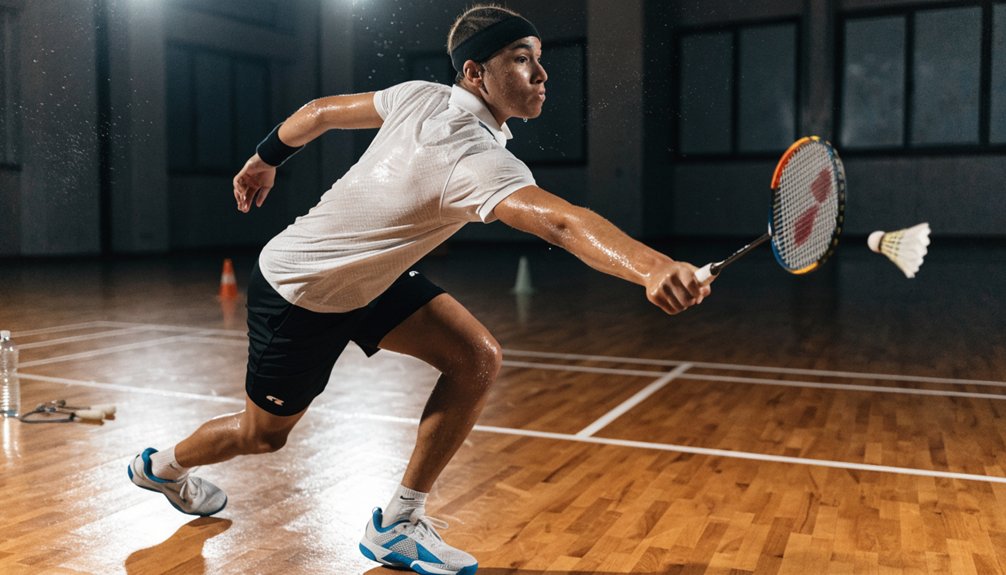
A long badminton match can feel like running a sprint on a thinning battery. If you want to last deeper into rallies and later into tournaments, you need more than effort: build your aerobic base, train intervals that match rally demands, improve footwork efficiency, and fuel with enough carbohydrate and fluid. Add targeted strength work and recovery, then track simple performance markers. The difference often comes from a few controllable details.
Key Takeaways
- Build an aerobic base with 30–60 minutes of easy cardio 2–4 times weekly to improve endurance and recovery between rallies.
- Fuel properly with carbohydrates before play, hydrate based on sweat loss, and use small carb snacks during long matches.
- Train with badminton-specific intervals that match rally-rest patterns to improve repeat-effort stamina and maintain high-intensity movement quality.
- Practice efficient footwork and court movement drills to reduce wasted energy, sharpen recovery steps, and sustain speed longer.
- Add lower-body and core strength training, then track heart-rate recovery, fatigue, and movement quality to measure stamina gains.
Build Your Aerobic Base for Badminton
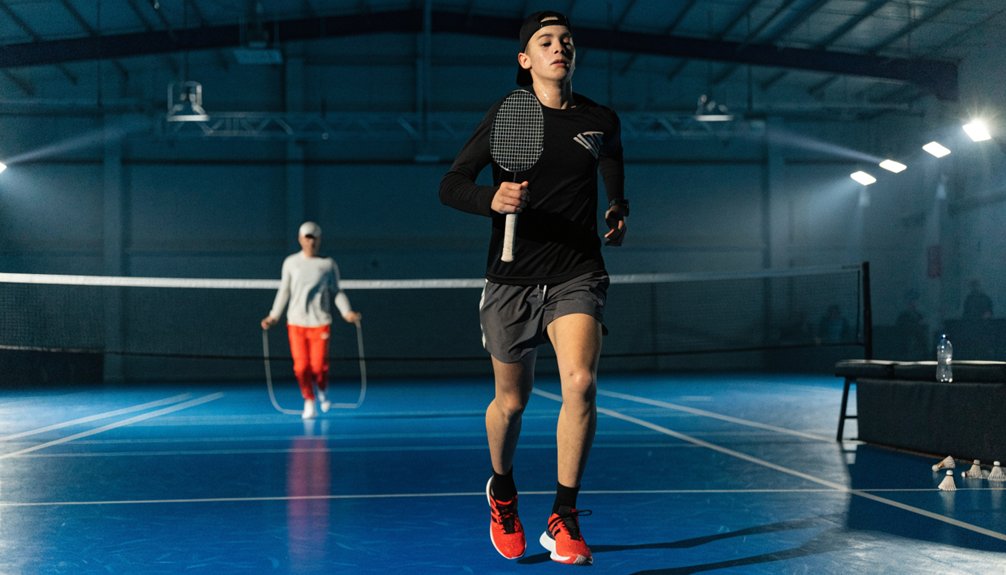
Before you focus on explosive footwork and repeated jump smashes, you need an aerobic base that lets you recover quickly between rallies, sustain movement quality deep into a match, and handle higher training loads without fading.
Build it with low to moderate-intensity aerobic exercises like brisk cycling, steady running, rowing, or court tempo movement for 30 to 60 minutes, two to four times weekly. Keep intensity around conversational pace or 60 to 75 percent of maximum heart rate, which improves mitochondrial density, capillarization, and cardiac efficiency. Those adaptations help you resynthesize ATP faster and clear metabolites more effectively between points. Pair sessions with controlled breathing techniques, especially nasal inhalation and longer exhalations, to improve ventilatory control and reduce unnecessary tension. Progress duration gradually so you build capacity without compromising recovery or court quality.
Train Intervals That Mimic Badminton
To build badminton-specific stamina, you should train intervals that match the sport’s stop-start demands rather than relying on steady-state work alone. Use rally-to-rest ratios that reflect real match play to improve repeat-sprint ability, phosphocreatine recovery, and movement efficiency under fatigue. Pair that with court movement circuits so you can condition the exact footwork patterns, directional changes, and work periods you’ll need in rallies. Add footwork drills to your weekly plan to enhance movement speed and agility during longer matches.
Rally-To-Rest Ratios
Because badminton is played as repeated short, explosive rallies separated by brief recovery, your interval work should match those rally-to-rest demands rather than rely on steady-state conditioning. Use rally duration of 6–12 seconds with 12–25 seconds recovery to target phosphocreatine restoration and repeated-sprint capacity. Vary rest strategies: shorter pauses build tolerance; longer pauses preserve speed quality.
| Focus | Ratio | Feeling |
|---|---|---|
| Singles pressure | 10s:20s | Controlled strain |
| Doubles pace | 6s:12s | Sharp urgency |
| End-game resilience | 12s:15s | Heavy legs |
Program 2–4 sets of 6–10 reps, keeping output high and technique clean. If your pace drops markedly, extend recovery slightly. This way, you’ll condition the exact energy-system demands that decide long matches and stay dangerous deep into the third game under real pressure.
Court Movement Circuits
Build your stamina with court movement circuits that replicate badminton’s stop-start footwork, directional changes, and stroke-specific recovery patterns. Use 20- to 40-second work intervals with 15 to 25 seconds’ rest, matching typical rally demands while stressing phosphocreatine recovery and aerobic support. Include six-point shadow drills, rear-court chasse-to-scissor actions, forecourt lunge-and-recover repetitions, and diagonal retreat sequences to train efficient movement patterns.
Keep intensity high but technically clean: stay low through the hips, push explosively off the outside leg, and recover to base after every action. For court agility, alternate planned sequences with reactive cues from a coach, shuttle feed, or visual signal. Complete 2 to 4 sets of 6 to 10 reps, resting 2 minutes between sets. You’ll improve repeat-effort capacity without sacrificing footwork efficiency.


Use Footwork Drills to Save Energy
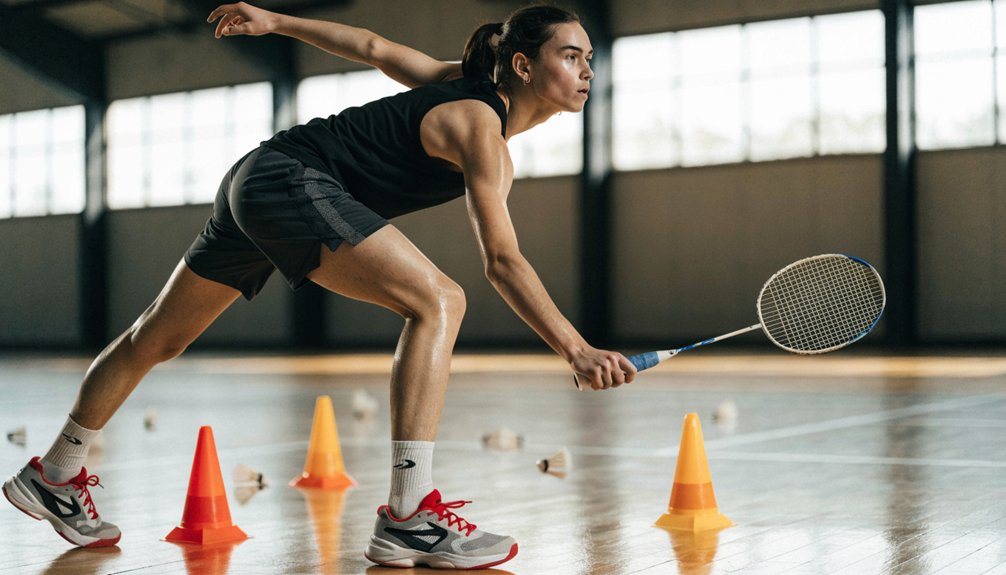
Footwork drills improve stamina by reducing unnecessary steps, lowering energy cost per rally, and sharpening efficient court movement. When you time your recovery step correctly after each shot, you restore balance faster and reach the next shuttle with less muscular strain. Shadow drill endurance then builds repeatable movement efficiency, so you can sustain speed and control deeper into matches. Practicing quick transitions between basic grips also supports energy-efficient movement by helping you handle changing rally situations without extra tension or wasted effort.
Efficient Court Movement
Efficient court movement is one of the fastest ways to improve badminton stamina, since better positioning cuts unnecessary steps and lowers the energy cost of each rally. You’ll last longer when your footwork stays compact, balanced, and biomechanically efficient under pressure.
- Prioritize court positioning so you arrive early and strike without lunging excessively.
- Use agility exercises like ladder patterns, cone shuffles, and split-direction sprints to sharpen multidirectional speed.
- Keep your center of mass low during changes; this improves braking control and reduces wasted motion.
- Train shadow footwork at match tempo, focusing on precise push-off angles and quick deceleration.
These habits improve movement economy, letting you cover more court with less metabolic cost. Over time, you’ll sustain pace deeper into long rallies and demanding matches.
Recovery Step Timing
Because every shot changes your recovery demands, the timing of your first step back to base can either conserve energy or compound fatigue across a match. If you recover too early, you’ll interrupt stroke balance; too late, and you’ll chase the next shuttle from a compromised position. The goal is immediate but controlled re-centering after contact, using a push-off that matches shot direction and landing mechanics.
You should train recovery techniques that link split-step readiness with efficient deceleration and re-acceleration. After lunges or deep corners, use active recovery through compact chasse or crossover steps instead of upright jogging. Keep your center of mass low, hips square when possible, and racket carriage stable. That sequencing reduces wasted movement, lowers metabolic cost, and helps you sustain rally quality late in longer matches.
Shadow Drill Endurance
A few well-structured shadow drill sets can raise your badminton stamina by improving movement economy, not just by making you work harder. When you rehearse efficient patterns without the shuttle, you reduce wasted steps, lower braking forces, and keep rallies cheaper metabolically. Use shadow techniques at match tempo, then control endurance pacing so quality stays high.
- Start with six-point movement, emphasizing split step timing and balanced first pushes.
- Keep your chest stable and racket up to limit upper-body leakage.
- Work 20- to 30-second bouts with 30 seconds’ recovery to train repeatability.
- Progress by adding directional calls, not random speed, so mechanics don’t break down.
If your footwork becomes cleaner under fatigue, you’ll spend less energy reaching shots and recover faster between exchanges during demanding games.
Use Strength Training to Delay Fatigue

Build lower-body and core strength to make each rally less metabolically costly and delay the drop-off in movement quality that shows up late in games. Prioritize compound strength exercises such as split squats, Romanian deadlifts, step-ups, calf raises, and anti-rotation presses, because they improve force production, braking control, and trunk stiffness during repeated directional changes.
You’ll get endurance benefits when stronger muscles handle each lunge, push-off, and recovery step at a lower relative intensity. That reduces peripheral fatigue and helps you preserve footwork precision under pressure. Train two to three times weekly, using moderate loads, full range of motion, and controlled eccentrics. Keep rest periods long enough to maintain output. Progress gradually, and emphasize unilateral work so side-to-side imbalances don’t accelerate fatigue or impair court coverage late.
Fuel for Better Badminton Endurance
Strength training helps you spend less energy per rally, but your fueling strategy determines how long you can keep producing fast, repeatable efforts without a drop in speed or concentration.
- Prioritize carbohydrates pre-match to maintain muscle glycogen and support repeated accelerations, lunges, and jumps.
- Use smart nutrition timing: eat a low-fiber, moderate-protein meal 2–3 hours before play, then top up with easily digested carbs 30–60 minutes before.
- Apply hydration strategies based on sweat loss: start hydrated, sip fluids between games, and include sodium when sessions are long or hot.
- During extended matches, use small carbohydrate doses to preserve reaction time, footwork precision, and decision-making under fatigue.
Your goal isn’t eating more; it’s maintaining usable energy and fluid balance exactly when match intensity rises most.
Recover Faster Between Badminton Matches
Because badminton tournaments often compress multiple high-intensity matches into a few hours, recovery between rounds isn’t just about feeling fresher—it directly affects your next-match movement quality, reaction speed, and shot accuracy. Use active recovery immediately after play: two to five minutes of light walking, easy shadow swings, and controlled breathing help clear metabolites without adding fatigue. Then prioritize hydration strategies, replacing fluids and sodium losses so plasma volume and neuromuscular function stay stable. If you’ve sweated heavily, include electrolytes rather than plain water alone. Even on the demanding BWF World Tour, players rely on efficient between-match recovery to maintain performance across tightly scheduled events.
Within 15 to 20 minutes, lower your core temperature with shade, cool towels, or a fan, since thermal strain can elevate heart rate and perceived effort. Keep sitting brief; prolonged inactivity can stiffen calves, hips, and shoulders, reducing explosive court coverage in the next match.
Track Your Badminton Stamina Progress
Although better conditioning often feels obvious on court, you’ll improve faster if you track objective markers of badminton stamina over time. Use consistent stamina tracking to see whether training actually raises work capacity and recovery under match-like demands.
- Record rally duration, total court time, and movement volume per session.
- Measure heart-rate recovery one minute after intense multi-shuttle or game intervals.
- Log perceived exertion, leg heaviness, and technical drop-off late in sets.
- Compare repeat-sprint times and split-step sharpness across weeks.
These performance metrics reveal whether you’re sustaining intensity, not just surviving sessions. If rally quality collapses after 30 minutes, your aerobic base, repeat-effort ability, or between-point recovery likely needs work. Review data weekly, adjust load gradually, and test under the same conditions for reliable trend analysis. Because weight distribution affects racket speed and maneuverability, note whether equipment changes influence your late-match movement quality and recovery.
Frequently Asked Questions
Can Breathing Techniques Improve Stamina During Long Badminton Rallies?
Yes—breathing techniques can improve your stamina during long badminton rallies by enhancing breath control and oxygen efficiency. You’ll delay fatigue, stabilize movement quality, and sustain higher-intensity footwork when you coordinate inhalation and exhalation rhythmically.
How Does Court Temperature Affect Endurance in Badminton Matches?
Hotter courts drain you faster—here’s why: elevated court humidity impairs sweat evaporation, while poor temperature regulation raises cardiovascular strain and core temperature. You’ll fatigue sooner, react slower, and sustain high-intensity rallies less efficiently overall.
Do Badminton Racket Weight and String Tension Impact Player Stamina?
Yes, they do: heavier frames, head-heavy racket balance, higher string tension, and stiff string material can increase muscular demand and fatigue. You’ll usually sustain rallies better with a manageable weight, balanced setup, and forgiving tension.
Can Mental Focus Training Help Prevent Fatigue in Tough Matches?
Yes, you can reduce perceived fatigue through mental visualization and concentration exercises, which improve attentional control, emotional regulation, and decision accuracy. You’ll conserve energy, maintain rally quality, and delay performance decline during prolonged, high-pressure matches.
Should Older Badminton Players Train Stamina Differently Than Younger Players?
Yes, you should train stamina differently as you age; age related adaptations and conditioning variations matter. You’ll benefit from lower impact intervals, longer recovery, strength maintenance, and monitoring workload closely to sustain badminton performance safely.

