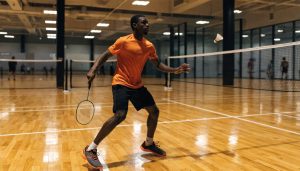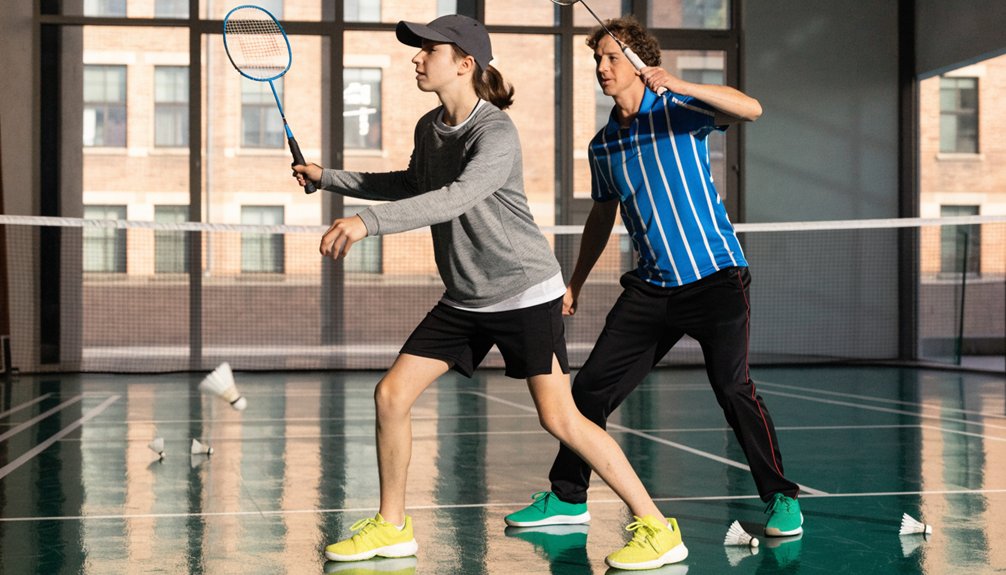
If you want to improve at badminton quickly, start with the fundamentals you can control every session: grip, stance, footwork, and shot placement. You don’t need more power yet; you need cleaner contact, better balance, and serves that land where you intend. Small technical fixes often produce fast results, especially when you practice with a clear purpose. The next steps will show you which habits to build first and which mistakes are slowing you down.
Key Takeaways
- Use a relaxed forehand and backhand grip, tightening only at contact for better control, comfort, and cleaner shots.
- Start from a balanced ready stance and practice efficient footwork to move quickly, recover faster, and avoid reaching.
- Build consistency with clears first, focusing on timing, smooth swings, and clean contact before adding power.
- Prioritize shot placement and reliable serves over power to reduce errors and control rallies more effectively.
- Practice with clear goals, proper warm-ups, and simple drills to build confidence, coordination, and long-term improvement.
Learn the Basic Badminton Grip
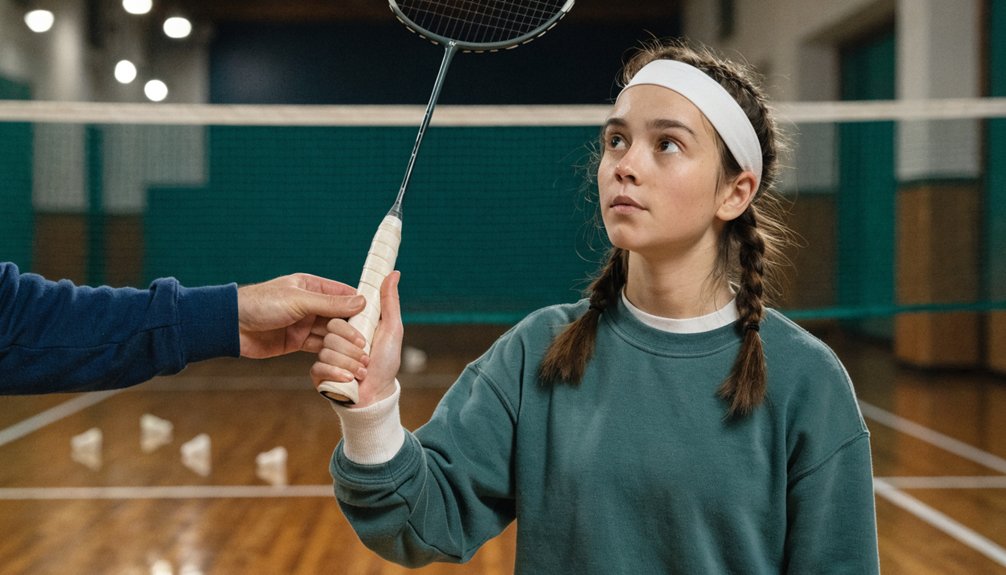
Before you work on swings or footwork, learn the basic badminton grip because it controls both accuracy and power. Hold the handle like a relaxed handshake, with your thumb and index finger forming a V along the top bevel. This position keeps the racket face stable and lets you change angles efficiently.
Focus on grip pressure next. Squeeze lightly during preparation, then tighten briefly at contact for sharper control and faster shuttle response. If you hold too hard throughout, your wrist stiffens and you lose deception.
As you improve, understand basic grip types: forehand and backhand. Don’t rotate the handle wildly; make small, deliberate adjustments between bevels. Practice switching cleanly while keeping the racket secure. A correct grip builds consistency, protects your wrist, and makes every shot easier to learn over time. Choosing the right grip size also improves comfort and can reduce the risk of injury.
Get Into a Better Ready Stance
Adopt a balanced ready stance so you can react quickly in any direction. Keep your feet slightly wider than shoulder width, knees bent, and weight on the balls of your feet. Your hips should stay low, chest upright, and shoulders relaxed so you’re stable without feeling stiff.
Hold your racket in front of your body at about waist to chest height, with the head angled slightly upward. These ready position techniques help you see the shuttle early and prepare efficiently for either a forehand or backhand response. In badminton, the shuttlecock is designed to fly cork-first, so a good stance helps you read its path earlier. Make small stance adjustments based on your opponent’s position, but don’t lean too far forward or backward. Stay light, centered, and alert between shots. If you practice this consistently, you’ll recover faster, feel more composed, and make cleaner first movements under pressure during rallies.
Use Simple Footwork Patterns
Once your ready stance feels stable, simple footwork patterns help you reach the shuttle with better balance and less wasted effort. Focus on repeatable movement patterns, not big steps. You’ll recover faster, stay centered, and make cleaner shots under pressure.
- Use short chasse steps for lateral movement across midcourt.
- Practice front-back court navigation with controlled split, push, and recover actions.
- Add basic footwork drills and agility exercises to sharpen direction changes.
- Apply positioning strategies, balance techniques, and compact defensive maneuvers when stretched wide.
Keep your hips low, your chest quiet, and your feet active. Don’t cross your legs unless you’re covering real distance. Small, efficient steps improve stability and reduce reaching. As you move, aim to arrive balanced so your racket preparation stays simple and your recovery path stays direct after every shot. Consistent practice with footwork drills also enhances movement speed and agility over time.


Improve Timing With Easy Drills
To sharpen your timing, start with shuttle toss timing drills so you can track the shuttle early and contact it at the right point. Add wall rally practice to build a consistent swing tempo and improve your reaction speed with each return. Then use split step rhythm to sync your feet with your opponent’s shot, so you’re balanced and ready to move.
Shuttle Toss Timing
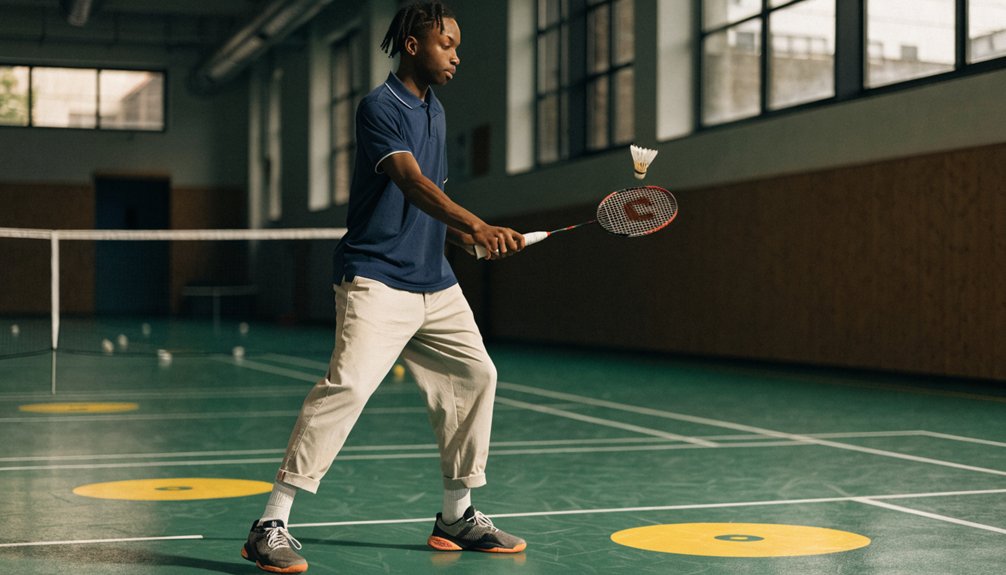
Although power and technique matter, your toss timing often decides whether your serve feels smooth or rushed. If you release too early or late, contact shifts and control disappears. Focus on consistent shuttle height and a calm toss rhythm so your racket meets the shuttle at the same point every time.
- Stand still first, then practice releasing the shuttle without swinging.
- Count “drop-hit” aloud to sync your hand release with racket motion.
- Keep the shuttle close to your body to reduce sideways drift.
- Record five serves and check whether contact happens at one repeatable height.
Once that feels natural, add a short backswing and keep your grip relaxed. You’re training precise coordination, not force. A reliable toss builds cleaner serves, better accuracy, and more confidence under pressure in matches.
Wall Rally Practice
A simple wall rally can sharpen your timing faster than many full-court drills because it gives you instant feedback on every hit. Stand a few feet back, use compact swings, and focus on meeting the shuttle slightly in front of your body. Keep your racket face stable so each wall bounce returns predictably.
Start with gentle forehand taps, then alternate forehand and backhand without rushing. Count consecutive contacts to build consistency, but don’t sacrifice form for speed. Aim at a small mark on the wall to improve target accuracy and train cleaner contact. If the shuttle flies too high or drifts sideways, adjust your grip pressure and contact point. Practice in short sets, recover your posture after each shot, and you’ll develop steadier timing and better control under pressure during rallies.
Split Step Rhythm
Once your contact feels cleaner from wall rally practice, the next step is syncing your feet with the shuttle through a reliable split step. You should land lightly just as your opponent strikes, not before or after. That exact split step timing lets you react explosively in any direction. Think of it as a mini hop, feet shoulder-width, knees bent, heels barely touching.
- Shadow split step, then push to each corner
- Clap on landing to train rhythm and balance
- Watch your opponent’s racket, not the shuttle
- Keep hops small, relaxed, and repeatable
The split step importance becomes obvious when rallies speed up. If you’re early, you’ll freeze; if you’re late, you’ll chase. Practice ten controlled reps before every session, and your movement will soon feel sharper, quicker, and more automatic overall.
Practice Clears Before Other Shots
Start with clears, because they teach the core mechanics behind almost every badminton stroke. When you practice a proper overhead clear, you learn timing, shoulder rotation, forearm pronation, and clean contact at the highest point. That foundation transfers directly to smashes, drops, and even fast drives. Good clear technique also trains your grip changes and recovery footwork after contact.
Focus on sending the shuttle high and deep with a relaxed preparation and a smooth acceleration through the hit. Keep your non-racket arm up for balance, turn your body sideways, and recover to base immediately. As you repeat the shot, aim for clear consistency from both forehand and backhand corners. If you build this stroke first, you’ll improve faster because your later shots will have better structure and control. Using a racket with suitable string tension can also help beginners balance power and control while practicing clears.
Focus on Consistency Before Power
Before you try to hit harder, make sure you can place the shuttle accurately and repeat that result under control. Consistent placement helps you keep rallies stable, manage court position, and reduce unforced errors. As your rally control improves, you’ll build the timing and mechanics needed to add power without losing accuracy. Using the right grip size can also improve control and comfort, making it easier to develop consistent shots.
Prioritize Accurate Placement
While it’s tempting to hit every shot as hard as you can, you’ll improve faster by placing the shuttle accurately and keeping rallies under control. Aim for simple, repeatable shots that land where you intend. Good placement forces movement, creates openings, and reduces your unforced errors. Use placement drills to sharpen direction and touch, and practice hitting specific target zones on court.
- Aim deep to push your opponent backward.
- Use wider angles to open space.
- Alternate forehand and backhand corners deliberately.
- Reduce swing speed when accuracy drops.
You don’t need maximum power to pressure an opponent. You need clean contact, balanced footwork, and a clear target before you swing. Start slowly, measure success by precision, and increase pace only when your accuracy stays dependable under pressure during practice.
Build Reliable Rally Control
Accurate placement works best when you can repeat it shot after shot, which is why rally control should come before trying to hit harder. Your goal is to keep the shuttle in play with balanced footwork, a relaxed grip, and compact swings. When you stay stable, you recover faster and make cleaner contact more often.
Use simple rally drills like straight clears, cooperative drives, and half-court exchanges to train consistency under light pressure. Focus on height, length, and direction before adding pace. Good shot selection matters too: choose returns you can execute reliably, not flashy winners with low percentage. If you’re late, play high and deep to reset the rally. As your control improves, you’ll force more errors, create better openings, and build a stronger foundation for power later on.
Practice Serves That Land In
Start by aiming for consistency over power, because a serve that lands in gives you control of the rally from the first shot. Focus on serve accuracy by choosing clear target zones and repeating the same setup each time. Your practice routines should include short sets of consistency drills, so you groove clean contact and reliable height. In doubles, remember the short service line sits 1.98m from the net, so using it as a visual reference can improve serve depth control.
- Place markers in target zones and hit ten serves to each.
- Use feedback methods like video, partner calls, or self-scoring.
- Test serve variations: short, flick, and wider placements.
- Build mental focus by serving under light pressure in game scenarios.
Keep your grip relaxed, your motion compact, and your contact point steady. If you miss long or wide, adjust one variable only, then repeat. Small corrections, tracked consistently, will sharpen dependable serves fast.
Use 3 Simple Badminton Tactics
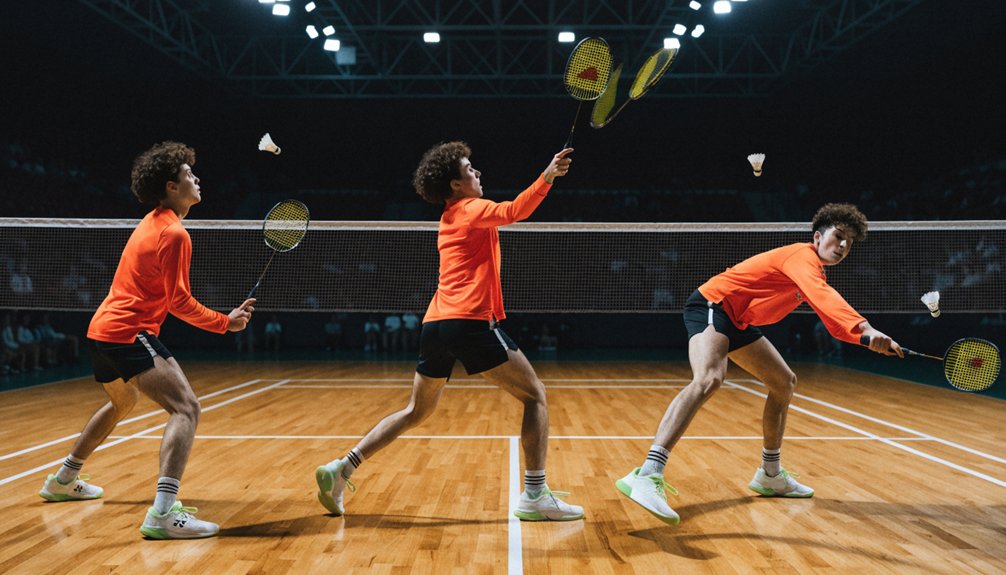
You can win more rallies by using three simple tactics with purpose. Hit deep to target the backcourt, then direct shots wide to force weak returns and open space. When you get the chance, control the net so you can pressure your opponent and finish points efficiently. Using a racket with an isometric head can also help beginners by providing a larger sweet spot for more consistent shots.
Target The Backcourt
Because beginners often focus only on hitting hard, aiming more of your shots to the backcourt is one of the simplest ways to take control of a rally. This backcourt strategy pushes your opponent deeper, buys you recovery time, and makes your next shot easier to read. Instead of swinging harder, aim higher and longer with clear target zones near the rear tramlines and center baseline.
- Hit deep clears to move pressure away from your forecourt.
- Use high lifts when you’re late and need time to recover.
- Aim two feet inside the baseline to reduce unforced errors.
- Practice consistency before speed, power, or deception.
When you regularly target the back, you’ll force weaker replies, improve court positioning, and build rallies on your terms. That’s a smart foundation for faster progress as a beginner.
Force Wide Returns
Once you’ve pushed your opponent deep, the next step is making them move side to side. Wide placement stretches their base, disrupts recovery, and lowers shot quality. Aim your clears, drives, and fast drops toward the sidelines, especially after you’ve created late contact at the rear court.
To do this well, focus on preparation and force application. You don’t need maximum power; you need controlled acceleration and a stable hitting arm so the shuttle travels flat or sharply outward. Watch your opponent’s stance, then choose return angles that pull them beyond their center line. If they’re slow recovering from one corner, send the next shot across to the opposite tramline. Keep your own footwork balanced after each stroke, so you’re ready to repeat the pattern and steadily build pressure.
Control The Net
Take charge of the forecourt by treating the net as a pressure zone, not just a place to block. When you move in early, you cut off time and force weaker lifts. Keep your racket up, knees bent, and net positioning slightly in front of your body so you can tumble, kill, or hold.
- Rush forward after every tight drop to threaten the reply.
- Aim spinning net shots downward to make lifts less controlled.
- Use a brief hold before contact to disguise your intention.
- Recover one step back after each touch to cover the push.
These net strategies help you dominate short exchanges without overhitting. If you stay balanced and attack loose shuttles quickly, you’ll create easy winners and stop opponents from settling into rhythm. Practice this until your reactions become automatic under pressure.
Avoid These Beginner Badminton Mistakes
A few common mistakes can slow your progress in badminton, but they’re easy to fix when you know what to watch for. One of the most common errors is standing flat-footed after each shot, which delays recovery and weakens your court coverage. Poor equipment selection, especially shoes without grip or a racket with the wrong weight, can also limit control. Learning a proper forehand grip can also speed improvement, because it reduces wrist and arm strain while helping with powerful smashes and accurate net shots.
You’ll improve faster by sharpening mental focus and using clear goal setting during practice routines. Don’t repeat the same drill mindlessly; add drill variations to build adaptability. In games, avoid predictable match strategies like lifting every return under pressure. Seek coaching or partner input because feedback importance is huge for correcting timing and spacing. Finally, prioritize injury prevention by warming up properly and not swinging with excessive tension during rallies.
Use a 20-Minute Badminton Practice Plan
Fixing common mistakes helps, but you’ll improve faster when your practice has structure. A simple 20-minute plan lets you train efficiently without feeling overwhelmed. Keep each segment short, purposeful, and repeatable so your technique improves every session. Start with warm up exercises to raise body temperature, loosen joints, and prepare your footwork mechanics.
- 3 minutes: dynamic warm up exercises and split-step timing.
- 5 minutes: shadow footwork to six court corners with recovery.
- 7 minutes: racket control drills, short serves, and net taps.
- 5 minutes: clear targets, then cooldown breathing for mental focus.
During every block, track accuracy, balance, and racket preparation. Don’t rush repetitions; clean movement matters more than speed at first. If you practice this plan consistently, you’ll build better habits, sharper coordination, and confidence faster. Using a racket with even balance can help beginners develop both control and timing during these short practice sessions.
Frequently Asked Questions
What Racket Weight Is Best for Badminton Beginners?
You’ll do best with a 4U racket, around 80–84g, because it’s light enough for control yet stable. Choose even racket balance and moderate string tension, so you can develop technique, timing, and confidence faster.
How Often Should Beginners Replace Badminton Shuttlecocks?
You should replace beginner shuttlecocks every few games, or sooner if flight wobbles, feathers fray, or speed drops. Monitoring shuttlecock durability helps you maintain performance consistency, sharpen timing, and practice with more reliable, technically accurate feedback.
What Shoes Should Beginners Wear for Badminton?
You should wear lightweight indoor court shoes; nearly 70% of badminton movements are lateral, so you’ll need strong grip and support. Match shoe types to court surfaces, and choose non-marking soles with cushioning.
How Do I Prevent Blisters While Playing Badminton?
Wear moisture-wicking socks, properly fitted shoes, and tape hot spots before play to prevent blisters. You’ll improve comfort with smart foot care, trimmed nails, dry feet, and stable grip techniques that reduce excessive sliding.
Is Joining a Badminton Club Worth It for Beginners?
Yes, joining a badminton club is worth it for beginners; you’ll gain structured practice, coaching feedback, and match experience. The club benefits accelerate technique development, while the social aspects keep you motivated, consistent, and improving faster.