Is it true that serve accuracy comes down more to repeatable mechanics than natural touch? In badminton, you’ll usually get better results when your grip stays relaxed, your stance stays balanced, and your contact point doesn’t change. From there, you can match a short serve to doubles, a high serve to singles, and train placement with purpose. The small errors that cost you points often start earlier than you think.
Key Takeaways
- Use a relaxed, compact grip to keep the racket face stable and allow precise wrist and finger control.
- Stand shoulder-width apart with the non-racket foot slightly forward and weight centered on the balls of your feet.
- Contact the shuttle at the same height and slightly in front of your body for more repeatable serve timing and direction.
- Practice target-based drills with a steady pre-serve routine to improve depth, trajectory, and overall consistency.
- Add serve variety gradually by changing one element at a time while keeping accurate contact and racket face control.
Choose the Right Grip for Your Serve
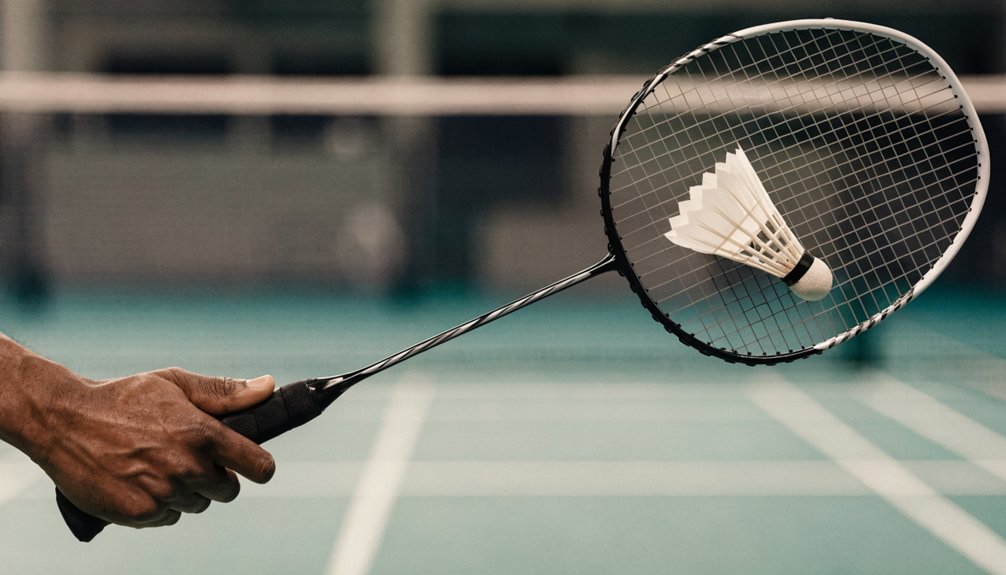
Before you focus on power or placement, make sure you’re holding the racket with the right grip, because your serve starts with clean racket control. For most serves, you’ll use compact grip types that let the racket face stay stable through contact. A relaxed forehand grip works well for low serves and controlled flicks, while a backhand grip supports tighter net delivery in doubles. Keep pressure light so your hand can adjust without locking the wrist.
Your finger positioning matters as much as the grip itself. Place your thumb and index finger to guide the handle, then let the remaining fingers support subtle tightening at impact. That small squeeze improves touch, sharpens racket-head alignment, and helps you produce repeatable serves without unnecessary tension. Consistency begins with efficient hand mechanics. The racket handle’s octagonal shape helps define the bevels that guide accurate forehand and backhand finger placement during serves.
Set Your Stance for Better Accuracy
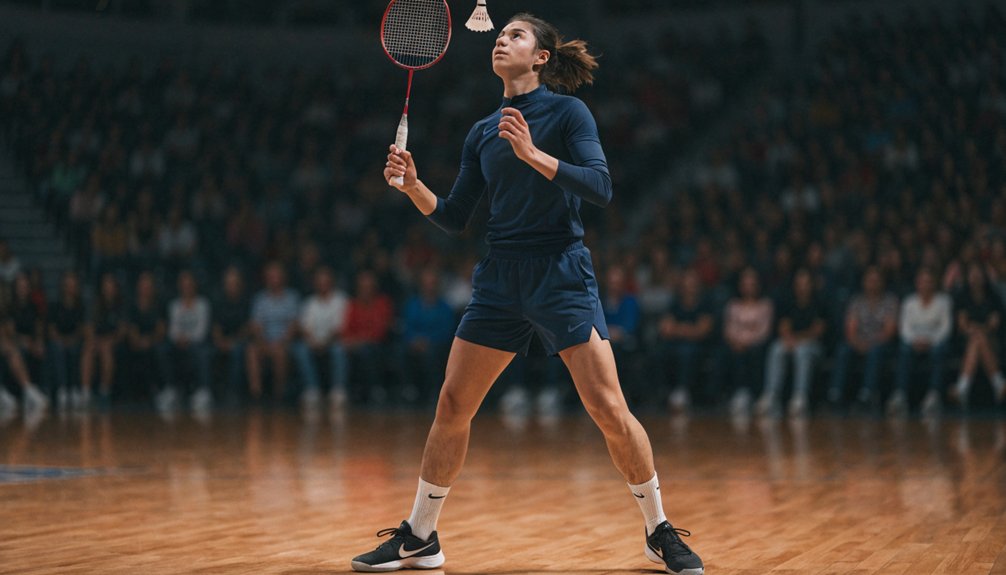
Your stance sets the foundation for a controlled, accurate serve. Place your feet shoulder-width apart with your non-racket foot slightly forward to align your body and stabilize your contact point. Keep your weight balanced and centered, so you can generate a smooth motion without sacrificing precision. Using a proper forehand grip also helps maintain control and improve serve accuracy.
Foot Placement Basics
A stable serve starts with two clear foot priorities: balance and alignment. Your serve stance should place the front foot slightly ahead of the rear foot, creating a narrow, controllable base. Keep your toes directed toward your intended target line, because precise foot alignment helps your racket path stay consistent through contact.
Set the feet about shoulder width or slightly narrower, depending on your height and flexibility. Avoid opening the front foot too far outward, since that can rotate your hips early and pull the shuttle off line. Keep the rear foot angled only slightly outward to support smooth positioning without restricting your motion. Small adjustments matter, so rehearse your setup until it feels repeatable. When your feet begin in the right place, accuracy becomes easier to build and trust consistently.
Balanced Weight Distribution
Although foot position sets the frame, balanced weight distribution determines how steadily you can deliver the shuttle. You should feel centered between both feet, with slight pressure on the balls of your feet and relaxed knees. This stance lets you stay stable without becoming rigid, so your racket path remains controlled through contact.
As you prepare, avoid leaning too far forward or loading your back foot excessively. Effective weight shifting should be subtle, moving pressure smoothly from your rear leg toward your front leg as you initiate the serve. These balance techniques help you keep your torso quiet, prevent unnecessary sway, and support repeatable timing. If your upper body stays stacked over your base, you’ll generate cleaner serves, improve placement, and recover faster for the next shot under match pressure consistently.


Contact the Shuttle at the Same Point
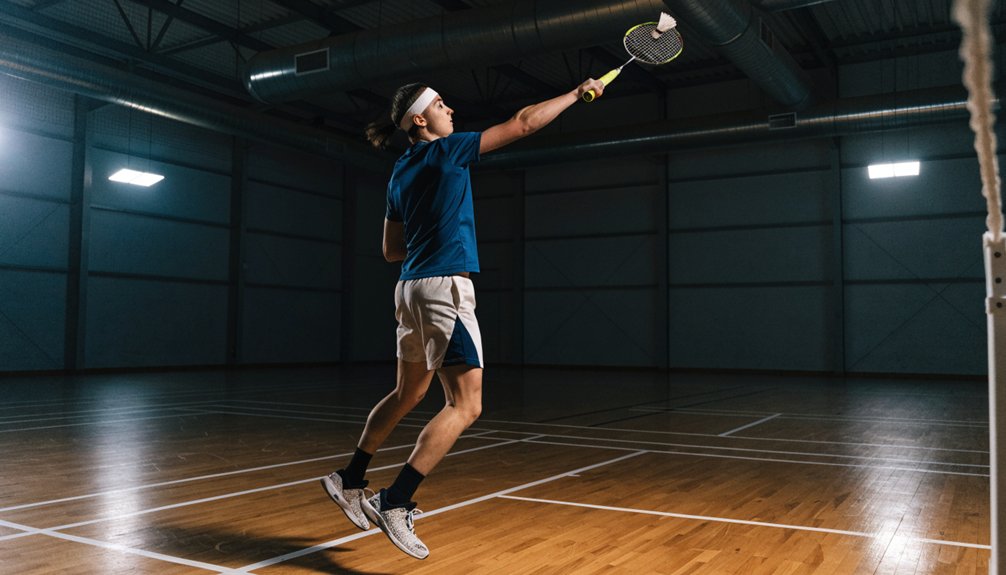
To improve serve consistency, you need to contact the shuttle at the same height on every repetition. That fixed contact point helps you lock in repeatable serve timing and control the racket face more precisely. If you can standardize this moment, you’ll reduce variation and place the shuttle with greater accuracy.
Consistent Contact Height
Rhythm matters in serving, and one of the fastest ways to build it is by contacting the shuttle at the same height every time. When your contact point stays stable, you reduce variables in racket angle, shuttle trajectory, and power transfer. That gives you tighter control and better directional accuracy.
- Keep your non-racket hand at a consistent release level to support identical contact height.
- Use a mirror or video check to spot unnecessary height adjustment before impact.
- Bend slightly through your knees, not your shoulders, if you need small positional corrections.
You don’t need a perfect serve instantly; you need repeatable mechanics. Focus on meeting the shuttle in the same vertical window on every attempt. With practice, you’ll notice cleaner strikes, fewer mishits, and serves that land with more reliability under pressure in matches.
Repeatable Serve Timing
Once your setup is stable, serve timing becomes the next key variable to standardize, because contacting the shuttle at the same point in your swing helps keep pace, angle, and placement predictable.
To build repeatable timing, match your shuttle release, racket acceleration, and contact point into one controlled sequence. You shouldn’t rush the forward motion or delay the strike, since either change alters racket face position and shuttle trajectory. Use simple timing techniques, such as a consistent pause before initiating the swing, then reproduce the same tempo on every serve. Your serve rhythm should feel smooth rather than forced, with contact occurring just as your racket reaches its intended path. Practice with short sets of identical serves, paying attention to when impact happens. Small adjustments in tempo can produce noticeably tighter, more reliable placement.
Use a Short Serve in Doubles
Because doubles rallies develop quickly, a short serve gives you the best chance to keep the shuttle low, deny an immediate attack, and force your opponents to lift rather than drive. To execute it well, contact the shuttle in front of your body, use a compact forehand or backhand action, and aim just over the tape. These short serve strategies improve control, reduce predictability, and support strong doubles positioning from the first shot. Staying composed under mind games also helps you deliver this serve accurately when opponents try to disrupt your rhythm.
- Keep your racket face stable to control trajectory and minimize unwanted spin.
- Target the T or the receiver’s backhand hip to limit aggressive returns.
- Recover instantly after contact so you’re ready to intercept the third shot.
If you practice this serve deliberately, you’ll create pressure early and start rallies on your terms consistently under match stress.
Use a High Serve in Singles
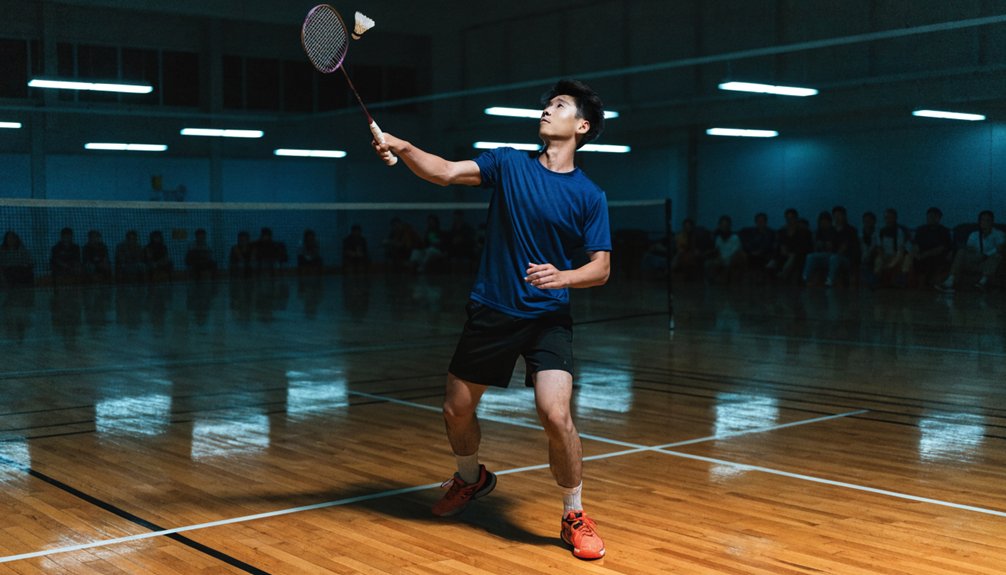
In singles, a high serve is often your safest and most strategic option, since it pushes your opponent deep into the rear court and gives you time to recover to base. Executed well, this high serve strategy reduces immediate pressure and limits your opponent’s attacking choices from the first shot. In singles, remember that the right service court is used when your score is even, while the left is used when your score is odd.
To produce it, strike the shuttle cleanly with a relaxed grip and controlled acceleration, sending it upward with enough height and depth to approach the back boundary. Your serve trajectory should be steep enough to force a rear-court contact point, yet stable enough to avoid drifting short. Keep your stance balanced, and return quickly to a central base after contact. If you maintain disguise, rhythm, and consistent shuttle height, you’ll build a dependable singles serve that supports rally control.
Practice Serve Placement With Court Targets
A reliable high serve becomes far more effective when you can place it on command, so target-based practice should be part of every serving session. Use markers in the rear tramlines and deep corners to sharpen target placement without changing your normal serve mechanics. You’ll learn how small adjustments in racket face angle, contact point, and shoulder alignment influence shuttle trajectory and landing depth. An isometric racket head with a larger sweet spot can also make serve contact feel more consistent during placement drills.
- Place one target near the back boundary and another slightly inside to distinguish ideal depth from safe margin.
- Use consistent aiming techniques by fixing your gaze on the target before initiating your backswing and follow-through.
- Evaluate each serve by where it lands relative to the marker, not just whether it stays in.
This approach builds spatial awareness, improves precision, and makes your singles serve tactically harder to attack.
Practice Badminton Serve Consistency Drills
Three simple consistency drills can make your serve repeatable under pressure: fixed-count repetitions, alternating target-depth sets, and tempo-controlled serving. Start with 20 identical short serves, tracking contact quality and landing zone on every rep. This builds calibration and exposes variation early.
Next, alternate five short serves with five deeper serves for four rounds. You’ll train distance control without losing the same preparation cues. Use serve visualization before each rep: picture trajectory, apex, and first bounce height. Remember that under service rules, the shuttlecock must be below the waist at the moment of serve, so your drill technique should always match legal match habits. Finish with tempo-controlled serving, using a steady three-count routine to lock in serve rhythm from setup through contact. Keep rest brief, but record percentages after each set. Your goal isn’t speed; it’s reproducibility. When your pre-serve routine, swing length, and contact timing stay stable, accuracy follows more reliably in matches.
Correct Common Badminton Serve Mistakes
When your serve starts missing for the same reason, don’t just hit more reps—identify the exact fault in grip pressure, shuttle position, racket path, or contact timing. Small adjustments in serve technique often fix common errors faster than extra volume. If your shuttle floats long, reduce finger squeeze and shorten follow-through. If it clips the tape, contact slightly higher and keep the racket face stable.
- Check whether your grip tightens before impact; tension disrupts touch and angle control.
- Align the shuttle in front of your body, not too wide, so contact stays repeatable.
- Trace a compact racket path; excessive backswing usually delays timing and changes direction.
- Remember that string tension also affects control and feel, so inconsistent serves may improve when your racket setup matches your skill level.
Use video or slow shadow swings to isolate one mistake at a time. You’ll build cleaner mechanics, better accuracy, and far more reliable serving under match pressure.
Add Serve Variety Without Losing Accuracy
Once your basic serve mechanics are repeatable, you can add variety by changing one variable at a time—trajectory, depth, speed, or placement—while keeping the same preparation and contact quality. That approach lets you test new serve types without disrupting timing or balance.
Start by pairing two reliable options, such as a low serve and a flick, then rehearse them from the same stance and racket path. You’ll make deception stronger while preserving control. Next, map targets: T, body, and wide sideline. Hit each target in sets, tracking misses by length and direction. This sharpens feedback and supports smarter serve strategy. Don’t chase surprise alone; choose variation that fits the receiver’s position and your own confidence level. Accuracy first, then disguise, then selective unpredictability under pressure. Consistent contact near the Sweet Spot can also improve serve accuracy and control across different serve variations.
Frequently Asked Questions
How Often Should I Replace My Badminton Shuttlecocks for Serving Practice?
You should replace badminton shuttlecocks every 1–3 sessions for serving practice, depending on shuttlecock lifespan, wear, and practice frequency. If flight wobbles, feathers fray, or speed drops, you’ll get more precise, consistent feedback using newer shuttles.
What Racket String Tension Helps Improve Serve Control and Feel?
You’ll usually get better serve control and feel with moderate string tension, around 22–24 lbs. If you’re advanced, try 24–26 lbs for precision. Don’t overtighten—slightly lower string tension gives you more forgiveness and consistency.
Can Sweaty Hands Affect Serve Accuracy During Long Matches?
Yes, sweaty hands can reduce your serve accuracy during long matches by compromising racket stability and tactile feedback. You’ll improve consistency through grip techniques, regular hand drying, absorbent overgrips, and towel breaks between rallies.
How Do I Stay Calm Before Serving on Important Points?
You stay calm by using breathing techniques to lower arousal and mental visualization to rehearse a precise serve. You’ll stabilize focus by following one repeatable pre-serve routine, relaxing grip pressure, and committing fully to execution.
Should Beginners Learn Forehand or Backhand Serves First?
You should learn backhand serves first, because they’re easier to control and repeat consistently. Once you’ve built reliability through backhand techniques, you can add forehand advantages for variety, power, and better tactical flexibility later.